
What Happens After the American Dream?
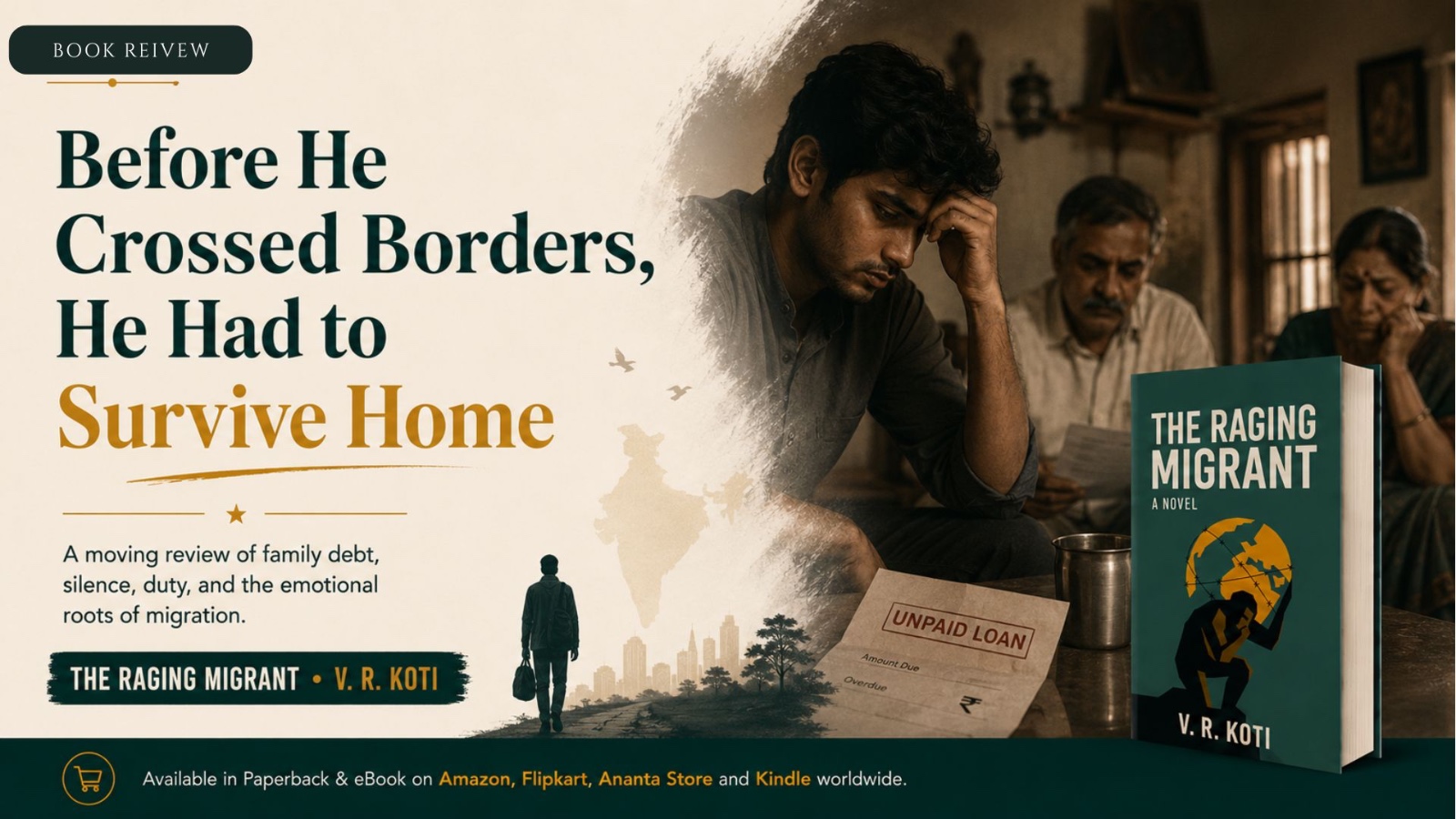
A passport may change your address, but it does not automatically heal what you carry inside.
The Raging Migrant by V. R. Koti is not the usual story of a young Indian man going abroad and discovering success. It is much more layered than that. The novel begins with a dream that many families recognise: leave home, study hard, build a career, earn respect, and rescue the people you love from financial and emotional struggle. But from the first pages, the book quietly warns the reader that migration is never only about geography. It is also about memory, duty, shame, love, fear, silence, and the difficult question of whether a person is moving toward freedom or simply running away from pain.
At the centre of the novel is Krishna Kant Sharma, known as KK. He is young, educated, sensitive, and full of ambition, but his ambition is not born out of comfort. His home life is already cracking under the pressure of debt, alcohol, family tension, and emotional exhaustion. His father drinks. His mother keeps the house together with a quiet strength that often goes unnoticed. His grandmother speaks with sharp honesty. Aunt Lakshmi arrives as the reminder of a loan that can no longer be ignored. The amount owed is not only money; it becomes a symbol of everything the family has avoided saying. This opening is important because it tells us that KK does not begin his journey as a free dreamer. He begins it as someone carrying a house on his shoulders.
This is where the book becomes different from many migration narratives. In common success stories, the hero leaves home because he wants a better life. Here, KK leaves because staying feels unbearable and leaving feels necessary. The question is not simple. Is he choosing growth or escape? Is America a destination, a rescue plan, or only a larger room in which the same wounds will echo? Koti uses this tension beautifully. The reader is not asked to judge KK. Instead, we are invited to understand him. His choices come from love, fear, ambition, guilt, and a deep desire to become someone who can finally stand on his own feet.
The novel is important because it shows the emotional cost behind the phrase “American Dream.” For many families, migration is spoken about as a clear upgrade. The child goes abroad. The family feels proud. The money will improve. The career will grow. Social respect will follow. But The Raging Migrant asks what happens between the airport photograph and the success story. What happens in the lonely apartment? What happens when the student must cook, study, survive, send updates home, understand a new culture, and carry the pressure of being the family’s investment? What happens when the country of opportunity also becomes a country of suspicion, especially in the tense years after 9/11?
KK’s arrival in America is written with small but meaningful observations. The immigration line, the questions at the airport, the customs inspection, the pressure cooker and rice from home, the limited cash, and the heaviness of personal secrets all make the experience feel real. The book does not romanticise the West. It does not demonise it either. It presents America as a place of systems, opportunity, discipline, loneliness, danger, misunderstanding, and unexpected kindness. This balanced view makes the novel more mature. KK does not simply become “successful” by landing in a new country. He must become alert, humble, adaptive, and emotionally honest.
One of the strongest parts of the book is how it connects external migration with internal migration. KK travels from India to the United States, but the deeper journey is from survival to self-understanding. He has to understand why he reacts the way he does, why silence frightens him, why violence leaves marks that the body remembers, why love can become conditional, and why family expectations can travel across continents. The body, in this novel, is not separate from memory. Anxiety, injury, shame, anger, sleeplessness, and sudden fear all become part of KK’s story. This makes the book especially relevant for readers who understand that trauma is not always loud. Sometimes it lives in the jaw, in the stomach, in the breath, or in the need to keep moving.
The title The Raging Migrant is powerful because the rage in the book is not only anger. It is also a form of unrest. KK is not a violent man by nature. In fact, one of the most touching aspects of the novel is his gentleness. He cares for his friend Piyush after a brutal attack. He tries to protect people he loves. He wants to do the right thing. Yet he is not immune to rage. He has been bullied, pressured, shamed, and emotionally cornered. He wants dignity. He wants control over his life. He wants to prove that he is not weak. The book carefully explores what happens when a gentle person is forced again and again into situations where restraint and reaction are both costly.
This is why The Raging Migrant is not just a novel about migration. It is also a novel about masculinity. KK is not built like a typical heroic figure who dominates every situation. He is thoughtful, anxious, caring, embarrassed, loyal, sometimes confused, and often self-questioning. The book treats these qualities not as weaknesses but as signs of humanity. In many stories, a man proves himself by conquering others. In this novel, KK proves himself by trying to remain compassionate without becoming passive, strong without becoming cruel, and ambitious without becoming selfish. That balance is difficult, and Koti allows the difficulty to remain visible.
The love story with Mira adds another important layer. Love in this book is not used as decoration. It becomes a test of identity. Mira is not simply the girl waiting at home while KK builds a future. She has her own family, fear, pressure, and emotional needs. Their relationship carries tenderness, promise, secrecy, urgency, and pain. The rushed choices they make do not disappear just because love is present. In fact, the book suggests that love without emotional safety can become fragile. This idea is very important for modern readers because relationships today often move across cities, countries, careers, family rules, and personal ambitions. The novel shows that distance does not create problems; it reveals the problems that were already there.
The supporting characters make the book feel alive. Piyush introduces friendship, vulnerability, literature, and the cost of being caught in someone else’s power game. Ashish offers practical support and pushes KK toward an American possibility. Charlotte brings an outside view that questions the fantasy of the West. Yatzil, Asha, Ojas, Vedant, Mira, Bianca, Aunt Lakshmi, the mother, the father, and the grandmother all contribute to the moral world of the novel. Each character creates pressure or comfort, sometimes both. This is one reason the book is engaging: KK’s life is never shaped by only one event. It is shaped by many small negotiations with people, systems, and expectations.
The structure of the novel also deserves attention. The chapter titles feel like questions and emotional milestones: Onward or Away?, Arrival Without Anchors, The Body Never Forgets, Conditional Love, The Cost of Silence, Holding the Center. These titles are not decorative. They guide the reader through KK’s psychological landscape. “Onward or Away?” captures the uncertainty of his first movement. “Arrival Without Anchors” explains the disorientation of reaching a new country without emotional certainty. “The Body Never Forgets” points to trauma that survives even when the mind tries to move on. “Holding the Center” becomes the real challenge: how does one remain whole when family, love, ambition, grief, and self-respect pull in different directions?
The language of the novel is direct, observant, and emotionally controlled. It does not depend on excessive drama, even when dramatic things happen. Koti often lets small details carry the weight: the thin walls through which parents argue, the pressure cooker packed by a worried mother, the wedding photograph that feels heavy with unfinished truth, the airport question that stings, the physical pain that hides emotional pain for a moment. These details create trust between the writer and the reader. The book feels lived rather than manufactured.
Why is this book important today? Because migration is often discussed in numbers: visa approvals, foreign income, remittances, job offers, university rankings, and settlement dreams. The Raging Migrant brings the human being back into the discussion. It reminds us that the immigrant is not a statistic. He is someone’s son, friend, lover, student, patient, debtor, dreamer, and survivor. He carries language, food, family shame, cultural pride, childhood wounds, and private promises. When we understand that, migration becomes not only an economic decision but a deeply emotional and moral journey.
The book is especially important for Indian readers because it understands the emotional structure of Indian families. Love and control often live side by side. Sacrifice and guilt can sound similar. Parents may protect, but they may also hide, demand, or collapse. Children may leave to become independent, yet remain tied to the needs of home. Koti handles this without turning the family into a villain. The family is difficult, but it is not disposable. That emotional honesty makes the novel relatable.
For international readers, the book offers a sensitive portrait of immigrant life beyond headlines. It speaks to anyone who has ever changed cities, left a family behind, started over in a new culture, or wondered whether progress is worth the loneliness it brings. It is a story for students, professionals, parents, partners, and readers who enjoy literary fiction that asks difficult questions.
In the end, The Raging Migrant matters because it understands that the longest journey is not always from one country to another. It may be the journey from fear to courage, from silence to speech, from borrowed strength to self-knowledge. V. R. Koti’s novel gives us a protagonist who is not perfect, but deeply human. KK’s story stays with the reader because it does not sell migration as an easy dream. It shows migration as a mirror. And when KK looks into that mirror, he sees not only America, India, Mira, his family, or his past. He sees the difficult work of becoming himself.
The Raging Migrant is available in paperback and e-book formats, with availability shared for Amazon, Flipkart, Ananta Store, and international readers across 150 plus countries. For anyone interested in stories about migration, identity, family, love, and self-worth, this novel deserves attention because it does what meaningful fiction should do: it makes us feel, think, and question the cost of the life we are trying to build.