
Death, Time, and the Courage to Live Differently
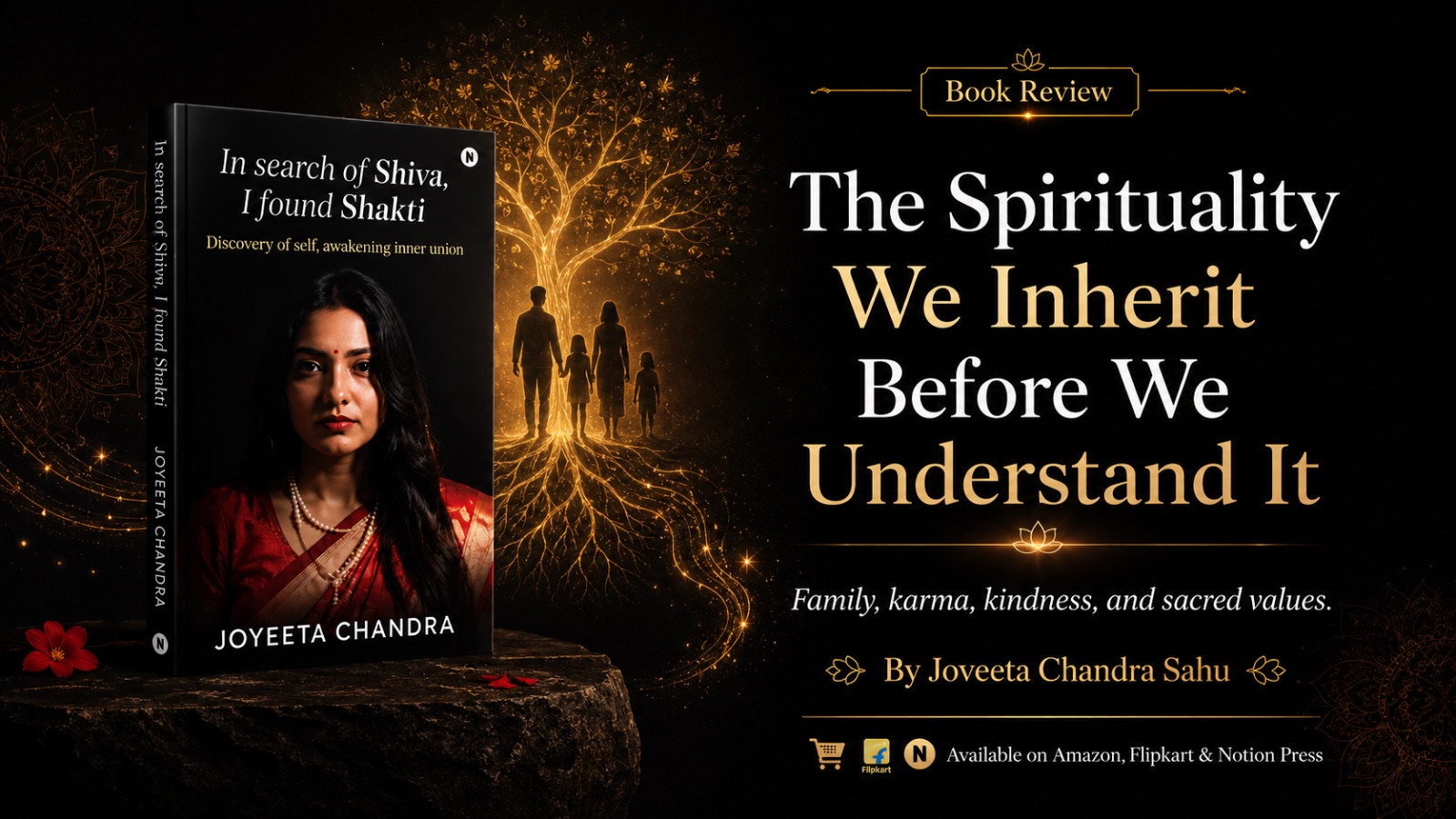
A book becomes unforgettable when it does not use death to frighten us, but to free us from the small fears that keep us half alive.
One of the most striking parts of In Search of Shiva, I Found Shakti is the section titled Mokshadhara, introduced with the thought of finding peace in time and death. This is not a usual beginning for a spiritual journey. Many books begin with hope, light, miracles, or success. Joyeeta Chandra begins this part with a subject most people avoid: death. She imagines the reader feeling confused and uncomfortable. Why begin with something so heavy? Why speak of the end before even discussing devotion, sadhana, or surrender? These questions are not ignored. They are placed directly in front of the reader, and that honesty makes the chapter powerful.
The book’s treatment of death is important because it does not turn death into a dark spectacle. It treats death as a truth that can reorganize life. The author suggests that death is not only an ending; it is also a lens. When a person understands that life is temporary, priorities change. Arguments become smaller. Ego becomes less useful. Relationships become more valuable. Actions become more urgent. The book does not ask the reader to become negative. It asks the reader to stop living as if there is unlimited time to become truthful.
The passage about the father’s passing gives this idea emotional weight. The author remembers her father not only as a parent, but as a deeply respected human being: intelligent, hard-working, kind, honest, disciplined, and humble. This is significant because the book does not speak about death in abstract philosophical language alone. It speaks about death through love. The father is not reduced to a lesson. He is remembered as a living force whose values continue after his physical absence. Through this memory, the book shows that death does not erase influence. It often makes influence more visible.
This is where the book becomes more than a spiritual reflection. It becomes a meditation on legacy. Many people think legacy means public success, money, awards, or social position. The author’s reflections suggest something quieter: legacy is the way a person makes kindness feel normal. Legacy is the way a child grows up seeing humility in strength. Legacy is the way one person’s discipline becomes another person’s moral compass. This makes the book important because it connects spirituality with character. It tells readers that awakening is not separate from how we behave with others.
The author’s father is described as someone who did not allow position or qualification to change his basic kindness. This matters deeply in today’s culture, where achievements are often treated as permission to become arrogant. The book pushes back against that idea. It says, through memory rather than preaching, that real strength is soft where softness is needed and firm where values are tested. In this way, the father becomes one of the book’s living symbols of grounded awareness. He represents a form of Shiva-like steadiness: not loud, not performative, but reliable.
The discussion of death also helps the book challenge spiritual escapism. Sometimes people use spirituality to avoid grief. They say everything is karma, everything is destiny, everything is illusion, and then they skip the human pain that needs to be felt. This book does not do that. It allows grief to be real. It allows confusion to be real. It allows loss to disturb the shape of life. But it also shows that grief can become a doorway to deeper consciousness when it is held with honesty. That balance makes the writing emotionally mature.
Another important point in the book is that peace is not shown as a simple result. The author writes that she did not simply find peace after loss; instead, she realized the importance of doing what one can every day. This is a grounded insight. Many readers expect spiritual books to offer instant calm. Here, the message is more practical. Life will still include actions, reactions, pain, sadness, grief, and even moments of happiness that do not follow a straight line. The purpose is not to control everything. The purpose is to become more conscious while living through everything.
This is a powerful message for readers dealing with uncertainty. In the age of constant pressure, many people are trying to optimize every part of life. They want perfect healing, perfect productivity, perfect relationships, perfect emotional regulation. The book quietly questions this obsession. It suggests that life is not linear, and perhaps it is not supposed to be. The path aligns not when everything becomes predictable, but when the reader begins to respond with awareness. This is one of the most useful lessons in the book.
The title Mokshadhara itself creates a beautiful tension. Moksha suggests liberation, while dhara suggests flow or current. Together, the feeling is of liberation not as a sudden escape, but as a stream one enters slowly. The author’s reflections on death support this idea. Liberation may begin when a person stops fighting reality. It may begin when a person accepts that the end exists, that loss exists, that control is limited, and that meaning must be lived in the present. The chapter therefore turns death into a teacher, not an enemy.
The book is important because Indian spiritual traditions often speak of death, time, karma, and liberation, but modern readers may not always know how to connect those ideas to their daily emotional life. Joyeeta Chandra makes the connection personal. She brings death into the home, into the memory of a father, into the ache of respect, into the confusion of why kind people matter so much. This gives the reader an accessible entry point. Instead of starting with complicated doctrine, the book starts with the heart.
Another memorable aspect is how the author links death with surrender. Surrender is a word often used casually in spiritual circles, but it can be misunderstood as passivity. In this book, surrender is not giving up. It is accepting truth so deeply that one can act with more clarity. Death reminds the reader that control is limited, but it does not remove responsibility. In fact, it increases responsibility. If time is finite, one must live more consciously. If people can leave, one must love with more sincerity. If ego is temporary, one must not build life around ego alone.
This review would be incomplete without noting the emotional simplicity of the writing. The author does not try to impress the reader with complicated metaphysical vocabulary in these passages. She speaks plainly about her father, her confusion, her observations, and the way loss changed her inner path. This simplicity makes the reflections relatable. Anyone who has lost someone, feared losing someone, or wondered how to make meaning after a difficult event can understand the emotional movement of the chapter.
Why is this book important from this angle? It is important because it teaches readers to face the truths they avoid. Death, grief, impermanence, and loss are not pleasant themes, but avoiding them does not make life lighter. It often makes life more anxious. By bringing these themes into the spiritual journey, the book helps readers see that awakening is not only about bliss. It is also about courage. The courage to grieve. The courage to remember. The courage to live differently because one has seen how fragile life is.
The book also reminds readers that spirituality is not always dramatic. Sometimes it is not thunder, trance, ritual, or sudden vision. Sometimes it is a daughter remembering her father’s kindness and asking why goodness feels rare in a world that should have made it normal. Sometimes it is noticing how a person’s values outlive their body. Sometimes it is seeing that karma is not only cosmic punishment or reward, but also the daily consequence of how we live, speak, serve, and love.
For readers, this approach can be healing. A person who is grieving may feel seen. A person who fears death may feel gently challenged. A person who is spiritually curious may understand that the path does not begin after life becomes peaceful; it begins while life is still uncertain. This makes the book useful not only as a devotional reflection, but also as a companion for inner healing.
The final takeaway from this review is that In Search of Shiva, I Found Shakti deserves attention because it turns mortality into a mirror. It asks: if death is real, what kind of life will you choose? If time is limited, what will you stop postponing? If love can become memory, how will you treat the people beside you today? These questions make the book important. They lift it beyond a simple spiritual theme and place it in the space of urgent human reflection. The book tells us that death is not the opposite of awakening. Sometimes, it is the first door.
For promotional reading, this angle is also very strong because it gives the book a human hook. Readers may first come for Shiva and Shakti, but they may stay because the book speaks to the universal fear of losing people and losing time. That emotional honesty makes the review shareable, relatable, and memorable.