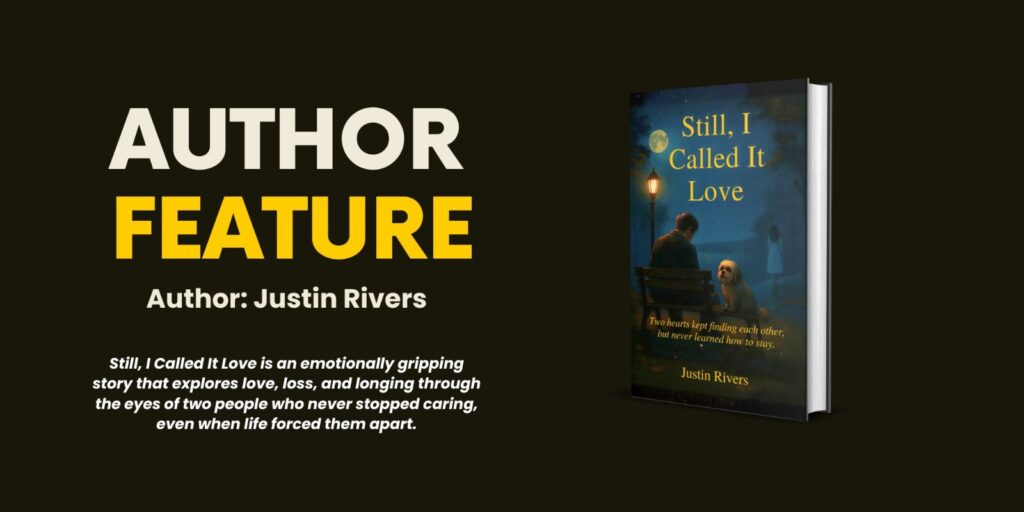
Still, I Called It Love — When Loving Deeply Becomes an Act of Courage
By Justin Rivers
Some stories are written to entertain.
Some are written to impress.
And then there are stories written because they refuse to stay silent.
Still, I Called It Love belongs to the last kind.
This novel is not merely a love story—it is a confession, a memory, and a quiet rebellion against the idea that love must always succeed to be meaningful. Through the life of Justin, a boy who learns loss before he learns permanence, the book explores what it means to love deeply in a world that rarely rewards softness.
At its heart, Still, I Called It Love is about endurance—the kind that doesn’t look heroic, doesn’t make noise, and doesn’t always win. It is about the people who stay when leaving would be easier, who forgive even when it costs them something, and who choose love even after it breaks them.
A Story Rooted in Memory, Not Fantasy
From its opening pages—where a man sits quietly in a park with his dog, surrounded by memory—the novel establishes its emotional tone: reflective, intimate, and unafraid of stillness. This is not a fast-moving romance driven by dramatic twists. Instead, it unfolds like memory itself—layered, nonlinear, and deeply personal.
Justin’s journey begins long before romantic love enters his life. His childhood, shaped by movement between Chennai and Bangalore, is marked by warmth and rupture in equal measure. The love of his grandmother, the safety of familiar routines, and the early loss of his mother form the emotional foundation of the story. These experiences quietly explain why Justin grows into someone who loves too much, stays too long, and forgives too easily.
The novel makes it clear: the way we love as adults is often a continuation of how we learned to survive as children.
Love That Arrives Gently—and Leaves Quietly
Justin’s first love, Sophie, represents innocence in its purest form. Their relationship unfolds within school corridors, staircases, bus stops, and handwritten notes—places and gestures that will feel achingly familiar to many readers. Their bond is tender, playful, and deeply sincere.
What makes this part of the novel especially powerful is its restraint. There is no exaggeration, no attempt to dramatize young love beyond what it already is. Instead, the author allows small moments—a shared lunch, a morning phone call, a first kiss at dawn—to carry the emotional weight. These scenes remind readers that love doesn’t need grandeur to be unforgettable.
When that love ends, it doesn’t explode—it fades under pressure, fear, and adult authority. The separation is not born from betrayal or lack of feeling, but from circumstances neither of them is old enough to fight. This quiet ending becomes one of the novel’s most haunting truths: sometimes love doesn’t fail because it wasn’t real, but because it wasn’t allowed to survive.
A Protagonist Who Feels Too Much
Justin Rivers writes a protagonist who feels everything—and never apologizes for it.
Justin is not emotionally guarded. He loves openly, waits patiently, and carries pain without turning it into cruelty. In a literary landscape often dominated by emotionally unavailable characters, Justin stands apart. His vulnerability is not portrayed as weakness, but as a form of courage.
Even when love costs him—emotionally, mentally, physically—he does not harden. Instead, he continues to believe in connection, in forgiveness, and in the idea that love itself is still worth choosing.
This makes Still, I Called It Love especially resonant for readers who have been told they love “too deeply” or “too much.” The novel quietly asks an important question: what if the problem was never the depth of your love, but the world’s inability to hold it?
The Return of Love—and Its Complications
As the story progresses, Justin’s life introduces new relationships—Selena, Jessie, and others—each representing a different version of love, timing, and emotional readiness. These relationships are not presented as replacements for Sophie, but as continuations of Justin’s emotional journey.
The novel is honest about the messiness of healing. Moving on is not linear. Loving again does not erase old love. And sometimes, the same patterns repeat—not because the heart hasn’t learned, but because it hopes this time the ending will be different.
Justin Rivers does not romanticize suffering, but he also does not simplify it. The novel allows love to be beautiful and damaging in the same breath, showing how unresolved pain can quietly shape decisions, relationships, and self-worth.
A Writing Style That Feels Like a Whisper
One of the most striking aspects of Still, I Called It Love is its voice.
The prose is gentle, poetic, and emotionally transparent. Short reflections and poems are woven between chapters, functioning like pauses for breath—moments where the reader is invited not to rush, but to feel. The language never overreaches. It trusts silence. It trusts simplicity.
This stylistic choice mirrors the emotional core of the book. The story does not shout its pain. It lets it sit quietly beside the reader, much like the park bench in the opening scene.
There is an authenticity to the writing that suggests lived experience rather than observation. The emotions do not feel imagined—they feel remembered.
Love as a Choice, Not an Outcome
Perhaps the most powerful message of Still, I Called It Love is its refusal to measure love by success.
In many stories, love is validated by permanence—marriage, reunion, or happy endings. This novel challenges that idea. It suggests that love can be real even if it ends, meaningful even if it hurts, and worthy even if it doesn’t last.
Justin does not regret loving. He regrets the pain, the silence, the loss—but never the love itself. This distinction is what gives the novel its emotional maturity.
To love deeply, the book suggests, is not a mistake. It is a risk. And sometimes, choosing that risk is the bravest thing a person can do.
Who This Book Is For
Still, I Called It Love will resonate deeply with:
• Readers who have experienced first love and never fully forgot it
• Those who stayed longer than they should have, hoping love would change things
• People who forgive easily and feel deeply
• Anyone who has been told to “move on” without being taught how
• Readers who appreciate slow, emotional storytelling over fast-paced drama
This book does not offer easy answers or perfect resolutions. What it offers instead is recognition—the comfort of knowing that someone else has felt this way too.
A Story That Lives Quietly Inside You
By the time the novel ends, Justin does not emerge untouched. But he emerges honest—with his memories, his scars, and his capacity to love intact.
Still, I Called It Love is the kind of story that doesn’t end when you close the book. It lingers—in certain songs, quiet nights, old messages, and places that still remember who you were once waiting for.
It reminds us that love doesn’t always stay.
But the way we love becomes part of who we are.
And sometimes, even after everything—
we still call it love.