
Book Review: Life Lessons They Never Teach in School by Santanu Borah
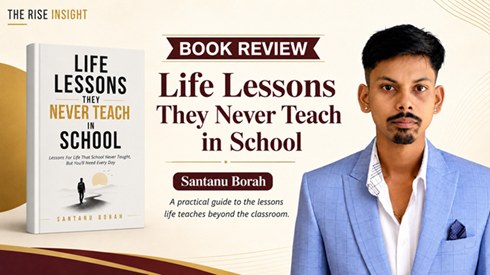
Life Lessons They Never Teach in School by Santanu Borah
Life Lessons They Never Teach in School by Santanu Borah is a simple, practical, and inspiring book about the lessons that people often learn only after entering the real world. The book speaks about success, failure, fear, discipline, relationships, purpose, courage, personal growth, and many other areas of life that are very important but are not always taught in classrooms.
The main strength of this book is its simplicity. It does not use difficult words or complicated theories. Instead, the author explains important ideas through relatable situations, short stories, examples, and practical reflections. Because of this, the book feels easy to read and understand. It can be useful for students, young professionals, entrepreneurs, and even older readers who want to think again about the way they are living their lives.
The very title of the book gives a clear idea of its purpose. School teaches us many useful subjects, but life demands some different skills. We may study mathematics, science, history, and language for many years, but later we discover that real life also asks us to manage money, handle pressure, face rejection, make difficult decisions, communicate with people, recover from failure, and understand ourselves better.
This idea is clearly explained in the first chapter, “Success Is Not What School Teaches.” The chapter starts with the memory of the first day of school. This makes the beginning very personal and familiar. Almost every reader can remember entering school with a new uniform, books, a school bag, and the hope that education would prepare them for the future.
The author then talks about the common formula of success that many of us hear from childhood: study hard, get good marks, secure a good job, and build a successful life. There is nothing wrong with this advice, and the book does not criticize education. In fact, the author respects the importance of schools and teachers. But he also explains that education alone cannot prepare us for every situation.
In the real world, people are not asked what marks they scored in school. Instead, they are judged by the way they solve problems, communicate, lead, manage emotions, deal with pressure, and take responsibility. This is one of the strongest messages of the book.
A very meaningful thought in the first chapter is that school gives the lesson first and then the test, while life often gives the test first and the lesson later. This line explains the difference between academic education and real-life learning in a very simple way. Many of the most important lessons in life come after mistakes, failures, disappointments, or difficult experiences.
Another beautiful chapter is “The Art of Letting Go.” This chapter begins with a simple story of a young boy sitting under a tree in autumn. He watches the tree lose its leaves and asks his grandfather whether the tree is afraid. The grandfather explains that the tree is not losing its life. It is preparing for a new season.
This short story gives a deep lesson without becoming difficult. Sometimes, moving forward in life requires us to leave something behind. We often think that personal growth means gaining more—more knowledge, more success, more money, more relationships, or more achievements. But the author reminds us that growth can also mean letting go.
We may need to let go of old memories, unhealthy habits, past failures, guilt, negative relationships, unrealistic expectations, or a version of ourselves that no longer helps us grow.
The example of the tree is especially effective because it shows that letting go is natural. A tree does not hold every old leaf forever. If it did, there would be no space for new growth. In the same way, people also need space for new beginnings.
This chapter can connect deeply with readers who are facing change. Letting go is never easy, but the book presents it as a necessary part of life rather than something to fear. Sometimes, what looks like an ending is actually preparation for a new chapter.
The chapter “Fear: The Invisible Wall Between You and Your Dreams” is also one of the most powerful parts of the book. It begins with the story of a traveler standing near a mountain. He wants to climb it, but fear stops him before he even begins. An old guide tells him that the mountain is not stopping him—his fear is.
This simple example explains how fear works in everyday life. Many people have dreams, talent, and opportunities, but they still do not move forward because they are afraid.
The author discusses different kinds of fear such as fear of failure, rejection, judgment, losing, uncertainty, and not being good enough. These are not unusual fears. Almost everyone experiences them at some point.
The book also makes an important distinction: fear itself is not always bad. Fear can protect us from real danger. The real problem starts when fear begins to control our decisions and stops us from taking steps that could improve our lives.
This is a very practical lesson. Many people remain inside their comfort zone because safety feels peaceful. They avoid risks, difficult conversations, new opportunities, public speaking, business ideas, or creative work because they do not want to fail.
But the author explains that the cost of always playing safe can be greater than failure itself.
One of the best ideas in the chapter is that failure is temporary, while regret can remain for a long time. The book gives the example of two people. One starts a business and fails. The other never starts because he is afraid. Years later, the first person may have gained experience, knowledge, and confidence. The second may only have one question: “What if I had tried?”
This is a powerful reminder that failure is not always the worst possible result. Sometimes, not trying at all can hurt more.
The book also explains courage in a very realistic way. Courage does not mean that a person has no fear. Brave people also feel nervous. Entrepreneurs, firefighters, athletes, artists, and speakers all experience fear. The difference is that they act despite it.
This message can be very encouraging for readers. Many people wait to feel fully confident before taking action, but that moment may never come. Sometimes, action comes first and confidence develops later.
Another important feature of the book is its practical tone. The author is not only discussing ideas from a distance. His own background as an entrepreneur and founder of a footwear brand adds a real-life quality to the book. His experiences of building something from the ground up, facing uncertainty, dealing with failures, and continuing despite challenges connect naturally with the lessons presented in the book.
This makes the message more believable. The book feels like it comes from observation and experience rather than from theory alone.
The writing style is conversational and encouraging. It often feels as if someone is sitting with the reader and sharing lessons learned over time. The short stories at the beginning of chapters also make the ideas memorable. Instead of simply saying “do not be afraid” or “learn to let go,” the author builds a small situation around the lesson. This makes the message easier to understand.
The book is especially suitable for young people because many important choices begin after school or college. Students are often prepared for examinations, but they may not be equally prepared for rejection, financial decisions, emotional pressure, failure, career uncertainty, relationships, or personal responsibility. A book like this can help readers start thinking about these areas earlier.
At the same time, it is not only a book for students. Adults can also relate to these lessons. Almost everyone has experienced fear, regret, failure, change, and the difficulty of letting go. This gives the book a wide appeal.
Overall, Life Lessons They Never Teach in School is a meaningful and easy-to-read book that encourages readers to look beyond marks, degrees, and traditional definitions of success. Its message is that life requires emotional strength, practical wisdom, courage, discipline, self-awareness, and the ability to learn from experience.
The book does not promise that life will become easy. Instead, it shows that we can become better prepared to handle it.
Its biggest strength is that the lessons are simple but useful. The ideas may sound familiar, but they are presented in a way that makes the reader stop and reflect. The book reminds us that success is not only about what we achieve. It is also about who we become during the journey.
For anyone looking for a practical self-growth book written in simple language, Life Lessons They Never Teach in School can be a valuable and motivating read. It encourages readers to face fear, learn from failure, let go when necessary, take responsibility, and keep moving toward a more purposeful life.
Buy this book on Amazon :https://www.amazon.in/Life-Lessons-Never-Teach-School/dp/9373355287/