
Introduction: The Illusion of Image and the Promise of Power
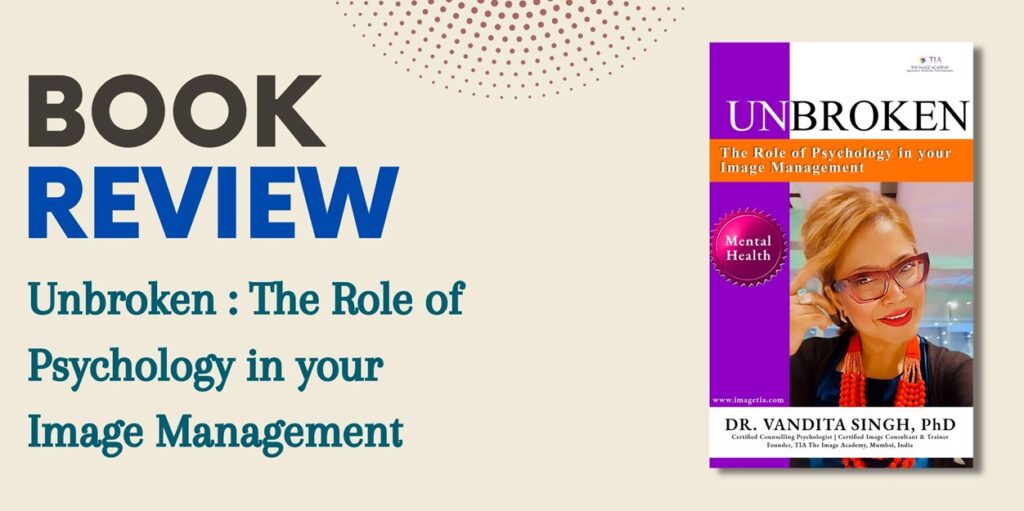
In an era saturated with surface-level advice—quick fixes, styling hacks, and 30-day confidence challenges—Dr. Vandita Singh, PhD, delivers a profound and necessary intervention. Her landmark work, UNBROKEN: The Role of Psychology in Your Image Management, is not just a book; it is a declaration that true, lasting influence can never be achieved through superficial means. It is a revolutionary text that fundamentally redefines ‘Image Management,’ lifting it from the realm of mere aesthetics into the rigorous discipline of Counselling Psychology.
Dr. Singh, a distinguished Image Consultant with a foundation in psychology and an extensive background in global service, crafts a compelling argument: your image is not what you wear, but who you are—and it must be a flawless alignment of your inner world and your outer presence. This book is a deep dive into achieving psychological congruence, turning the fragmented, self-doubting professional into a singular, confident, and trustworthy presence. For anyone who has felt their brilliance undermined by their presentation, or their genuine efforts obscured by miscommunication, UNBROKEN offers the blueprint to reconstruct your professional life from the inside out. Forget the band-aid solutions; this is a comprehensive structural overhaul that promises not just competence, but undeniable credibility.
The Core Thesis: Unbroken Influence Through Psychological Congruence
The true power of UNBROKEN lies in its radical premise: the external image is merely the visible manifestation of the internal psychological state. Dr. Singh argues that when there is a disconnect—when your appearance and behavior do not authentically reflect your skills, values, and intentions—you become “broken” in the eyes of others. This incongruence creates noise, breeds mistrust, and, critically, leads to professional stagnation.
The concept of “Unbroken” is therefore a metaphor for seamless authenticity. It is the state where your quiet posture, your written word, your tone of voice, and your deliberate choices in attire all speak a singular, coherent, and confident language.
Dr. Singh meticulously explains how this alignment combats some of the deepest cognitive biases at play in human interaction. She pulls back the curtain on “Thin-Slicing,” the psychological phenomenon where individuals make complex, accurate judgments about a person’s character, competence, and trustworthiness within seconds of meeting them. This is where most image advice fails; it focuses on correcting the symptom (a poor first impression) rather than the psychological root cause. UNBROKEN teaches you to curate the subconscious cues—posture, gaze, vocal quality—that feed the “Thin-Slicing” process, ensuring your internal confidence is the only signal being broadcast.
This isn’t about vanity; it’s about strategic self-awareness. The author challenges the reader to move past the idea of faking it ’til you make it and instead focuses on being it so you project it. By merging clinical psychological understanding with Image Management principles, Dr. Singh provides a roadmap for cultivating genuine self-belief that effortlessly translates into a commanding external presence. The foundational message is clear: Master your inner self, and your outer self will naturally master the room.
Deconstructing the A.B.C. of Image Management
The structure of UNBROKEN is built around the fundamental A.B.C. of Image Management: Appearance, Behaviour, and Communication. Dr. Singh dissects each pillar, offering practical tools grounded in verifiable psychological research.
A: Appearance – The Inner Power of Outer Presentation
Appearance, in Dr. Singh’s framework, is far more than just clothing; it is a deliberate decision reflecting self-respect and mental preparedness. The key concept here is “Enclothed Cognition,” the psychological effect where the clothes you wear influence your mental state and performance. UNBROKEN teaches readers how to dress not just for the occasion, but for the state of mind they wish to inhabit. Want to feel decisive? Dress decisively. Want to feel creative? Dress creatively.
This principle is reinforced by the author’s “No Lazy” philosophy, a challenging yet empowering mandate that “attractiveness is discipline, not just DNA.” This section shifts the focus from inherited physical attributes to conscious, daily acts of self-management—grooming, fitness, and meticulous detail—that signal respect for oneself and one’s professional environment. Dr. Singh ensures that the reader understands how controlling their presentation is an act of proactive personal leadership, directly affecting the subconscious biases, such as the “Halo” and “Horn” effects, that determine how others perceive their overall competence. By presenting a polished, disciplined front, you leverage the Halo Effect, ensuring your underlying skills are seen in the most favorable light.
B: Behaviour – The Unspoken Code
If Appearance is the cover, Behaviour is the typography—the subtle, constant structure that holds the message together. This section is perhaps the most transformative for professionals, addressing the silent language that often betrays inner turmoil or insecurity.
Dr. Singh provides essential lessons in Body Language, going beyond standard textbook advice. She addresses the pernicious problem of the “Resting Face” (sometimes humorously referred to as the “Bedroom Face” in the context of avoiding unintentional negative cues), teaching readers how to maintain an open, receptive, and engaged expression even when passive. This is crucial for collaborative environments where unintended scowls can shut down dialogue before it even begins.
A significant portion of this pillar is devoted to Emotional & Social Mastery, specifically the cultivation of Self-Regulation—the practical application of Emotional Intelligence. For the author, composure in a crisis is the ultimate sign of a leader with an “unbroken” image. She offers strategies to maintain equanimity, demonstrating how a calm, measured response, even under extreme pressure, solidifies credibility and trust far more effectively than any verbal statement. Finally, Dr. Singh elevates Etiquettes and Manners from fussy rules to the ultimate social skill: the ability to consistently “put others at ease.” This simple re-framing changes etiquette from a burden into a tool for influence and rapport building.
C: Communication – Conversational Influence
The final pillar focuses on the verbal and vocal expressions of congruence. Communication is where most professionals feel the pinch—they may have brilliant ideas but struggle to convey them effectively, especially in unstructured settings.
UNBROKEN provides actionable techniques to overcome the fear of silence and awkwardness. Dr. Singh teaches readers how to bridge initial gaps with compelling “Conversation Starters” and master “Small Talk,” which she correctly identifies not as a trivial time-filler, but as the essential bridge to deeper, more meaningful professional rapport. She provides structures for thriving in “Group Conversations,” ensuring that one’s voice is heard, respected, and contributed at the right time.
Critically, the book emphasizes the importance of the “Tone of Voice.” A perfectly crafted message can be instantly undermined by a flat, nervous, or aggressive tone. Dr. Singh coaches the reader on ensuring their vocal delivery—pitch, pace, and volume—supports, rather than contradicts, their verbal message, sealing the deal on their psychological congruence.
The Indian Nexus: Context and Global Relevance
One of the book’s most distinguishing features is its integration of Indian cultural nuances. While the psychological principles of UNBROKEN are universal—Thin-Slicing, Enclothed Cognition, the Halo Effect—their application must be locally contextualized.
Dr. Singh’s expertise in the Indian professional landscape adds immense value, providing necessary adjustments to a field often dominated by Western paradigms. She implicitly guides the reader on how to balance global professional standards with local cultural expectations regarding formality, respectful distance, hierarchy acknowledgement, and non-verbal cues (such as the appropriate use of hands and gestures). This grounded approach makes the advice not only relatable but immediately implementable for professionals working within or engaging with the Indian ecosystem. It is this contextual richness that makes UNBROKEN an essential volume for the contemporary, globally-minded Indian professional.
Impact and Application: The Roadmap to Self-Managed Leadership
The ultimate objective of UNBROKEN is to transition the reader from being merely present in a room to becoming a presence that is unforgettable.
Dr. Singh dedicates the final segments to the practical application of her unified framework in achieving professional success. This culminates in the concept of “Confident Behavior” (Challenge, Change & Act) and “Self-Managed Leadership.”
The book serves as a powerful motivator, providing a chilling, yet honest, diagnosis of the consequences of inaction:
- Misunderstanding: Your brilliant ideas are undermined by subconscious cues (The Horn Effect).
- Missed Opportunities: Poor listening, shyness, and a lack of authentic non-verbal presence prevent vital connections.
- Emotional Fatigue: The constant struggle between the inner self and the external presentation leads to a fragmented sense of self and perpetual exhaustion.
The cure is Dr. Singh’s insistence on “translating daily action into reality.” This means the practice of image management is not a one-time grooming session but a continuous, disciplined, and mindful engagement with oneself. The book offers the tools to proactively manage one’s brand, ensuring that every interaction, gesture, and piece of communication is an intentional step towards one’s long-term professional vision. For leaders, aspiring executives, entrepreneurs, and young professionals, the framework provides the necessary discipline to move beyond competence and secure true influence.
Conclusion and Final Verdict
UNBROKEN: The Role of Psychology in Your Image Management is more than a guide; it is a manifesto for authentic personal power. Dr. Vandita Singh, PhD, has successfully fused the pragmatic demands of Image Consulting with the enduring truths of Counselling Psychology, creating a holistic system that is academically rigorous yet intensely practical.
This is not a light weekend read, but a workbook for life. It demands introspection, challenges comfortable excuses, and provides the structure needed to close the gap between aspiration and reality. The book’s comprehensive, three-part A.B.C. framework, its reliance on proven psychological principles, and its vital cultural grounding make it the definitive text for anyone serious about elevating their career and cultivating a reputation of undeniable credibility.
If you are tired of superficial fixes and are ready to embark on the demanding, yet profoundly rewarding, journey of achieving true self-mastery, UNBROKEN is essential reading. It is a vital investment in the only brand that truly matters: yourself.
Rating: 5/5 Stars – A revolutionary and essential blueprint for the modern professional.