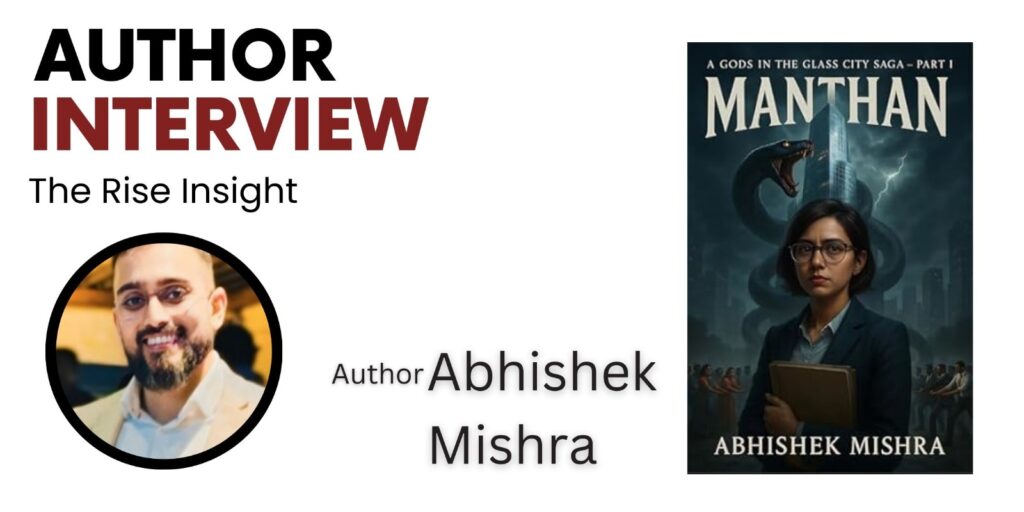
About the Book – Gods in the Glass City is a conspiracy thriller about a smart city that edits reality with polite screens. By day, Amaravati sells “calm.” By night, it quietly decides what the public will see. The result is a churn—manthan—where nectar and poison rise together, and no one is sure which cup is in their hand.
At the center is Mridula Sharma, an archivist who trusts paper over dashboards. A late-night file and a small mismatch on a “donor lane” turn her into a witness. Kaal, a street-clever listener, hears the city’s hidden beat—1, 2, 3, hold, 4—and begins to measure how long “safety” holds harm in place. Together with Kashi, a steady ex-cop, they collect small proofs: a stamp, a serial, a minute that won’t learn a new name. In the glass towers, programs with soft names—City Balance, mohini_gate, Vajra—choose which truth to pour. Varun slides into a quiet chair that looks like it has been waiting for him; Maya keeps the tone clean; a convoy meant for a hospital ends at a data annex. Calm is arranged. Costs are hidden.
What to expect: short, tense chapters; plain language; human stakes. Each chapter ends with a brief paradox note and a sharp hook to the next. The book favors touchable proof—ink, paper, time—over jargon. It begins with a prophecy in an old room and builds toward a simple, stubborn question: can a record made by hand outlast a story made by code?
If you like thrillers where small acts refuse to vanish, this is your book.
Question- How did the idea of fusing Samudra Manthan with a modern, high-tech authoritarian city come to you?
Answer- I didn’t start with “a smart city.” I started with a feeling: that we are living through a churning – of truth, memory, identity, and anger. The myth of Samudra Manthan has always stayed with me because it is not a neat story of victory. It is messy. It produces nectar, yes – but it produces poison first. And I kept wondering: what is our poison today?
Then I looked around and realized we’re building cities that promise “ease,” “safety,” and “certainty”… but under that promise sits an invisible machinery that watches, remembers, predicts, and quietly decides. That’s when Amaravati arrived in my mind – not as a place of glass and lights, but as a question: What happens when a society tries to engineer perfection?
So the fusion happened naturally: the ancient churn gave me the spiritual metaphor, and the modern system gave me the mechanism. Together they became MANTHAN: a world where myth is not decoration – it is a warning that refuses to die.
Question- The premise is in the prophecy: “The greatest sin of the past… was for a man to declare himself a god. The greatest sin of the future… will be to prove it.” What was the spark moment?
The spark was a frighteningly simple thought: we have stopped being satisfied with belief. We want proof for everything – proof that someone is loyal, proof that someone is guilty, proof that someone is “safe,” proof that a story is “true.” And once a society begins worshipping proof, it starts building machines that manufacture proof.
That’s where the prophecy struck me like a bell. In older times, a tyrant demanded obedience by declaring himself divine. Today, the more dangerous tyrant doesn’t declare – he demonstrates. He makes the system “show” you a reality, makes the crowd nod, and then says: See? The machine agrees. The data agrees.
That’s why this prophecy felt like it wasn’t about the future. It felt like it was describing the present – quietly, accurately, and without mercy.
Question- The title MANTHAN means “churning.” What layers of meaning did you intend – memory, data, social conflict?
Answer- To me, churning is not just action. It is consequence.
- In the book, churning is what happens when a city refuses to let anything die – not memories, not mistakes, not rumours, not grief. Memory becomes an ocean that doesn’t evaporate.
- Churning is also what happens inside people: when fear and pride and helplessness get stirred every day until they turn into rage – or silence.
- And socially, churning is what a controlled society accidentally creates: the more you compress human complexity into a clean “risk score,” the more pressure you build underneath. And pressure always seeks an exit.
So MANTHAN is the churn of data into certainty, certainty into power, and power into conflict. It is also the churn inside the reader: you begin by admiring the order, and then you start asking, what did this order cost?
Question- What research did you conduct on mythology and on concepts like algorithmic governance, smart cities, data retention? (Re-phrased Answer)
The starting point of my research was not technology – it was mythology. I went back to Samudra Manthan not as a story of gods and demons, but as a study of process and consequence. The myth is often remembered for the nectar, but when you read it closely, the real lesson is in the order of emergence: poison rises first, and only because someone is willing to hold it does the world survive.
That idea stayed with me. I spent time understanding why ancient myths insist on this sequence – why power, when churned without restraint, always produces something destructive before it produces anything divine. Mythology, I realised, is not fantasy; it is early systems thinking. It encodes warnings about scale, ambition, and hubris in forms that survive centuries.
Modern systems, for me, were not an abstract leap. Coming from a background in data science and neuroscience, I’m constantly exposed to how systems learn, predict, optimise, and sometimes overreach. I understand how memory systems behave, how feedback loops amplify certain outcomes, and how certainty emerges not from truth, but from repeated reinforcement.
While writing MANTHAN, I didn’t need to imagine these systems – I needed to translate them into story. The city of Amaravati behaves the way large-scale systems do: it doesn’t hate, it doesn’t rage, it simply decides. And that, to me, is far more dangerous than an openly violent regime.
So the research was a dialogue between the ancient and the modern. Myth gave me the moral grammar; modern systems gave me the mechanism. MANTHAN lives in that space where a years-old warning suddenly feels uncomfortably current.
Question- Why 1985 and the Garhwal Himalayas for the prologue and the original delivery of the prophecy?
Answer- Because I wanted the prophecy to arrive from a place that feels older than ambition.
A peak in the Garhwal Himalayas is not just a location – it is a spiritual temperature. It strips away noise. It makes words feel heavier. And setting it in 1985 allowed the prophecy to exist before the internet, before the algorithmic age – so that later, when the modern city starts behaving like the prophecy, the reader feels that uncanny chill: this was not written after the fact; it was carried forward like a wound.
Also, the prologue needed a keeper – someone whose last breath is not dramatic, but sacred. The book opens with that quiet severity: a Keeper in a cave, thin air, barley broth gone cold, and a truth that doesn’t beg to be believed – it just waits.
Question- Your characters feel restrained, observant, and burdened rather than heroic. Why did you choose to write them this way?
Answer- I didn’t want heroes who conquer. I wanted witnesses who carry weight.
In the world of MANTHAN, power doesn’t roar – it hums. It operates quietly, efficiently, and without apology. Against such a force, traditional heroism feels dishonest. What matters instead is attention: the ability to notice patterns, to feel when something is wrong even when everything looks “clean.”
Characters like Mridula, Kaal, and Varuni are not fearless. They hesitate. They doubt. They get tired. But they keep looking – and that, to me, is the most human form of resistance. I wanted readers to recognize themselves in that restraint, to feel that bravery doesn’t always announce itself. Sometimes it simply refuses to look away.
Question- Amaravati feels almost like a living character in the novel. Was that intentional?
Answer- Very much so.
I wrote Amaravati as a system with a personality, not just a city. It listens, remembers, predicts, and reacts. It doesn’t sleep. It doesn’t forgive. And most importantly, it believes it is doing the right thing.
That belief is what makes it dangerous.
I wanted readers to feel both awe and unease when encountering Amaravati – the way we often feel toward real-world systems that promise efficiency, safety, and order. The city isn’t evil in the traditional sense. It is convinced. And conviction, when paired with power, can be more frightening than cruelty.
Amaravati doesn’t shout at its citizens. It guides them. And slowly, that guidance becomes governance.
Question- Memory and forgetting are recurring ideas in the book. Why are they so central to the story?
Answer- Because mercy requires forgetting, and systems hate mercy.
In MANTHAN, memory is treated as sacred – but also as suffocating. An ocean that never forgets becomes an ocean that never forgives. And when forgiveness disappears, humanity soon follows.
I was deeply interested in what happens when societies treat memory as purely technical – when everything is stored, scored, and recalled without context. Humans survive because we forget selectively. We forgive imperfectly. We allow people to grow beyond who they once were.
The tragedy of MANTHAN is that its systems do not understand this. They remember flawlessly – and in doing so, they erase compassion.
Question- What was the most emotionally difficult part of writing this book?
Answer- Accepting that the book would not comfort everyone.
There were moments when I wondered if I was being too harsh, too quiet, or too unsettling. But every time I tried to soften the narrative, it felt dishonest. The world of MANTHAN demanded restraint, not reassurance.
The hardest part was writing scenes where characters know something is wrong but cannot immediately stop it. That helplessness – the slow realization that a system has moved beyond individual control – was emotionally heavy to sit with.
But I stayed with it, because discomfort is part of truth. And I believe readers feel that honesty on the page.
Question- What do you hope readers take away after finishing MANTHAN?
Answer- I don’t want readers to walk away with answers. I want them to walk away with better questions.
Questions like:
- Who benefits from certainty?
- What does convenience ask us to give up?
- When does order stop serving people and start replacing them?
- And most importantly: what poison are we currently asking someone else to hold for us?
If a reader closes MANTHAN feeling unsettled, reflective, and a little more attentive to the systems shaping their lives, then the book has done its job.
Because stories don’t warn loudly.
They stay with you.