
Book Review – HOMOEOPATHIC INFOGRAPHICA GUIDE VOL 2 by Group Captain Manoj Dayal (Retired)
An examination of remedy essence, clinical interpretation and the search for coherence in classical homoeopathic education.
The most revealing idea behind Homoeopathic Infographica Guide Vol 2 is that a clinical decision can lose its meaning when the person being treated is reduced to a checklist. Group Captain Manoj Dayal (Retired) begins from a familiar frustration within homoeopathic practice: the tendency to select a remedy using isolated bodily symptoms or an overly quick reading of temperament. The book’s stated response is to look for a more coherent picture of the individual. Rather than treating such fragments as sufficient, it proposes that practitioners consider the connections among physical experience, emotional patterns and mental life. That central concern gives the guide its editorial identity: it is less a catalogue of disconnected observations than an argument for interpretive discipline.
Its conceptual anchors, the Elemental Diagnostic Codex and the Clinical Compass, are presented as means of moving between abstract learning and actual clinical encounters. The distinction matters. An orderly theory can appear persuasive on the page yet become difficult to apply when a patient’s history is contradictory, incomplete or continually changing. The guide takes those difficulties seriously in its description of the clinical ‘void’: the uncertain space in which a practitioner must decide what is relevant, how different signs relate and whether an apparent pattern is trustworthy. By bringing two named frameworks together, Dayal seeks to give that process a clearer direction. Readers will still need to assess how the frameworks are defined and applied in the full text, but the intention is readily understandable.
A significant emphasis falls on what the author calls the ‘essence’ of a remedy. In the book’s stated approach, essence is not simply a memorable label or a convenient personality stereotype. It is intended to represent an integrated reading of a case. This is an important distinction because the author explicitly identifies superficial personality judgments as a source of weak prescribing. The value of the argument lies in its demand for greater attention, not in any suggestion that an intuitive impression alone should settle a clinical question. A conscientious reader can take from this an invitation to examine assumptions, revisit ambiguous information and distinguish a nuanced understanding of a patient from the seductive simplicity of a type.
The other organizing idea is time. The patient, as Dayal describes the problem, should be understood through an ‘evolutionary timeline’ rather than as a static collection of symptoms. This shifts attention from what is immediately visible to how the account of illness and experience has developed. Changes, recurrences, turning points and the order in which concerns emerge may all matter to a practitioner constructing a narrative of the case. The book description connects this orientation to the teaching of Professor George Vithoulkas, whom Dayal identifies as his guru. That acknowledgment gives the project an intellectual lineage while also signaling its primary readership: those who already know the vocabulary and debates of classical homoeopathic education.
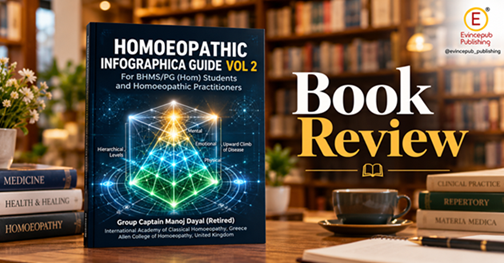
Dayal further frames his method through a hierarchy of mental, emotional and physical levels, a relationship reinforced by the supplied cover artwork. Such a hierarchy makes for a memorable visual idea because it offers a way to organize material that might otherwise feel unwieldy. It also creates questions a serious reader should ask: How are these levels distinguished in practice? What happens when signs point in competing directions? How does a practitioner avoid assigning undue weight to one form of evidence? These questions are not objections to presenting a framework; they are the questions that make a framework useful as a teaching tool. A guide succeeds when its structure encourages examination rather than automatic conclusions.
The discussion of miasmatic layers adds another dimension to that structure. Dayal credits his teacher, Dr. Subrata Kumar Bannerjea, for instruction in this area, and places the idea within a tradition associated with Hahnemann and Kent. For readers approaching the work from within classical homoeopathy, those references identify a recognizable set of concepts and historical influences. For newcomers, they also indicate that the book is written from a particular school of thought rather than from a neutral, cross-disciplinary medical perspective. That distinction deserves to remain visible. The conceptual richness of a tradition and the clinical effectiveness of its treatments are different questions, and one cannot be treated as proof of the other.
The title’s use of ‘Infographica’ and the geometric diagram on the cover suggest a strong preference for visual synthesis. The supplied description, however, does not specify the book’s internal illustrations, diagram count or chapter layout, so those features cannot be assessed here. What can be evaluated is the promise of organizing difficult conceptual material into relationships that students can remember and discuss. For BHMS and postgraduate homoeopathy students, the proposed hierarchy and paired diagnostic frameworks may provide prompts for case analysis, classroom debate and closer reading of the authors and teachers cited. Practitioners may find the same material most valuable as an occasion to reconsider how they gather histories and explain their reasoning.
The writing approach described is aspirational as well as instructional. Dayal invokes the figure of the ‘artist-physician’, positioning clinical practice as an act requiring perception, interpretation and judgment. That choice of language reflects a concern that a mechanical method of matching symptoms to remedies can obscure the human being in front of the practitioner. It is a compelling educational theme when understood as a call for attentiveness and intellectual humility. At the same time, claims of ‘clinical certainty’ and ‘permanent cure’ in the book description should be understood as the author’s aspirations, not as outcomes established by the material supplied for this review. Homoeopathy lacks reliable evidence of efficacy for treating medical conditions; it should not replace evidence-based care or delay medical assessment.
As an editorial proposition, then, Homoeopathic Infographica Guide Vol 2 stands out for the clarity of its central problem and the ambition of its response. It asks readers to move beyond fragmented observations and examine the patient as a developing whole, with explicit attention to mental, emotional and physical dimensions. Its potential strength is as a structured account of how one practitioner connects the concepts and teachers that have shaped his approach. The limitations of this review are equally important: without the full manuscript, its case examples, internal pedagogy and accuracy cannot be independently judged. Its intended audience is therefore best described as learners and practitioners studying classical homoeopathic thinking, rather than anyone seeking verified evidence of treatment effectiveness.
Ultimately, Dayal’s guide invites a distinction that is useful in every field of study: knowing terminology is not the same as exercising sound judgment. The book’s proposed Codex and Compass attempt to bring coherence to complexity, and its emphasis on chronology and hierarchy gives that attempt a consistent direction. Whether readers accept its premises or question them, the work offers a focused starting point for discussing the strengths and risks of interpretive models in clinical education. Read with critical attention and alongside established medical evidence, it can be approached as a statement of a specific homoeopathic philosophy—and as a reminder that careful observation must always be matched by responsible scrutiny of the claims made from it.
Amazon Link – https://www.amazon.in/Homoeopathic-Infographica-Guide-Full-Color/dp/9373357387/