
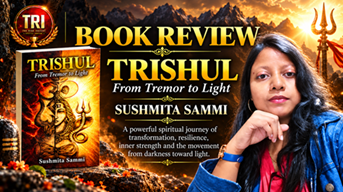
TRISHUL – From Tremor to Light is a deeply emotional and thoughtful book about pain, healing, self-discovery, and inner transformation. It speaks to those moments in life when everything feels shaken, when we feel lost, broken, or unsure about what comes next. But instead of treating these difficult moments only as suffering, the book asks us to look at them differently. What if the moment that breaks us is also the moment that begins to change us?
This simple question becomes the heart of the book.
The idea behind TRISHUL – From Tremor to Light is inspired by Lord Shiva’s Trishul. Usually, we see the Trishul as a divine weapon and an important symbol connected with Shiva. But in this book, it becomes something more personal. The three edges of the Trishul represent three important stages of a person’s inner journey—the one that shook you, the one that broke you, and the one that rebuilt you.
This is a beautiful way to understand transformation because healing does not usually happen in one straight line. First, something may disturb the life we know. Then there may come a time when we feel completely broken. Only after passing through that pain do we slowly begin to understand ourselves differently and rebuild from within.
The word “tremor” in the title itself is meaningful. A tremor is the first sign that something is moving beneath the surface. The same can happen in our lives. Sometimes everything may look normal from outside, but inside, something has started changing. We may feel uncomfortable, restless, emotionally tired, or disconnected from the person we used to be.
Often, we try to ignore such feelings. We stay busy. We distract ourselves. We tell ourselves that everything is fine. But eventually, those inner tremors ask to be noticed. The book encourages the reader not to run away from these feelings. Instead, it asks us to sit with them, understand them, and listen to what they may be trying to tell us. This is where the spiritual connection with Shiva becomes especially meaningful. Shiva represents many things—stillness, destruction, transformation, awareness, and creation. The book takes inspiration from these qualities without making the journey feel like a difficult religious lesson. Shiva becomes a symbol through which the reader can understand their own emotional life.
Sometimes something must end before something new can begin. This idea may sound frightening, especially when we are going through a difficult phase. Nobody enjoys losing relationships, dreams, confidence, security, or the version of life they had imagined. But TRISHUL – From Tremor to Light reminds us that destruction does not always mean that everything is over. Sometimes it creates space. Space to understand ourselves. Space to see the truth. Space to begin again. The emotional side of the book is one of its strongest qualities. It talks about pain without making pain look beautiful or easy. It does not tell the reader that everything will suddenly become perfect.
Instead, it accepts that suffering is real. There may be days when a person feels empty. There may be times when moving forward seems impossible. There may be questions that do not have immediate answers. And sometimes healing itself can feel tiring. The book does not judge these emotions. That is important because people often feel pressure to “move on” quickly. We are told to be positive, stay strong, forget what happened, or stop thinking about the past. But real healing rarely works that way. Sometimes we first need to accept that something hurt us.
Only then can we understand what that pain has changed within us. Another important theme in the book is vulnerability. Many people believe that being strong means never crying, never feeling confused, and never admitting that something has hurt them. But this book offers a different understanding of strength. Sometimes strength is simply being honest enough to say, “I am struggling.” Sometimes courage means looking directly at the part of ourselves we have been avoiding. And sometimes the strongest thing we can do is stop pretending that we are fine.
This idea makes the book feel human.
It reminds readers that vulnerability and strength can exist together. The book also speaks about emptiness, an emotion that is difficult to explain. Sadness has tears. Anger has energy. But emptiness can feel like there is nothing left inside. For anyone who has experienced emotional exhaustion, loss, heartbreak, or a major life change, this feeling may be familiar. TRISHUL suggests that emptiness does not always have to remain empty. Sometimes it becomes a quiet space where we finally begin meeting ourselves without all the noise. This is where the idea of stillness becomes important. Shiva is often associated with deep stillness, and the book uses that symbolism beautifully. In a world where everyone is constantly doing something, stillness can feel uncomfortable. We are always scrolling, talking, planning, working, worrying, or thinking about what comes next. But when everything becomes quiet, we may finally hear what has been happening inside us.
The book encourages that inward journey. Not as an escape from life, but as a way of returning to life with greater awareness. Another positive part of the book is the idea of self-discovery. Difficult times often remove the things we used to depend on for identity. A relationship may end. A career may change. A dream may fail. Someone may leave. And suddenly we are forced to ask a difficult question: Who am I now?
This can be painful, but it can also become one of the most important questions of our lives. The book shows that rebuilding is not always about returning to the person we were before. Sometimes we are meant to become someone new. That is the real meaning of transformation.
Why Should You Read This Book?
TRISHUL – From Tremor to Light can be meaningful for readers who are going through a difficult stage in life. If you have ever felt lost, emotionally tired, broken, confused, or uncertain about your future, the ideas in this book may feel familiar. One reason to read it is that it does not make you feel ashamed of your difficult emotions.
It gives space to pain.
It allows the reader to understand that healing takes time.
Another reason is its spiritual yet relatable approach. You do not necessarily need to be deeply religious to connect with the message. The symbolism of Shiva and the Trishul is used to explore universal human experiences—pain, change, fear, surrender, courage, and hope.The book may also help readers who are learning to accept change. Life rarely happens exactly as planned. Sometimes people leave, plans collapse, and situations appear that we never expected. The book gently reminds us that change may shake us without completely destroying us.
Positive Lessons from the Book
One of the strongest lessons is that being broken does not mean being finished. A difficult chapter is still only a chapter. Another important lesson is that pain can teach us something when we are ready to understand it. The book also encourages self-awareness. Instead of always searching outside for answers, sometimes we need to look inward. It speaks about acceptance too. Acceptance does not mean liking what happened. It means understanding that fighting the reality of the past cannot change it. Only then can we decide what to do next. There is also a strong message of hope. Not loud or unrealistic hope. A quieter kind. The kind that says there may still be light even when we cannot see it clearly yet.
From Tremor to Light
The movement from “tremor” to “light” is perhaps the most beautiful part of the book’s concept. The tremor represents disturbance. The breaking represents pain. The rebuilding represents awareness. And the light represents the person who emerges from all of it. Not perfect. Not untouched. But wiser. More aware. And perhaps more connected with their true self. Overall, TRISHUL – From Tremor to Light is an emotional, spiritual, and reflective journey about becoming whole after feeling broken.
It does not promise that pain will disappear forever.
Instead, it gives the reader a different way of looking at pain.
Pain can shake us, but it can also wake us.
Loss can empty us, but that empty space can eventually hold something new.
Fear can stop us, but awareness can help us move again.
And darkness can make light easier to recognize. For anyone going through change, emotional struggle, healing, or a deeper search for themselves, this book can feel like a gentle companion. Its most comforting message is also its simplest: You may have been shaken. You may have been broken.But your story does not have to end there. There is still another edge of the Trishul. The one that rebuilds. And beyond the tremor, there can still be light.
Amazon Link – https://www.amazon.in/TRISHUL-Tremor-Light-SUSHMITA-SAMMI-ebook/dp/B0GX36QBQY/