
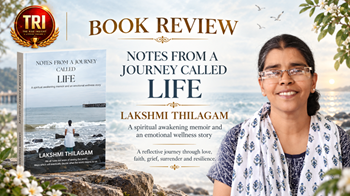
Notes From a Journey Called Life by Lakshmi Thilagam is a warm, honest, and deeply reflective book about relationships, loss, faith, healing, and spiritual growth. It is not written like a heavy philosophy book. Instead, it feels personal, almost like sitting with someone who is calmly sharing the lessons she learned through her own life.
The book is a collection of short reflections and real-life experiences. These are not extraordinary events in the usual sense. In fact, many of them are connected to emotions and situations that almost everyone faces at some point—love, expectations, disappointment, grief, family relationships, faith, anger, regret, and the search for inner peace.
That is what makes this book easy to connect with.
One of the most touching ideas in the book comes from the author’s own reflection that if she had possessed the same wisdom in her younger years, she might have loved her mother more unconditionally, expected less from her husband, and guided her son differently. This thought immediately gives the book a very human quality.
There is no attempt to present a perfect life.In fact, the book quietly asks whether a perfect life even exists. That question stays with the reader because most of us spend a lot of time wishing that some parts of our life had happened differently. We regret certain words. We carry old hurts. We wish people had understood us better. We sometimes feel we could have loved differently, responded differently, or made better decisions.
Lakshmi Thilagam does not try to hide these feelings. Instead, she looks at them with honesty. The book shows that wisdom often comes after experience. Many lessons cannot be learned from advice alone. We understand them only after going through relationships, mistakes, separation, loss, and emotional pain.
This gives the book a gentle and mature tone. Another important part of the book is its focus on relationships. The author speaks about the emotional burden that relationships can sometimes create. Love can bring happiness, but expectations can also bring disappointment. We often want people to behave in the way we think is right. When they do not, pain begins. The book encourages the reader to look at relationships with more understanding. This does not mean accepting everything blindly. Rather, it means learning that every person carries their own experiences, limitations, and emotional struggles. Sometimes peace begins when we reduce unnecessary expectations. This idea may connect strongly with readers who feel tired by family conflicts or emotional misunderstandings. The book also talks about letting go of the past.
This is easier to say than to do. Many people continue to live mentally inside old situations long after those situations have ended. We replay conversations. We remember hurtful words. We think about what should have happened. The author’s reflections encourage the reader to understand that holding on to pain does not change the past. It only keeps the pain active in the present. The idea of letting go in this book is not about forgetting. It is about learning to carry memories without allowing them to control your life.
That is a powerful message. Another major theme is grief. Losing someone we love can change the way we see everything. The world continues, but something inside us may feel frozen. The book speaks to readers who are carrying that kind of loss. Instead of giving easy answers, it looks at grief with sensitivity. It reminds us that pain is part of love. When someone has been deeply important to us, their absence naturally leaves a space. The spiritual side of the book becomes especially meaningful here. Lakshmi Thilagam draws inspiration from Yoga and Saiva Siddhantham to explore questions about life, God, suffering, and surrender. But the book does not feel like a religious lecture. The spiritual ideas come through personal experiences. This makes them easier to understand. The author explores the connection between the individual, the world, and God. She encourages readers to look beyond immediate pain and ask deeper questions.
Why do we suffer?
Why do we become attached?
Why do we expect so much?
What is the meaning of surrender?
What does faith look like when life does not go according to our wishes?
These are difficult questions, and the book does not try to give one simple answer to all of them.Instead, it invites reflection. This is one of the strengths of the book. It does not force the reader to believe something. It gently opens a door and allows the reader to think. Another beautiful theme is kindness. In difficult times, small acts of kindness can have a huge impact. A kind word, a patient conversation, a small gesture of care—these things can stay in someone’s memory for years. The book reminds us that spiritual growth is not only about meditation or prayer. It is also about the way we treat people in everyday life.
This is a very practical message.
The book also explores faith in a very honest way.
Faith is not shown as something that is always strong and clear.
Sometimes faith includes doubt.
Sometimes it includes anger at God.
Sometimes it includes questioning why certain things happened.
This makes the book more believable.
Many people feel guilty when they become angry with God during difficult times. But the book seems to accept that spiritual searching can include confusion.
A real relationship with faith is not always simple.
Sometimes we move closer to understanding only after passing through doubt.
The theme of resilience also appears throughout the book.
Resilience does not mean never feeling pain.
It means continuing even after pain.
The author’s experiences show that difficult events can change a person, but they do not always destroy them. Sometimes they create a deeper understanding of life.
The book is especially meaningful for readers who are emotionally tired.
If someone is struggling with family relationships, old memories, grief, loneliness, spiritual questions, or the feeling that life has become too heavy, this book may feel comforting.
Not because it gives quick solutions, but because it reminds the reader that these feelings are human.
Why Should You Read This Book?
One reason to read Notes From a Journey Called Life is its honesty.
The author writes from personal experience, so the book does not feel artificial.
Another reason is that the language is reflective and easy to connect with.
The book does not require the reader to be highly spiritual or deeply familiar with philosophy.
It can be read by anyone who has gone through emotional struggles.
The short-story and reflection format is also helpful. You do not have to read the book in one sitting. You can read one piece, think about it, and return later.
This gives the book a peaceful reading experience.
The book can also help readers look at ordinary moments differently.
Sometimes we believe that only major events change us.
But life is often shaped by small things—a conversation with a parent, a disagreement with a partner, a moment of kindness, a loss, a memory, or a quiet realization.
The author finds meaning in such moments.
That is one of the most beautiful qualities of the book.
Positive Messages from the Book
Final Thoughts
One strong message is that there is no perfect life.
This itself can be freeing.
We do not need to compare our lives constantly with others.
Another message is that relationships need understanding more than expectations.
The book also reminds us that grief is not weakness.
Faith can survive questions.
Healing takes time.
Letting go does not mean forgetting.
And spiritual growth can begin in the middle of ordinary life.
These ideas make the book encouraging without becoming overly motivational.
Overall, Notes From a Journey Called Life by Lakshmi Thilagam is a sincere and emotionally rich book about life as it really is—not perfect, not always fair, but still meaningful.
It is a book about looking back without becoming trapped in the past.
It is about learning from relationships.
It is about grieving without losing hope.
It is about questioning God and still continuing the search.
Most importantly, it is about understanding that every experience can teach us something if we are willing to look at it deeply.
The book feels less like a set of instructions and more like a companion.
For readers who enjoy personal memoirs, spiritual reflections, emotional wellness books, and stories about healing and self-discovery, this can be a meaningful read.
It leaves behind a simple thought: life may not become perfect, but with awareness, acceptance, faith, and kindness, we may learn to see it differently—and sometimes that change in perspective is where healing begins.