
🌟 Heartfelt Congratulations to Dr. Seema Jain on Winning the TRI Literary Awards Season 3! 🌟
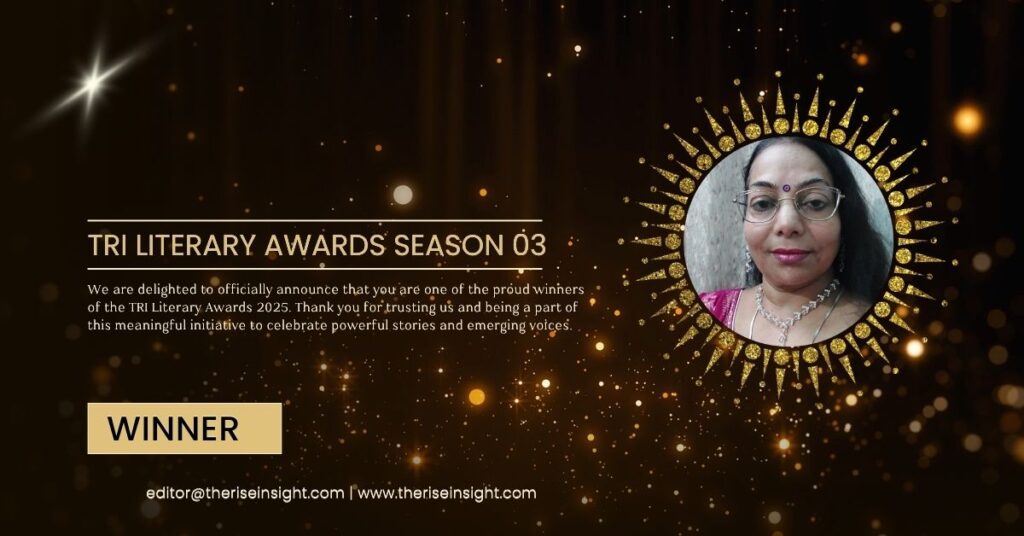
It is with immense joy and admiration that I extend my warmest congratulations to Dr. Seema Jain for her extraordinary achievement—winning the prestigious TRI Literary Awards Season 3 for her soul-stirring poetry collection, Shabdon Mein Saans Leti Striyan. This recognition is not just a personal milestone but a cultural moment that affirms the power of language to illuminate, heal, and connect. In a time when the world is clamoring to be heard, Dr. Jain has chosen to listen—and through her, so do we.
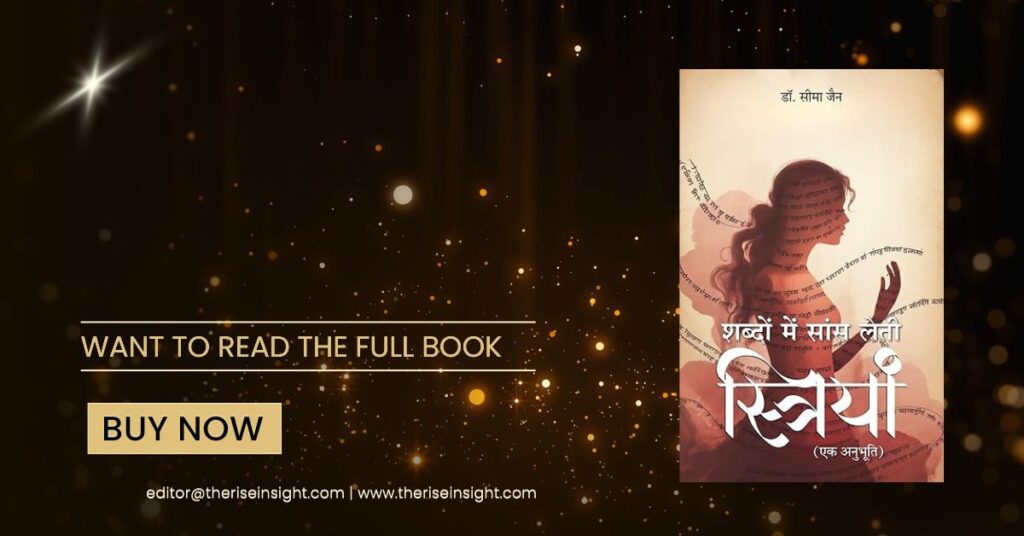
A Review of “Shabdon Mein Saans Leti Striyan”: A Poetic Tapestry of Womanhood in Whispers and Silences
In Shabdon Mein Saans Leti Striyan, Dr. Seema Jain crafts a poignant, luminous, and emotionally layered anthology that transcends the traditional boundaries of poetry. This book is not simply a literary collection—it is a living, breathing archive of the everyday lives of women. With each line, she etches into the heart of the reader the unsaid truths, the quiet courage, and the subtle vibrancy of womanhood that society too often overlooks or suppresses.
The title itself—Shabdon Mein Saans Leti Striyan—is revelatory. It evokes the image of women who live and survive within words—an existence often reduced to the margins, yet resilient, ever-persistent, ever-giving. It is a collection that doesn’t shout or declare war, but rather, gently whispers truths that resound louder than screams.
Thematic Richness and Emotional Integrity
At the thematic core of the collection lies the everyday. But within this everydayness, Jain masterfully exposes the extraordinary. Her poems are not dramatizations of womanhood; rather, they are invitations—to observe, to reflect, and to empathize.
She writes of the woman not as a monolith but as a multitude. She is a mother who forgets herself in nurturing, a daughter absorbing the burdens of tradition, a wife who bears emotional silences, and above all, a self who dares to exist quietly. In one stroke, Jain paints the woman as strength, and in the next, as vulnerability. This duality is the very essence of her poetic power.
What is particularly admirable is her resistance to idealization or rebellion. This is not a feminist manifesto in the loud, conventional sense—it is deeper, subtler, and more enduring. Her poems do not declare a new order; they reveal what has always been but seldom seen. This nuance gives the collection a rare maturity and grace.
Language as Shelter and Sword
Jain’s command over the Hindi language is as intricate as it is evocative. Her words don’t just describe—they evoke textures, voices, glances, and silences. Her verse flows like river water over stones—smooth at times, tremulous at others, but always shaping the reader’s consciousness.
Each poem is carefully constructed, yet feels spontaneous—like the unfiltered breath of a soul that has long remained silent. She doesn’t resort to ornamental language or overused metaphors. Instead, she leans into clarity, rhythm, and emotional precision.
In one poem, the image of a woman tying her hair becomes a metaphor for gathering shattered pieces of self. In another, the act of folding clothes becomes a ritual of folding away dreams. These are not grand gestures, yet they carry the weight of generations.
Women as a Point of View
Perhaps the most striking conceptual contribution of this book is the reimagining of the woman not merely as a subject but as a point of view. This shift challenges centuries of literary objectification. The woman here is not seen through the male gaze, nor even through the lens of societal expectation—she is the seer.
Through her lens, we are offered an alternative epistemology—a way of knowing and feeling the world that is grounded in relationality, care, and silent endurance. This is particularly powerful in the current era, where loudness is often mistaken for strength. Jain reclaims silence as resilience.
Listening as Literary Praxis
The book’s introduction makes a subtle yet powerful promise: “It is only an attempt to understand, listen and walk with women.” This is not a casual statement. It is a political, emotional, and literary stance.
Dr. Jain’s poetry insists on listening—a quality so rare in our fragmented, performative times. She invites the reader not to dissect or analyze but to accompany—to sit beside the poem like one would beside a weary friend.
And in this act of poetic companionship, a radical transformation occurs. We don’t just read about the woman. We begin to hear her. In her tired sighs, in her hopeful glances, in her worn feet and unfed dreams.
Socio-Cultural Relevance
This book arrives at a critical moment. As gender discourse grows increasingly polarized, there is a need for voices that navigate complexity with empathy. Dr. Seema Jain’s work neither vilifies nor glorifies. It simply observes with unflinching honesty.
In a society where women are still fighting for space, safety, and sovereignty, Shabdon Mein Saans Leti Striyan does something invaluable: it holds space. It creates a literary shelter for the unspeakable. And in doing so, it becomes both archive and altar.
Authorial Integrity and Vision
Dr. Jain’s literary gravitas is evident not only in this collection but in her larger body of work. With national and international accolades such as the London Book of World Records 2024, Women Icon Award 2025, and National Divya Pratibha Samman 2025, she has firmly established herself as a force in contemporary Hindi literature.
What sets her apart, however, is not just her recognition but her intention. Even as Head of the Hindi Department at Deen Dayal Upadhyay Government PG College, Prayagraj, her academic and literary pursuits are interwoven with a deep commitment to social responsibility—especially towards marginalized children. This authenticity enriches her poetry. It is not birthed in isolation but in solidarity.
Here’s feedback from each of the nine reviewers after reading Shabdon Mein Saans Leti Striyan by Dr. Seema Jain:
1. Prashant Sahu:
“Shabdon Mein Saans Leti Striyan is not just a book—it’s a mirror held up to society. Dr. Seema Jain’s poetry gently unveils the silences of women with such emotional authenticity that I found myself pausing often, reflecting deeply. Her words are like soft rain on parched earth, awakening empathy and awareness. This collection has changed the way I observe the women around me.”
2. Sameer Gudhate:
“Reading this collection was a soul-touching experience. Dr. Jain has an uncanny ability to weave emotions into words so delicately that each poem becomes a complete story. What moved me the most was how she celebrates the unseen aspects of women’s lives—not with loud slogans, but with quiet strength. It’s a subtle, graceful revolution in verse.”
3. Apeksha Gupta:
“This book felt like coming home. As a woman, I saw myself, my mother, and every woman I know in these poems. Dr. Seema Jain’s portrayal of womanhood is not just relatable, it’s healing. Her poetry acknowledges the small heartbreaks and invisible sacrifices that often go unnoticed. It felt like someone finally put my unspoken feelings into words.”
4. Akansha Sinha:
“Shabdon Mein Saans Leti Striyan is a powerful reminder that poetry doesn’t need to shout to make an impact. Dr. Jain’s language is soft, yet it leaves a lasting echo. I was particularly struck by the way she turned ordinary domestic acts into metaphors of resilience. Her writing is quiet, reflective, and incredibly powerful.”
5. Glenville Asbhy:
“As someone deeply involved in literature and culture, I found this collection remarkably profound. Dr. Jain’s voice is lyrical, deeply rooted in Indian ethos, and yet universally resonant. Her work transcends linguistic boundaries and offers a global reflection on the feminine experience. A poetic triumph that deserves international recognition.”
6. Pooja Sahu:
“Each poem in this collection made me pause and breathe. The way Dr. Seema Jain touches upon everyday realities of women with so much sensitivity and compassion brought tears to my eyes. This is not just poetry—it is emotional truth wrapped in grace. I recommend this book to anyone who truly wants to understand a woman’s soul.”
7. Versha Singh:
“This book is like listening to the forgotten music of women’s hearts. Dr. Jain writes with clarity, depth, and a rare tenderness. I was amazed by how she captured the unexpressed pain and quiet strength of women without glorifying or victimizing them. Every poem felt personal, real, and powerfully reflective.”
8. Shivangi Yadav:
“I felt a deep sense of connection with this collection. Dr. Seema Jain has given voice to emotions we often bury due to societal norms. Her poems validate the inner lives of women and honor their resilience in the most beautiful way. I will be revisiting this book many times over—it’s not just poetry, it’s therapy.”
9. Kavita Kaushik:
“Dr. Jain has done something extraordinary—she has translated silence into verse. Her poems are intimate yet universal, simple yet profound. Shabdon Mein Saans Leti Striyan is a rare gem in contemporary Hindi literature that not only uplifts the female voice but also calls for a more empathetic society. A must-read for all genders.”
Conclusion: An Incomplete Collection That Completes Us
In the most haunting and beautiful part of the book’s description, Jain writes, “If while reading these poems, you hear your mother’s voice, your daughter’s smile, your wife’s tiredness or the forgotten woman within you, then consider that this collection is not incomplete.”
And indeed, this is the book’s greatest triumph. Its incompleteness is its invitation. It doesn’t seek to finish the story of womanhood. It seeks to awaken it—in the reader, in the society, and in the forgotten corners of the self.
Shabdon Mein Saans Leti Striyan is not a collection of poems. It is a conversation—long overdue, quietly courageous, and deeply necessary.
🌸 Once again, heartfelt congratulations to Dr. Seema Jain for gifting us this literary gem and for her well-deserved recognition at the TRI Literary Awards Season 3. 🌸
May her words continue to breathe, break silences, and build bridges.