
Pickled: When Love Becomes the Invisible Work of a Lifetime
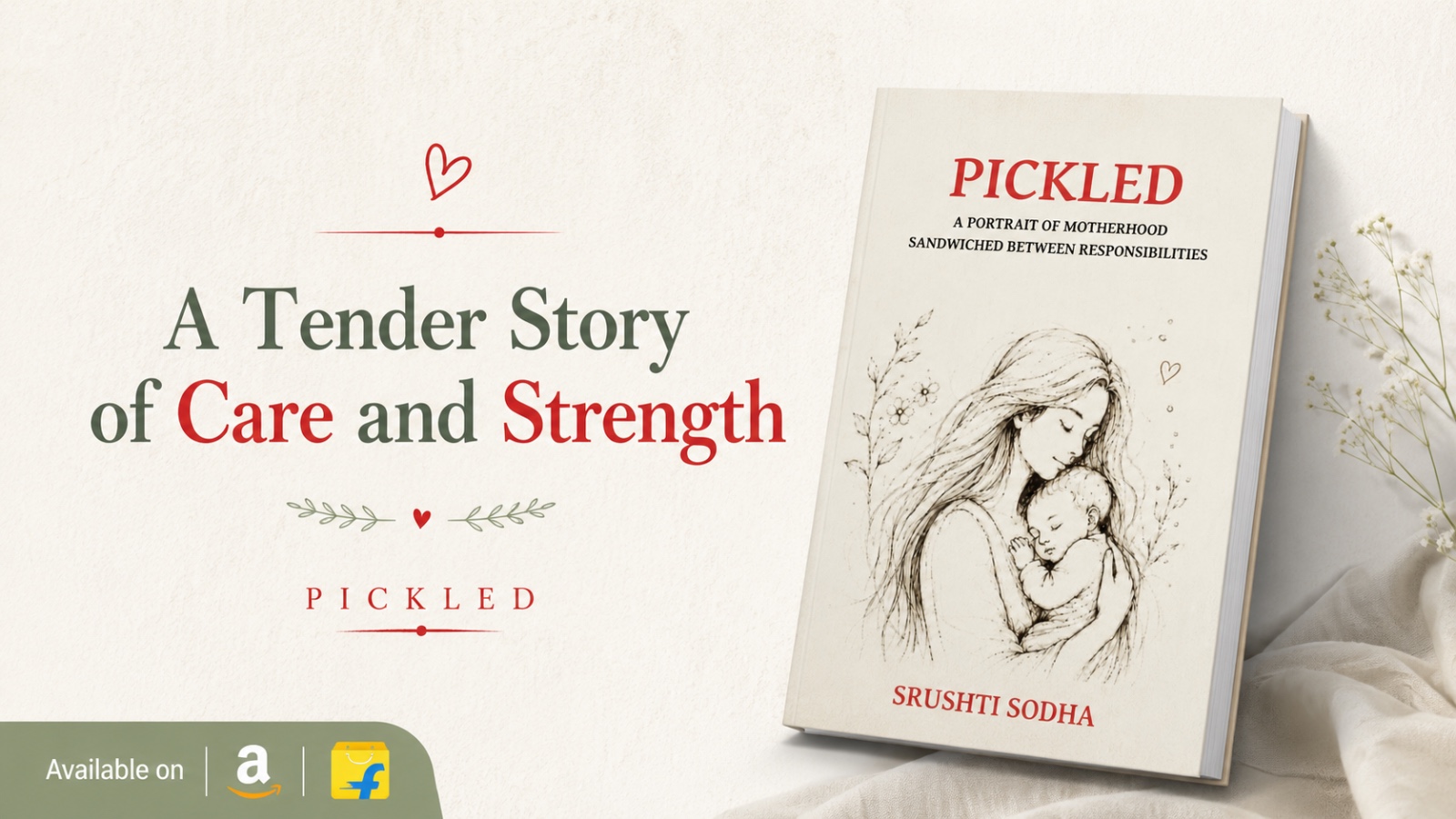
Book: Pickled: A Portrait of Motherhood Sandwiched Between Responsibilities
Author: Srushti Sodha
There are books about motherhood that celebrate tenderness, books that discuss parenting, and books that document family life. Srushti Sodha’s Pickled: A Portrait of Motherhood Sandwiched Between Responsibilities does something more intimate. It looks closely at the kind of love that becomes so ordinary within a household that people stop noticing how much effort it requires. The mother remembers who has eaten, who is worried, who needs a phone call, whose medicine is running out, which festival is approaching, and which child needs reassurance even after becoming an adult. None of these acts may look dramatic on their own. Together, they form an invisible system that keeps generations connected.
That is why Pickled feels important. It recognizes a generation of women who were expected to care in every direction at once. They raised children while remaining daughters to aging parents. They learned the moods of husbands, the needs of extended families, the rhythms of kitchens, the pressures of social expectation, and the endless small negotiations required to keep a home emotionally functional. The phrase “sandwiched between responsibilities” is not simply descriptive. It captures a whole way of living in which a woman’s identity can become compressed between what others need from her.
The title gives the book its most memorable metaphor. To be “pickled” is to be preserved, soaked, seasoned, and changed over time. In the book, this becomes a way of thinking about women who were not necessarily destroyed by responsibility, but were transformed by it. They learned patience because patience was required. They developed emotional intelligence because someone had to understand the family without being told. They became strong because there was rarely time to ask whether they wanted strength. Like something left to mature slowly, their personalities absorbed the flavors of duty, resilience, affection, compromise, humor, irritation, and endurance.
What makes this metaphor work is that the book does not treat sacrifice as a one-dimensional tragedy. There is warmth in these lives. There is pride, competence, wit, tradition, and genuine love. A mother packing homemade snacks for a child living thousands of miles away may be tired, but she may also feel joy in still having a way to care. A mother who urges her daughters to “fly higher” than she did may experience the loneliness of distance, but she also sees their independence as evidence that her work mattered. Pickled respects this complexity instead of forcing motherhood into the simple categories of victimhood or sainthood.
One of the strongest aspects of the book is its attention to domestic detail. Pressure cookers, tea, phone calls, parcels, family meals, temple bells, newspaper pages, small-town rhythms, and the predictable language of concern make the emotional world believable. These details are not decorative. They reveal how care is actually delivered. Love is often not announced. It arrives as food, reminders, instructions, waiting, planning, and the ability to anticipate a need before it is spoken. In many families, “Did you eat?” carries more emotional weight than a grand declaration of affection.
The book becomes especially moving because it is written from the perspective of a daughter approaching motherhood herself. Pregnancy changes the way she looks backward. What once seemed normal begins to look astonishing. The mother who always seemed available was not magically free of exhaustion. She repeatedly made herself available. The home that felt secure did not become secure by accident. Someone built that feeling through thousands of quiet choices. The daughter begins to understand that the comfort she received was the result of effort she could not recognize as a child.
This shift in perspective is one of the book’s greatest strengths because it will feel familiar to many adult children. We often understand our parents only after reaching the ages or responsibilities they once carried. The same decisions that seemed strict begin to reveal fear. The same routines that felt ordinary reveal discipline. The same repeated questions reveal attachment. Pickled captures that late-arriving recognition with softness rather than guilt. It asks readers to notice more carefully, not to punish themselves for not having noticed earlier.
The book also raises a difficult but necessary question: must love always require self-erasure? For many women, especially in older generations, motherhood was considered complete only when the mother placed herself last. Dreams could be postponed. Careers could be limited. Personal space could disappear. Exhaustion could become proof of devotion. Pickled does not mock that model or dismiss the women who lived by it. Instead, it asks whether the next generation can preserve the depth of that love without reproducing all of its costs.
That question gives the book a contemporary urgency. Many women today are still negotiating multiple identities: daughter, mother, partner, professional, caregiver, friend, and individual. They may have more language for boundaries and self-care than previous generations did, but the emotional expectations have not disappeared. The desire to be present for everyone can still become overwhelming. Pickled creates a bridge between generations by suggesting that change does not have to mean rejection. A daughter can deeply honor her mother’s sacrifices while choosing a different definition of motherhood for herself.
The book is also valuable because it expands our idea of power. Power is usually imagined as loud, visible, and commanding. The mothers in Pickled often exercise another kind of influence. They create stability without constantly announcing their authority. They build trust so gradually that it feels natural. Their guidance may sound like advice rather than instruction, and their leadership may appear as warmth. Yet those quiet choices shape the people their children become. The book’s insight is simple but powerful: influence does not have to be dramatic to be permanent.
Another beautiful idea in the book is the paradox of raising children to leave. A mother spends years becoming the center of a child’s world, only to hope that the child will eventually be strong enough to build a world elsewhere. Success therefore contains loss. The independent daughter is both a source of pride and an empty chair. The child studying or working abroad is proof that the mother’s sacrifices opened doors, yet distance creates a new kind of longing. The image of sending homemade snacks across continents captures this contradiction perfectly: the child has flown, but care continues to travel after them.
Humor keeps the book from becoming heavy. The idea of solving uncertainty with chai, the familiar theatrics of family hunger, the collision of old domestic habits with smartphones and AI, and the affectionate exaggeration of family life all make the narrative breathe. Motherhood is not only pain or sacrifice. It is also absurd, repetitive, funny, frustrating, delicious, loud, and deeply human. The humor respects the women being described because it allows them to be whole people rather than symbols.
Why should readers pick up Pickled? Because many of us have been shaped by someone whose work we did not fully see. Because the book offers language for emotional labor that is easy to overlook. Because it encourages daughters and sons to view their mothers as people with histories, ambitions, disappointments, and identities beyond motherhood. And because it invites current and future mothers to imagine a form of care that remains generous without demanding disappearance.
Pickled is not a manual that tells women how to mother. It is not a memoir in the narrow sense of recounting one life as exceptional. It is closer to recognition. Readers enter through one family’s textures and find patterns that may belong to their own. A kitchen becomes familiar. A phrase sounds like something their mother says. A packed box of food suddenly carries the emotional meaning it always had. That is the quiet achievement of the book.
Ultimately, Pickled reminds us that the people who hold families together are often the least likely to describe what they do as extraordinary. They simply continue. They adjust. They remember. They endure. Sodha’s book asks us to look again at that ordinary persistence and see the architecture hidden inside it. It honors the women who gave deeply, while making space for the possibility that the next generation can love just as deeply and still remain visible to themselves.
Amazon India
Book Link: https://www.amazon.in/dp/B0HBD6TR78
Amazon USA
https://www.amazon.com/dp/B0H8WXNCPG