
From the Big Bang to the Human Mind: Why An Observer’s Guide to Reality Is Worth Reading
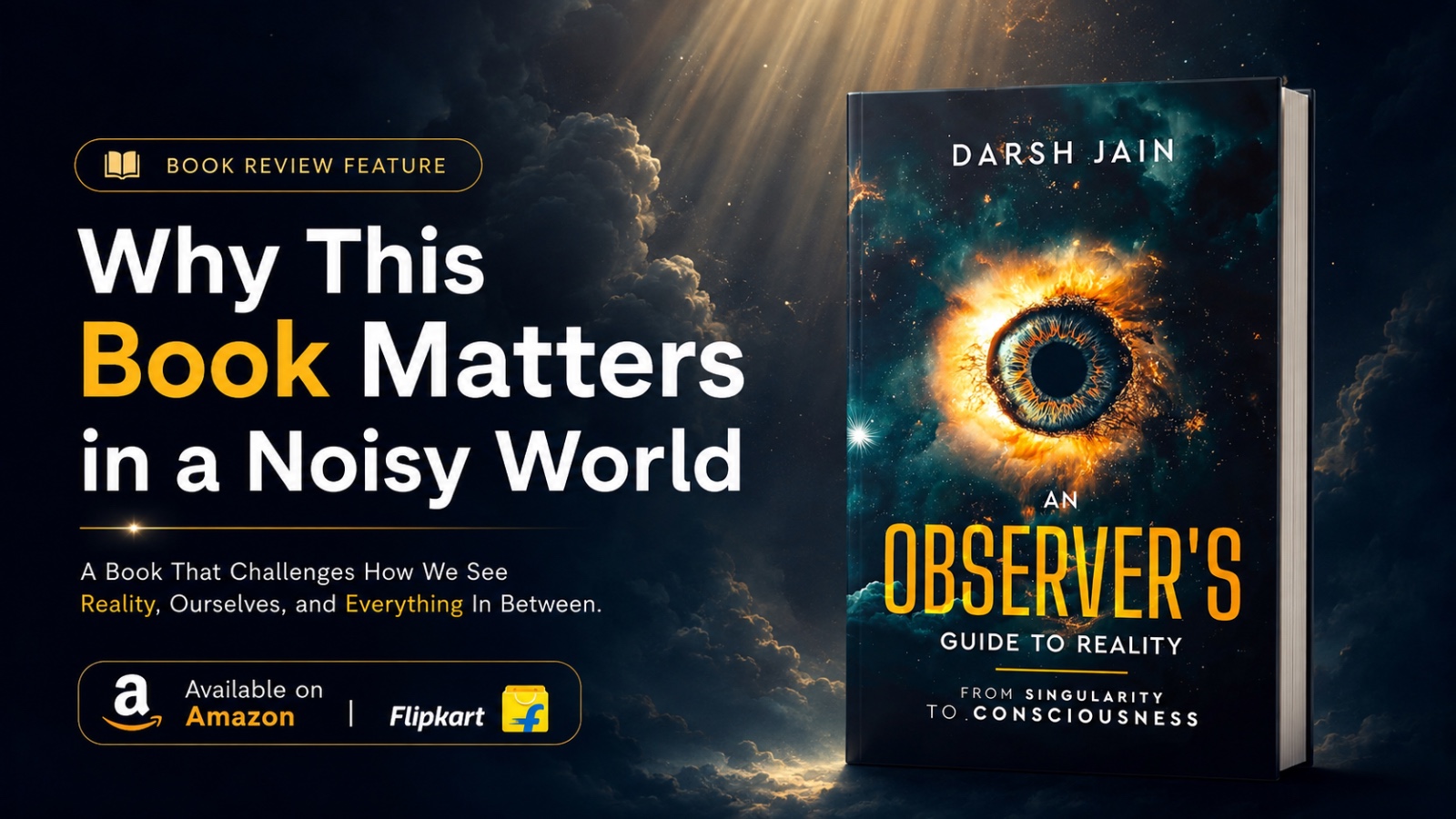
Some books begin with a person, a place, or a problem. An Observer’s Guide to Reality begins with almost everything. Darsh Jain starts with the birth of the universe and then slowly brings the reader closer and closer to the present moment: from the Big Bang to particles, from particles to atoms, from atoms to the Earth, from the Earth to life, from life to evolution, and from evolution to the strange human ability to ask, “Who am I?” That large movement is the first reason this book matters. It does not treat cosmology, biology, anthropology, history, and philosophy as separate islands. It tries to show them as parts of one continuous story. The reader is not simply learning facts about stars or genes. The reader is being shown how the same universe that formed galaxies eventually produced a living brain capable of looking back at the universe and wondering what it all means.
The book’s ten-chapter structure makes this huge journey surprisingly easy to follow. The opening chapters discuss the beginning of the cosmos, the planet of life, and the evolution of living organisms. The middle chapters move through primates, the origins of the genus Homo, and Homo sapiens. The later chapters become more psychological and philosophical: The Human Matrix, The Meaning of Meaninglessness, The Illusion of Self, and finally Observe the Observer. This progression is important because it gives the book a strong sense of direction. The author does not suddenly jump from quantum particles to consciousness. He builds a bridge. By the time the reader reaches questions about identity, morality, belief, and free will, the earlier chapters have already established the biological and evolutionary background needed to understand why those questions are being asked.
One of the book’s strongest qualities is its insistence that science should be understandable to ordinary readers. Jain repeatedly writes as a curious observer rather than as someone trying to impress the reader with technical authority. Difficult ideas such as singularity, quantum mechanics, atomic structure, energy, thermodynamics, natural selection, genetics, neural activity, and the prefrontal cortex are explained through examples drawn from everyday experience. The goal is not to make every reader a specialist. The goal is to make the reader feel comfortable enough to ask questions. That choice matters because many people lose interest in science during school, where it can become a list of definitions, formulas, and examination answers. This book tries to restore the wonder that often existed before science became a subject to memorize.
The transition from physical reality to biological life is also one of the book’s most satisfying features. Instead of presenting life as a sudden mystery disconnected from matter, the book follows energy, atoms, molecules, cells, genes, and environmental pressures. It explains evolution not as a ladder with humans waiting at the top, but as an enormous process of variation, survival, adaptation, and chance. Dinosaurs, mammals, primates, hominins, Neanderthals, and Homo sapiens appear not as decorative history but as parts of the reader’s own background. This creates a useful sense of humility. Human beings are extraordinary in many ways, but the book continually reminds us that our bodies, instincts, fears, emotions, and social behaviours carry deep evolutionary histories. Understanding those histories can change how we see ourselves.
The chapter on Homo sapiens expands that idea by asking what truly made our species so powerful. The answer is not simply intelligence. The book gives special importance to cooperation, communication, culture, and imagination. Human beings survive because knowledge can move from one mind to another. A tool discovered by one person can be copied by many. A ritual can travel across generations. A story can unite strangers. This prepares the reader for one of the book’s most memorable ideas: imagined orders. Money, nations, laws, status, sacred symbols, and social identities may not exist in nature in the same way a mountain or river exists, yet they become powerful because large groups of people believe in them together. The point is not that such things are useless. The point is that their power comes from collective agreement.
This is where the book becomes more than a popular-science overview. It turns into a study of the human world. A piece of paper can become money. Cloth can become a flag. Lines on a map can become national borders. Words written in a constitution can shape the lives of millions. The physical materials are ordinary, but the meanings placed upon them are enormous. Jain asks the reader to notice the difference between material reality and the stories humans build around it. That distinction is important because it helps explain both human cooperation and human conflict. The same imagination that allows strangers to build cities, institutions, and systems can also divide people into opposing identities and make them defend inherited beliefs without examining where those beliefs came from.
The later chapters become even more personal. After examining how humans create shared realities, the book asks where meaning itself comes from. If the universe does not provide a clear purpose, does life become empty? Jain’s answer is not to hand the reader a new belief system. Instead, he explores the possibility that meaning is something the human brain makes. We feel love, grief, ambition, wonder, belonging, and purpose because our biology and experience allow these states to exist. This can sound unsettling at first, especially for readers who are used to thinking of meaning as something given from outside. Yet the book tries to show that a created meaning is not automatically a false or worthless meaning. A song can move us even though sound is vibration. Love can matter deeply even when hormones and neural circuits are involved.
The discussion of the self and free will adds another layer. The book asks whether the “I” we feel at the centre of our lives is a fixed, independent controller or a story created by the brain from memory, sensation, emotion, language, and neural activity. It considers how decisions emerge from biological processes and how the feeling of authorship may come after many causes have already shaped our response. Readers do not have to agree with every conclusion to benefit from this section. Its value lies in how strongly it invites self-examination. If our reactions are influenced by genetics, childhood, culture, language, hormones, and past experience, then judging ourselves and others becomes more complicated. We may begin to ask not only what someone did, but what chain of causes helped produce that action.
The final chapter, Observe the Observer, gives the entire book an emotional purpose. After hundreds of pages looking outward at the universe and backward at evolution, the gaze turns inward. The reader is invited to watch thoughts, anger, fear, joy, jealousy, identity, and belief as they arise. The book suggests that understanding can create a small but meaningful space between feeling and reaction. That idea makes the scientific journey practical. Knowing about the brain is not presented merely as information. It becomes a way of noticing how the mind works in daily life. A person cut off in traffic, for example, can observe the anger forming instead of immediately becoming the anger. A person can notice how memory changes perception or how identity shapes judgment.
Why should readers choose this book? Because it offers a rare combination of scale and intimacy. It asks the largest questions possible—where the universe came from, how life began, why humans became different, what consciousness is—and then returns those questions to the reader’s own mind. It is especially suitable for people who enjoy science but do not want a textbook, people who enjoy philosophy but want evidence-based discussion, and younger readers who are curious about existence yet feel intimidated by technical language. It can also be valuable for readers who loved the broad historical thinking of books such as Sapiens but want a more direct movement into biology, neuroscience, meaning, and the self.
The book is long and asks for patience. That is not a weakness so much as part of its design. It wants the reader to travel through billions of years before arriving at the present second. Some ideas will challenge inherited beliefs, especially around divine purpose, the soul, free will, and morality. Readers who enter expecting confirmation may feel uncomfortable. Readers who enter willing to question may find that discomfort useful. The best way to read An Observer’s Guide to Reality is slowly, with pauses. It is a book that wants to be discussed, argued with, and revisited. Its greatest success is not that it provides a final answer to reality, but that it teaches the reader to look again—with more curiosity, more humility, and a stronger desire to understand before believing.
Why readers should consider this book
- It connects cosmology, evolution, human history, society, and consciousness in one continuous narrative.
- It explains difficult ideas without requiring a specialist science background.
- It turns the reader from a passive learner into an active observer of beliefs, behaviour, and perception.
Book link: https://www.amazon.in/dp/934747276X