
An Interview with Anand Lakshmivarahan R. and Neha Taneja, Authors of Bytes and Breaths: The Vitasphere Quest
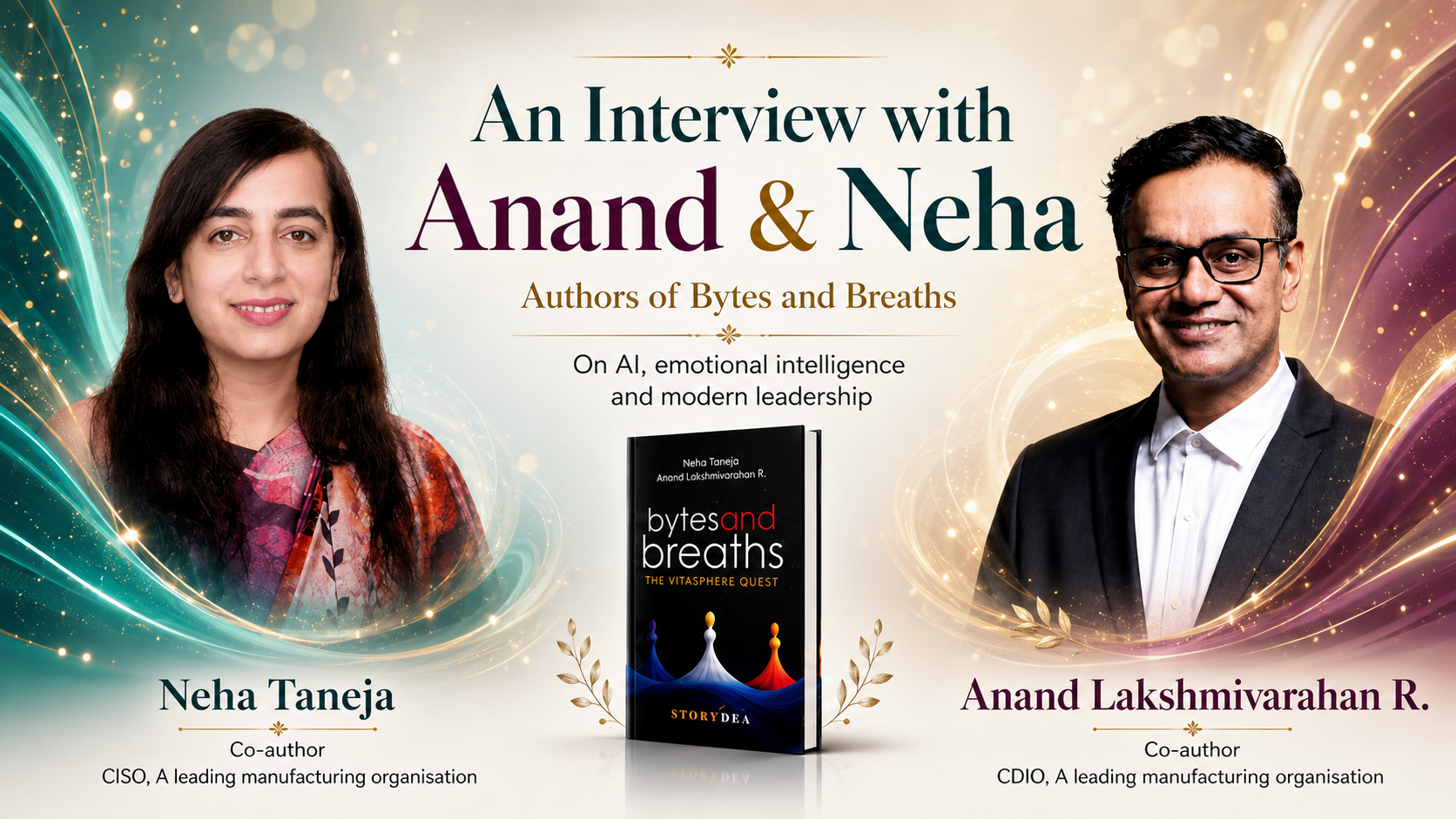
The authors discuss artificial intelligence, emotional intelligence, leadership, storytelling, and the future of human-centred innovation.
Bytes and Breaths: The Vitasphere Quest is a contemporary leadership parable exploring the powerful intersection of Artificial Intelligence and Emotional Intelligence.
Through the journey of Zara, a founder navigating professional pressure, uncertainty, loneliness, and personal transformation, the book examines an increasingly important idea: the future of leadership will not be shaped by technology alone. It will depend equally on empathy, self-awareness, emotional resilience, sound judgement, and meaningful human connection.
In this insightful conversation, authors Anand Lakshmivarahan R. and Neha Taneja discuss the inspiration behind the book, their collaborative writing process, the creation of its characters, and the role AI could play in developing emotionally intelligent leaders.
Q1. What was the original spark that led you to write Bytes and Breaths: The Vitasphere Questtogether?
We would trace it back to something we had each noticed independently during our corporate journeys: transformation programmes rarely stall because of technology alone. More often, they struggle because of what is happening within the people responsible for leading them.
A casual conversation between us revealed how strongly we both felt about this subject. Within a few exchanges, we knew we wanted to create something that combined the complexity of the systems we had built with the rawer and less frequently discussed reality of how leaders feel while working under pressure.
The book grew from that intersection between technological transformation and human emotion.
Q2. You both come from technology backgrounds, yet you chose fiction instead of writing a conventional business or self-help book. Why did the parable format feel right?
A conventional business book would have allowed us to hide behind frameworks, models, and recommendations. Fiction does not offer that protection.
When you place a founder in a room after losing a co-founder, or show her looking at a dashboard that indicates her company is shrinking, you cannot reduce the emotional reality of that experience to three bullet points and a management model.
The parable format required us to remain inside the discomfort rather than analyse it from a safe distance. That is probably why readers tell us they recognise themselves in Zara instead of simply agreeing with the advice presented in the book.
Q3. The book suggests that emotional intelligence may be even more important than technical capability in modern leadership. Where did that conviction come from?
The idea initially came from Neha, almost as an aside, during one of our earliest conversations about the direction of the book. The moment she expressed it, the entire project was reframed.
We had both spent years in professional environments where even the strongest technology strategies failed because the emotional undercurrents in the room were misunderstood or ignored.
Once we clearly identified that idea, emotional intelligence stopped being a secondary theme. It became the central spine supporting the entire narrative.
Q4. What was it like translating complex ideas about AI, technology, and data systems into narrative fiction?
It was both challenging and rewarding.
It was challenging because data platforms and AI architecture do not naturally lend themselves to scenes and dialogue. A character cannot explain a system design for several pages while the writer expects the reader to remain emotionally invested.
However, the process became rewarding once we found the right balance. Technology stopped being the subject of the book and became part of its texture instead.
It appears in the way Aria, the AI coach, listens to Zara, the way a board meeting unfolds, and the way a dashboard communicates only one part of a much larger story.
The writing process taught us to trust restraint rather than explanation.
Q5. Zara is a founder dealing with external market pressure and internal emotional conflict. How did you develop her character?
Zara is not based on any single individual. She is a composite of several leaders we have observed closely, including, if we are being honest, versions of ourselves during difficult periods.
We developed her character by asking what could truly break someone who appeared completely in control from the outside. We then worked backwards from that point.
Her professional competence was never in doubt. What interested us was the gap between how capable she appeared and how invisible her internal struggle remained to everyone around her—including Zara herself—for a significant part of the story.
Q6. Aria is a compelling fictional AI construct. How did you design her, and what ethical boundaries did you establish for her role?
Aria had to earn her place in the story. An AI character can easily become either a gimmick or an unrealistic solution to every problem.
We designed her around the idea of helping Zara observe and understand her own reactions rather than providing ready-made answers. Aria is closer to a mirror than an oracle.
The ethical line we maintained throughout the book was clear: Aria could strengthen Zara’s judgement, but she could never replace it.
Any version of Aria that began making decisions on Zara’s behalf would have undermined the book’s entire argument about human responsibility, self-awareness, and leadership.
Q7. The friendship between Zara and Hana feels deeply authentic. How important was their relationship to the book’s larger message about trust and collaboration?
It was enormously important.
Leadership stories often isolate the protagonist, creating the impression that personal growth happens in a vacuum. Zara and Hana’s friendship challenges that idea.
Real trust—the kind that allows someone to say something uncomfortable without destroying the relationship—is one of the few forces powerful enough to interrupt a leader’s descent into isolation and self-protection.
We wanted at least one relationship in the book that was not transactional. Their connection is not based on the dynamic between a founder and a coach or a mentor and a mentee. They are simply two people who continue to show up for each other.
Q8. What did your collaborative writing process look like? How did you maintain a unified voice while preserving your individual perspectives?
We divided the chapters between us early in the process and maintained that structure throughout the draft.
However, the real work happened between the chapters—in long telephone conversations, detailed message threads, and honest discussions in which we challenged scenes written by the other person.
The unified voice did not come from trying to make our individual writing styles identical. It came from agreeing strongly on what each scene needed to accomplish emotionally before either of us began writing it.
Once the emotional intention of a scene was clear, the prose usually developed its own consistency.
Q9. The book argues that the future belongs to leaders who can integrate Artificial Intelligence with Emotional Intelligence. What does that integration look like in practice?
In practical terms, it means building intentional pauses into the working day.
This could involve a structured debrief, a regular journaling practice, or even a five-minute emotional check-in before a difficult conversation. Reflection should not be treated as something that happens only during a crisis.
Very few organisations currently do this well. Most workplaces continue to reward speed, confidence, and certainty while overlooking quieter qualities such as awareness, empathy, and considered judgement.
We are beginning to see some leaders experiment with a more balanced approach. Often, these are people who have personally experienced the consequences of ignoring the human cost of moving too quickly. However, this is still far from being the norm.
Q10. Can emotional intelligence genuinely be learned? What role might AI play in that process?
Our research and personal experiences point towards the same conclusion: emotional intelligence can certainly be learned, but it is rarely developed through information alone.
It grows through repeated, low-risk practice—recognising a reaction, naming the emotion behind it, understanding its source, and choosing a different response when a similar situation arises again.
This is where an AI tool like Aria could play a meaningful role.
It would not teach emotional intelligence merely as a concept. Instead, it could create safe and repeatable opportunities to practise it. This type of rehearsal may be especially valuable for busy leaders who cannot always reach a human coach at the precise moment they need support.
Q11. India’s startup ecosystem is an intense environment for leadership. Did you consciously choose this setting to speak specifically to Indian founders and managers?
Yes, the setting was deliberate.
India’s startup ecosystem compresses several forms of pressure into one environment: speed, scrutiny, capital, competition, ambition, and ego. This concentration makes underlying leadership patterns easier to observe.
However, the emotional experiences Zara goes through are not limited to startups. Isolation, fear of admitting uncertainty, and the gradual erosion of personal wellbeing under prolonged pressure can appear in a century-old boardroom just as easily as in a five-year-old company.
The setting is specific, but the emotional resonance is universal.
Q12. One of the book’s quieter themes is the loneliness of leadership. How could AI tools such as Aria address this in the real world?
Loneliness at the top is real, but it remains under-discussed because acknowledging it can feel like admitting weakness.
A tool like Aria could offer two things that are often difficult for leaders to find at the exact moment they need them: availability and freedom from judgement.
A leader may experience a moment of doubt at two o’clock in the morning that they would never discuss with a board member, colleague, or even a close friend. However, they might be willing to spend ten minutes exploring that uncertainty with a system that listens without judging or keeping score.
Such a tool should never replace human connection, and it should not attempt to do so. However, it could support leaders during the gaps between meaningful human conversations.
There is also value in simply expressing a concern aloud without having it interpreted as indecision. Sometimes, articulating the worry completes half the work required to understand it. A system like Aria could hold that space consistently.
Q13. Was there a moment during the writing process when the collaboration genuinely surprised you?
Yes. Some of our most valuable moments did not occur while drafting the chapters. They happened in the comment threads where we reviewed and challenged each other’s work.
Chapter Nine is a good example.
The chapter was originally set on Diwali night, with the founders exchanging ideas over samosas and chai. The discussion that followed between us became almost generational.
One of us felt that this was exactly how a founder team would relax together. The other argued that a startup team in its late twenties and thirties would be more likely to gather at someone’s apartment with cocktails, music, and playlists.
After several rounds of good-natured debate, we arrived at the fairy-lit apartment gathering that now opens the chapter. The characters hold gin and cocktails as the mood gradually changes when troubling news begins to arrive.
That exchange pushed both of us to write more honestly about the generation being represented rather than relying on the social environment with which we had personally grown up.
Q14. Looking back now that the book has been published, is there anything you wish you had explored more deeply?
With some distance, we might have introduced the seriousness of Zara’s physical decline earlier rather than developing it so gradually.
Business readers, in particular, can sometimes skim over sections that do not appear directly connected to strategy. Bringing her physical deterioration into focus earlier may have reinforced how deeply professional pressure affects the body.
We have also heard from readers who wanted to understand more about Ishaan’s perspective after his departure. In hindsight, there was a richer story there that we explored only partially.
We view these as honest gaps rather than regrets. They are the kind of things writers often recognise only after a book has entered the world and readers begin responding to it.
Q15. What do you hope readers take away from Bytes and Breaths: The Vitasphere Quest?
We would be satisfied if readers closed the book and asked themselves one slightly uncomfortable question:
What am I refusing to let myself feel because acknowledging it would be inconvenient to my role?
The unicorn status, funding rounds, and professional milestones in Zara’s story were never intended to be the central point. They are almost incidental compared with the internal transformation she experiences.
If even a few readers become willing to sit with their own discomfort rather than constantly managing their way around it, the book will have achieved what we hoped it would.
For readers who would like to continue exploring these questions beyond the book, we have created bytesnbreaths.com as a space for ongoing conversations about leadership, technology, and emotional intelligence.
About the Authors
Neha Taneja
Neha Taneja is an accomplished cybersecurity executive with more than 20 years of experience strengthening digital security for Fortune 500 companies.
With an academic foundation in computer science, an MBA, and advanced cybersecurity certifications, she combines technical expertise with strategic thinking and leadership insight.
A passionate reader, Neha draws inspiration from diverse literary works and applies their lessons to real-world leadership challenges. In Bytes and Breaths, she explores the importance of emotionally intelligent leadership in the digital age and reflects her belief that technological progress must remain balanced with human-centred values.
She is also a strong advocate for diversity in technology and is committed to mentoring the next generation of leaders.
Anand Lakshmivarahan R.
Anand Lakshmivarahan R. is a seasoned technology executive with more than two decades of experience leading digital transformation initiatives for Fortune 500 companies.
With a background in electronics and telecommunications, along with an MBA, he brings a multidisciplinary perspective spanning software development, product strategy, consulting, and business innovation.
In Bytes and Breaths, Anand examines how emotional intelligence can help leaders build resilient teams, strengthen workplace relationships, and achieve sustainable business success.
An active voice in the technology community, he continues to share his experience through industry publications, thought-leadership articles, and his blog.
Buy the Book
Bytes and Breaths: The Vitasphere Quest is available for purchase on Amazon India.