
Book Review: The Bone Dice: A Curse of Dark Shadows by Prateek
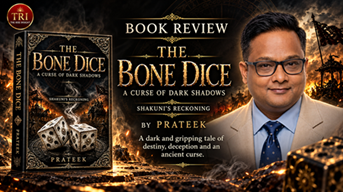
The Bone Dice: A Curse of Dark Shadows by Prateek is a dark, intense, and imaginative retelling inspired by the world of the Mahabharata. Instead of telling the story from the side of the well-known heroes, the book turns toward one of the most feared and misunderstood figures—Shakuni. It asks the reader to look at him not only as a villain, but as a brother, a survivor, a grieving prince, and finally, a man who turns his pain into a long and dangerous plan.
The strongest idea in the book is right there in the beginning: before Shakuni became the mastermind people remember, he was simply a brother who loved his sister.
That one thought changes the way the reader enters the story.
Most people know Shakuni as the man connected with manipulation, dice, deceit, and the destruction that eventually leads to the great war. But this book tries to go behind that image. It asks what kind of pain could create such a person. What kind of loss could turn intelligence into revenge? What happens when grief is allowed to grow for years without healing?
This makes the story emotionally interesting from the very start.
The book presents a brutal past where Shakuni’s kingdom is destroyed, his family is killed, and one hundred men are left to starve beneath Hastinapur. Only Shakuni survives. The reason is almost cruel in its own way—his sharp mind makes him too useful to kill.
From here, the story becomes more than a tale of survival. It becomes a story of memory.Shakuni does not forget.He does not forgive. And most importantly, he does not rush. This patience becomes one of the most powerful parts of his character. The image of Shakuni carving dice from the knuckle bones of his dead father is especially dark and memorable. The dice are not just gaming pieces. They carry grief, anger, family, death, and revenge inside them. Every throw becomes connected to the past. This gives the title The Bone Dice a strong meaning. The dice are not only tools in a game. They are symbols. They represent a promise that Shakuni refuses to let die. Another interesting part of the book is that Shakuni chooses not to attack with a sword. He chooses something far more dangerous—patience, intelligence, and emotional control.
He decides to smile. He decides to wait. He decides to become close to the people he wants to destroy. This makes the story feel more psychological than physical. Instead of open battle, the real war begins inside relationships, decisions, pride, and trust. That is what makes this version of Shakuni so interesting. He is dangerous because people do not immediately see the danger. He does not stand outside the palace as an enemy. He walks inside it.He becomes part of it. He studies people. He learns what they want, what they fear, and where they are weak. Then he slowly uses those weaknesses against them. The line about feeding their arrogance “one spoonful at a time” gives a very clear picture of this strategy. He does not destroy the Kuru dynasty in one action. He lets people destroy themselves. That is a powerful idea because it also reflects something very human. Sometimes destruction does not come from outside. Sometimes people create it through ego, jealousy, anger, pride, and bad choices. The book seems to understand this very well. Another strong element is Shakuni’s bond with the favourite prince he treats almost like a son. This makes the story more complicated emotionally.If Shakuni only hated everyone, he would be easier to understand. But love and revenge can exist together. That creates conflict. A person can care for someone and still use them.A person can believe they are protecting someone while also leading them toward destruction.This grey area gives the character depth.The story also presents revenge as something that costs the person seeking it.This is important.Shakuni may be building the greatest game of his life, but he is also losing pieces of himself while doing it.That is what makes the book more than a simple “villain origin story.” It becomes a tragedy. The reader may understand his pain without fully accepting his actions. And that is probably one of the strongest things a retelling can do. It allows us to see complexity. The Mahabharata itself is full of such complexity. Very few characters are completely simple. People make mistakes. They love and hurt. They act from duty, pride, fear, loyalty, anger, and ambition. The Bone Dice seems to use that same spirit but places Shakuni at the centre.This fresh point of view can make the book especially interesting for readers who already know the epic.They know where the larger story is heading. They know the war is coming. They know Kurukshetra will burn. But seeing the events through Shakuni’s eyes can make familiar moments feel different. That is one of the biggest strengths of a good retelling. It does not need to change every event.It changes where the reader stands. And when the point of view changes, the whole meaning can change. The title A Curse of Dark Shadows also fits the mood of the story. The book is not presented as bright heroic fantasy. It is darker. It deals with imprisonment, starvation, death, revenge, manipulation, family destruction, and the long shadow of trauma. The “curse” in the title can also be understood in more than one way. It may be something supernatural. It may be the curse of grief. It may be the curse of hatred. Or it may be the curse of a person who can no longer imagine life beyond revenge. That gives the story emotional weight. Why Should You Read This Book?
One of the best reasons to read The Bone Dice is its unusual point of view. Many readers know the Mahabharata from the side of the Pandavas, Krishna, Draupadi, Bhishma, or Arjuna. This book asks the reader to enter the mind of Shakuni. That alone creates curiosity.Another reason is the dark psychological tone. This is not only a mythological story. It is also about how pain can change a person. It explores how grief can become anger, how anger can become purpose, and how purpose can slowly become obsession. Readers who enjoy layered characters may find this especially interesting.The book may also appeal to people who like stories where strategy is more important than physical strength.
Shakuni is not powerful because he is the strongest warrior. He is powerful because he watches, thinks, waits, and understands people. This makes his danger feel different. Another positive point is the connection between mythology and emotional storytelling. The world is epic, but the emotions are human. A brother’s love. A family destroyed. A promise of revenge. A mind unable to let go. These emotions are easy to understand even inside a grand mythological setting.
The Meaning Behind the Game
The idea of the “game” is probably the most powerful theme in the book. Shakuni’s life becomes a long game. Every smile may be a move.Every relationship may be a piece. Every mistake made by others may bring him closer to his goal. But games also have a price. When a person spends too long trying to destroy others, they may destroy themselves too. That seems to be the tragic heart of the book. The line that the Pandavas may have won the war, but Shakuni won the game, is a striking way to think about the ending. It suggests that victory can mean different things. The people who survive may not truly win. The people who sit on the throne may still lose everything they loved. That idea makes the book feel darker and more thoughtful.
Final Thoughts
Overall, The Bone Dice: A Curse of Dark Shadows by Prateek is a bold and dark reimagining of Shakuni’s story.
Its biggest strength is that it does not treat him as a one-line villain. It gives him pain. It gives him memory. It gives him love. And then it shows what happens when all of those things are turned toward revenge. The book seems perfect for readers who enjoy mythological fiction, dark retellings, psychological characters, revenge stories, and morally grey figures. It is not a story about good people on one side and bad people on the other. It is a story about how suffering can shape a person. It is about how patience can become a weapon.And it is about how revenge, even when planned perfectly, can consume the person carrying it.
The Bone Dice leaves the reader with one uncomfortable but powerful thought: Sometimes the most dangerous weapon is not a sword. Sometimes it is a wounded mind that has learned how to wait.
Amazon Link – https://www.amazon.in/Bone-Dice-Curse-dark-Shadows/dp/9379000561/