
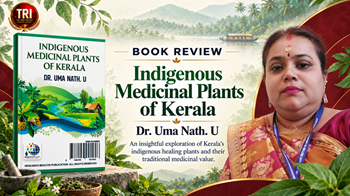
Indigenous Medicinal Plants of Kerala by Dr. Uma Nath U is a useful and informative book that brings together important details about traditional medicinal plants found in Kerala. The book is written in a clear reference style and is especially helpful for students, teachers, researchers, herbal medicine enthusiasts, and readers who are interested in understanding the medicinal value of plants used in Indian traditional practices.
One of the first things that stands out about the book is its practical approach. It does not try to make the subject unnecessarily complicated. Instead, it introduces different plants one by one and provides important information about their botanical identity, family, local names, traditional uses, and medicinal importance. This makes the book easy to use as a reference whenever someone wants to learn about a particular plant.
The book includes a range of indigenous medicinal plants such as Aeschynomene indica, Abrus precatorius, Celosia argentea, Achyranthes aspera, Curculigo orchioides, Dioscorea oppositifolia, Drosera indica, Aerva lanata, Dillenia indica, and several others. The inclusion of many plants gives the reader a broader picture of Kerala’s rich medicinal plant diversity.
A major strength of the book is that the author does not only mention the scientific names. The plant entries also include details such as family, subfamily, common name, Hindi name, vernacular names, synonyms, and accepted species names. This makes the book more useful because one plant may be known by different names in different regions. For a student or researcher, this kind of information is very important for correct identification.
The photographs included with the plant entries are also helpful. Botanical names can sometimes feel difficult or unfamiliar, especially for beginners. A photograph makes the plant easier to recognize and creates a stronger connection between the scientific information and the actual plant seen in nature. This visual support improves the practical value of the book.
The section on Aeschynomene indica is a good example of the book’s simple presentation. The plant is introduced with its family information and vernacular names. The arrangement is straightforward, which means that even a reader without advanced botanical knowledge can understand the basic information. This is one of the best qualities of the book: it is technical enough to be useful, but not so complicated that it becomes difficult to follow.
The entry on Abrus precatorius also shows the systematic approach followed throughout the book. The reader is given its family, subfamily, synonym, and species name. Such organization makes the book suitable for academic study as well as general reference. Instead of having to search for scattered information from many different places, the reader gets several basic botanical details together.
Another interesting plant discussed in the book is Celosia argentea. The book provides a number of synonyms and classification details. This shows that the author has tried to make the work detailed and useful for readers who may come across different scientific references for the same plant.
The medicinal-use sections are especially valuable. The book mentions traditional systems and uses connected with Ayurveda and other medicinal practices. In some entries, it also points to reported activities such as antimicrobial, antioxidant, anti-inflammatory, and other properties. These sections help readers understand why these plants have remained important in traditional healthcare systems.
At the same time, the book should be read as an educational and reference work rather than as a self-treatment manual. Medicinal plants can be powerful, and some plants may be unsafe if used incorrectly. Their effects can depend on the part of the plant used, preparation, quantity, and individual health conditions. Because of this, the information in such books is most useful when combined with proper professional guidance and scientific understanding.
What makes this book especially meaningful is its focus on Kerala. Kerala has a long history of plant-based healing traditions, especially through Ayurveda and local knowledge passed from one generation to another. The state is also known for its rich biodiversity. By documenting indigenous medicinal plants, the book helps preserve knowledge that may otherwise slowly disappear.
This preservation is important today. Modern lifestyles have created distance between people and traditional plant knowledge. Many younger readers may recognize packaged herbal products but may not know the actual plants from which those products come. Books such as Indigenous Medicinal Plants of Kerala help bring that knowledge back into focus.
The book also has educational value for students of botany, pharmacy, Ayurveda, biotechnology, herbal science, and related subjects. For them, the classification details can serve as a starting point for further study. Teachers may also find it useful for introducing students to medicinal plants in a more practical way.
The language and structure of the book remain fairly direct. Rather than long theoretical discussions, the author focuses on information. Each plant is treated almost like an individual profile. This makes it easy to read the book in sections rather than from beginning to end. A reader can simply look for a plant of interest and study its details.
This reference-style format is suitable for the subject because medicinal plant books often need to be used repeatedly. A reader may return to the same page many times. Clear headings, plant photographs, family details, and medicinal uses make this easier.
Another positive point is that the book connects traditional knowledge with modern research language. For example, some plant uses are presented under traditional medicine while others mention reported biological activities. This gives the reader a sense that traditional knowledge and modern scientific investigation can both contribute to understanding medicinal plants.
The book also encourages curiosity. When a reader sees that a commonly available plant has traditional medicinal use, they may become interested in learning more about its chemistry, ecology, or cultural importance. In this way, the book can act as an introduction to a much larger subject.
However, readers who are looking for very detailed clinical evidence, dosage information, or advanced pharmacological analysis may need additional scientific sources. The main strength of this book appears to be its role as a compact guide and introduction to indigenous medicinal plants rather than an exhaustive medical textbook.
From a reader’s point of view, the most enjoyable part is the combination of photographs and concise information. It gives the feeling of exploring Kerala’s plant life while also learning why certain plants have been valued for generations.
Overall, Indigenous Medicinal Plants of Kerala by Dr. Uma Nath U is a valuable contribution to the documentation of traditional plant knowledge. It brings together botanical identification, local names, photographs, traditional medicinal uses, and useful scientific details in an accessible form.
The book is especially suitable for students, researchers, herbal enthusiasts, teachers, and anyone interested in Kerala’s natural medicinal heritage. It reminds us that many plants growing around us are not merely part of the landscape. They are also connected with culture, traditional healing, history, and generations of human observation.
What makes the book worth reading is its simple purpose: to make people more aware of the medicinal plants found in Kerala and the knowledge connected with them. In a time when traditional knowledge can easily be forgotten, this kind of documentation is both educational and important.
For readers who enjoy learning about nature, medicinal plants, botany, or traditional healthcare practices, Indigenous Medicinal Plants of Kerala is an informative and worthwhile reference book.