
The Love We Understand Too Late: A Story Review of The Rolling Stone That Gathered Moss by Arv
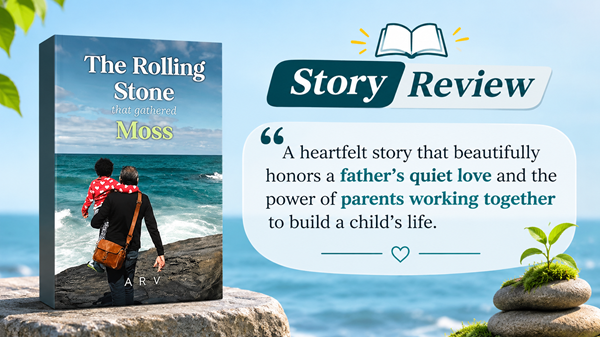
There are some forms of love that announce themselves through affectionate words, reassuring gestures, and memorable celebrations. Others remain almost invisible, quietly shaping our lives without asking for recognition. A father’s love often belongs to the second category. This is the emotional truth that forms the foundation of The Rolling Stone That Gathered Moss by Arv, a book dedicated to recognizing the profound yet frequently overlooked world of fatherhood.
At its heart, the book’s message invites readers to look beyond the familiar image of a father as a protector and provider. It asks us to consider the emotional experiences that may exist behind his responsibilities: the concern he carries, the hopes he nurtures, and the sacrifices that become part of everyday family life.
The most touching aspect of this premise is its emphasis on love that does not always know how to speak.
During childhood, we often understand affection through what we can immediately recognize. A comforting embrace, an encouraging word, or time spent together may make us feel loved. Practical responsibilities, however, can appear ordinary. We may not understand why certain decisions are difficult or why a parent worries about matters that seem unimportant to us.
Only with maturity do we sometimes begin to recognize the emotional meaning behind those everyday actions.
Arv’s focus on fathers creates an opportunity for such reflection. The idea of paternal love as an enduring anchor suggests that a father’s influence may continue to guide a child even when direct expressions of affection are limited.
Yet the book’s theme also opens a more challenging question: should love remain unspoken simply because it is genuine?
The answer invites consideration rather than certainty. Responsibility is a valuable expression of affection, but emotional communication also matters. A child may appreciate practical support while still needing reassurance, understanding, and visible tenderness. Recognizing a father’s dedication should therefore go hand in hand with encouraging deeper emotional connection.
The title The Rolling Stone That Gathered Moss adds a beautiful layer of symbolism. A rolling stone ordinarily suggests constant movement, while moss represents something that slowly develops through attachment and time. Together, these images create a metaphor for the transformation that accompanies meaningful relationships.
A father may move through changing responsibilities, demanding circumstances, and uncertain stages of life. Despite this movement, love can provide an enduring center around which his priorities gradually take shape.
The story of such transformation is not necessarily dramatic. It can unfold through years of ordinary choices, repeated acts of care, and the gradual realization that another person’s well-being has become deeply connected to one’s own.
This is why the book’s underlying idea can resonate across generations. A young reader may discover a reason to appreciate a father’s quiet efforts. An adult may find an opportunity to reconsider childhood memories. A father may recognize emotions he has rarely been encouraged to express.
The work also acknowledges the importance of mothers and fathers remaining rooted together. Its comparison of parenting to two hands joining in prayer or an embrace is a reminder that a child’s sense of belonging can be strengthened through cooperation, understanding, and shared emotional responsibility.
The metaphor is gentle but meaningful. It suggests that family life is built not through one person’s sacrifice alone but through the continuing contributions of those committed to caring for one another.
Ultimately, The Rolling Stone That Gathered Moss offers a reflective exploration of a love that is often felt more deeply than it is described. Rather than treating fatherhood as merely a collection of obligations, Arv’s message places it within the larger human need for connection, appreciation, and belonging.
The book’s central idea leaves readers with a simple yet powerful realization: sometimes the people who have shaped our lives most profoundly are the very people whose emotions we have understood the least.
And perhaps recognizing that quiet love is the beginning of a deeper conversation.