
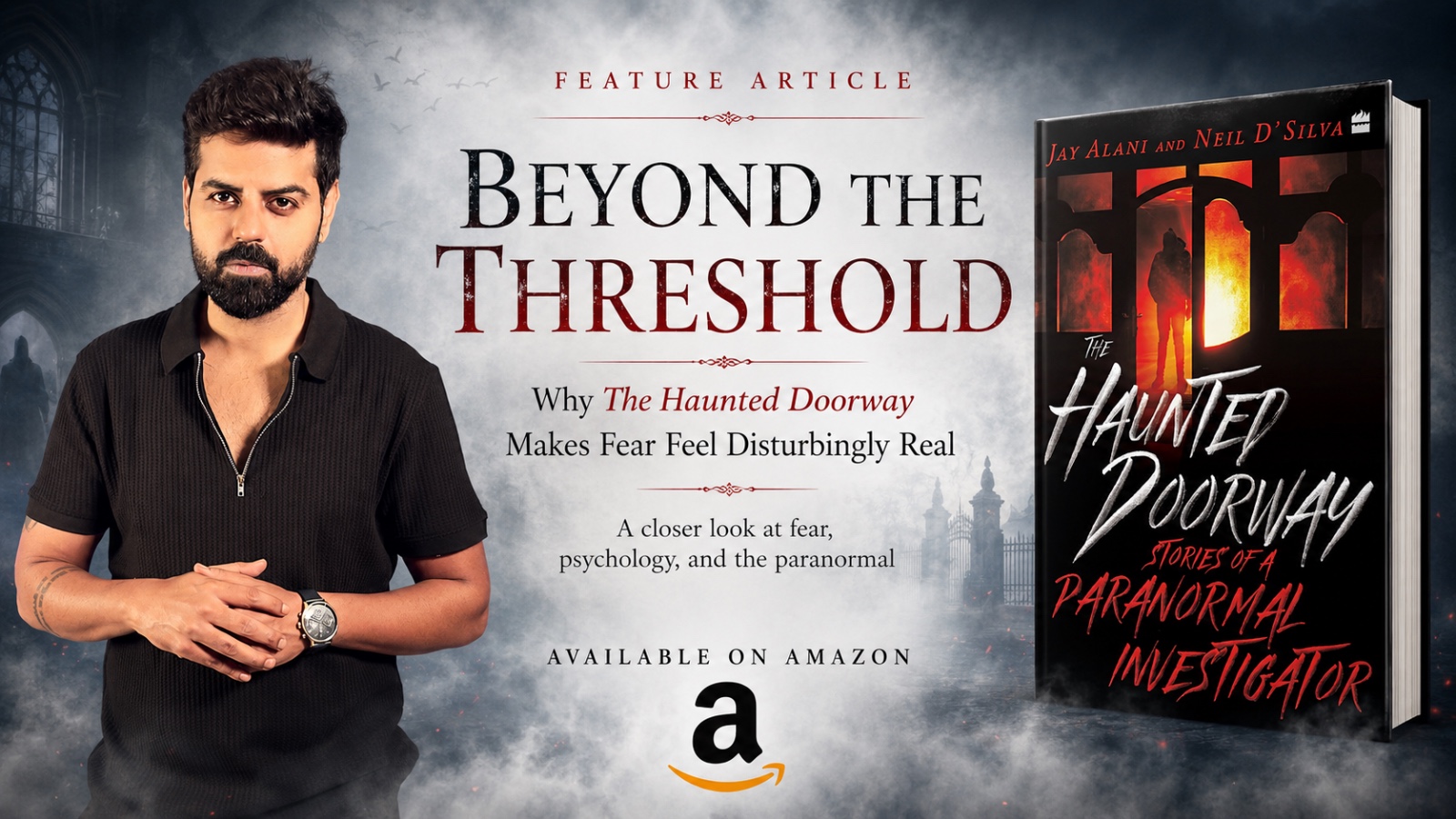
The paranormal investigator discusses the psychology of fear, ethical casework, collaboration with Neil D’Silva, and the responsibility of turning the unexplained into stories.
Paranormal investigator Jay Alani has spent more than fifteen years examining experiences that people often struggle to describe. With over1,500 investigations, a widely heard podcast, a paranormal awareness helpline, filmmaking projects, and the development of a largerParanormal Universe through The Paranormal Company, his work moves between evidence, psychology, folklore, technology, andstorytelling. In The Haunted Doorway: Stories of a Paranormal Investigator, Alani collaborates with author Neil D’Silva to transform theatmosphere and questions of paranormal casework into ten fictional stories. The following interview answers are editorially drafted fromthe biographical and book information supplied for this project. They should be reviewed and approved by Jay Alani before publication.
Table of Contents
ToggleQ1. What made you want to turn paranormal investigation into a collection of fictional stories?
After years of investigation, I realised that a case is never only about an unusual sound, an apparition, or an allegedlyhaunted object. Every case contains human emotion, family history, cultural belief, fear, grief, and sometimes apsychological or physical explanation that people have not considered. Fiction gave me the freedom to bring these layerstogether without presenting a private individual’s pain as public evidence. It also allowed us to create a strong narrativeexperience. A reader can enter the atmosphere of an investigation, feel the uncertainty, and still understand that theresponsible approach is not to declare everything supernatural. The Haunted Doorway grew from the need to tell storiesthat are thrilling but also honest about how complicated paranormal claims can be.
Q2. How did your experience of more than 1,500 investigations shape the book?
The investigations shaped the texture of the stories more than any single plot. When you have met many witnesses,entered many locations, and examined many different claims, you begin to notice recurring patterns. Fear changes theway people remember. Families influence one another. A local legend can determine what a witness expects to see.Environmental conditions can create strange sensations. Trauma and grief can appear through images that feel external.At the same time, there are cases where a detail remains difficult to place. That range was important to the book. I didnot want every story to end with a ghost, and I did not want every story to end with a debunking. Real investigationteaches humility, and we tried to preserve that.
Q3. Why did you choose to collaborate with Neil D’Silva?
Investigation and storytelling require different forms of discipline. I could bring the experiences, the investigative mindset,the psychological questions, and the cultural material. Neil could shape those elements into stories with structure,character, escalation, dialogue, and emotional impact. A case file records information, but fiction must create anexperience. Our collaboration allowed the book to
remain informed by fieldwork while becoming accessible to readers who simply want a gripping story. Neil’s ability toidentify the dramatic heart of a situation was essential. The goal was never to reproduce a report. It was to build storiesthat feel authentic because the questions and behaviour come from a real understanding of paranormal investigation.
Q4. The book often moves between psychological and supernatural explanations. Why is that balance important?
Because that is the honest position. People can have extremely vivid and frightening experiences for psychological,neurological, environmental, or social reasons. Sleep paralysis, trauma, grief, anxiety, suggestion, and stress can allproduce sensations that feel completely real. A responsible investigator must consider these possibilities first andencourage professional help when it is needed. But honesty also means admitting when the available evidence does notprovide a complete answer. I am not interested in forcing every case into belief or disbelief. The balance protects thewitness from exploitation and protects the investigation from becoming theatre. In fiction, that balance also createsstronger suspense because the reader cannot predict the conclusion in advance.
Q5. How do you respond to people who say that psychological explanations make paranormal stories less frightening?
I think the opposite is often true. The human mind is extraordinary, and the possibility that fear, trauma, or memory canreshape our experience of reality is deeply unsettling. A psychological explanation does not mean that the experience wasinsignificant. It means the person may be carrying something that needs attention. Sometimes the most frighteningdiscovery is not that a spirit entered the house, but that a wound inside the family has never been addressed. Horrorbecomes more meaningful when it reveals something about us. The supernatural can still remain as a possibility, but psychology gives the story emotional depth and ethical responsibility.
Q6. Several readers have highlighted stories such as The Demonic Doll and Dead Man’s Fingers. What makes objects and natural phenomena so effective in horror?
An object gives fear a physical centre. People can look at it, avoid it, blame it, protect it, or attach a history to it. A doll isespecially powerful because it resembles a person while remaining lifeless, so the imagination immediately begins tosupply intention. Natural phenomena work differently. They remind us that the world already contains forms andprocesses that can look impossible or grotesque. Something may appear supernatural because we have neverencountered it before. In both cases, the investigator must separate the object itself from the story surrounding it. Thelegend, expectation, and behaviour of people around the object can become as important as any physical evidence.
Q7. How did you decide which kinds of folklore to include?
Paranormal belief is never culturally neutral. People describe unusual experiences through the stories, religious ideas,legends, films, and family warnings they already know. India contains an enormous range of local traditions, andcontemporary audiences are also familiar with Arabian, European, and Western myths through global media. We wantedthe collection to reflect that mixture. Folklore can intensify fear, but it also reveals how communities explain danger, grief,forbidden spaces, and moral boundaries. The important thing was to treat these traditions with curiosity rather than usingthem as random decoration. Each belief changes the way characters understand what is happening to them.
Q8. What ethical responsibility does a paranormal investigator have toward frightened people?
The first responsibility is not to increase the fear. A witness may already feel isolated, embarrassed, or convinced thatsomething wants to harm them. An investigator should listen without ridicule but must also avoid confirming asupernatural explanation without evidence. Practical risks should be checked. Medical or psychological support may benecessary. Consent and privacy matter. A case should not become content simply because it is dramatic. Theparanormal awareness helpline was created from this need to guide people responsibly. Whether the final explanation ispsychological, environmental, fraudulent, unknown, or possibly paranormal, the person’s safety must remain more important than the story.
Q9. Has the popularity of paranormal videos and haunted-location challenges made your work more difficult?
It has increased public interest, which can be positive, but it has also encouraged risky behaviour. People may enterunsafe buildings, trespass, imitate rituals, provoke others, or create fear for views. Even without any paranormal factor,abandoned locations can contain structural hazards, toxic substances, animals, criminal activity, or legal risks. There isalso the possibility of causing distress to families connected with a place. Entertainment needs accountability. I wantpeople to remain curious, but curiosity should be informed and respectful. One purpose of my work across podcasts, films, books, and awareness initiatives is to replace reckless imitation with a more mature understanding of investigation.
Q10. What role does fear play during an investigation?
Fear is information, but it is not proof. It can tell you where a person feels threatened, which belief has been activated, orwhich detail the witness considers important. It can also affect memory,
perception, and group behaviour. In a charged environment, one person’s reaction can spread quickly to others. Aninvestigator must remain aware of personal fear without allowing it to determine the conclusion. The goal is not topretend that fear disappears; the goal is to observe it. In storytelling, fear becomes the emotional engine. Ininvestigation, it becomes one element among many that must be documented and understood.
Q11. Why leave some mysteries unresolved?
Because an unresolved case is sometimes the most accurate result. Evidence can be incomplete, accounts may conflict,an event may not repeat, and the location may change before further testing is possible. Declaring a supernatural causesimply because a normal explanation has not been found is not responsible. Declaring that nothing happened is equallycareless when a witness has experienced genuine distress. In the book, unresolved elements preserve the reality ofuncertainty and give the reader space to think. I would rather leave a question open than close it with a conclusion the evidence does not support.
Q12. How did writing fiction differ from speaking on your podcast Paranormal Reality?
A podcast conversation can follow evidence, memory, and discussion in a flexible way. Fiction demands architecture.Every detail must serve the character, atmosphere, or movement of the story. The reader cannot see the location or hear awitness’s voice, so language must create that experience. At the same time, fiction offers extraordinary freedom. It cancombine patterns from many cases, explore a character’s inner life, and create symbolic connections that a factualformat
may not allow. The podcast invites listeners into discussion; the book invites readers into a constructed world where theyparticipate through imagination.
Q13. What misconception about paranormal investigators would you most like to correct?
The biggest misconception is that an investigator arrives with the purpose of proving a ghost is present. That is notinvestigation; that is confirmation bias. The work should begin with questions, documentation, environmental checks,interviews, timelines, and alternative explanations. Another misconception is that fearlessness means takingunnecessary risks. Professionalism is not about provoking an alleged entity or entering unsafe places withoutpreparation. It is about discipline, observation, and responsibility. The most useful investigator is not the person whomakes the loudest claim, but the person who helps everyone understand what can and cannot be supported by evidence.
Q14. How does The Haunted Doorway connect with the larger Paranormal Universe you are building?
The Paranormal Universe is an attempt to create interconnected storytelling through films, immersive experiences, audio,books, and technology while keeping psychological depth and investigative authenticity at the centre. Projects such asWinston Villa, The Paranormal Boy, Numinous, and Monster Café can explore different tones and formats, but they sharean interest in the unknown and in the human consequences of encountering it. The Haunted Doorway is importantbecause short fiction allows us to open many different worlds. Each story demonstrates a possible direction for horrorthat is rooted in atmosphere, character, culture, and responsible inquiry rather than imitation.
Q15. What do you hope first-time horror readers take away from the book?
I hope they discover that horror can be thoughtful, curious, and emotionally meaningful. It does not have to dependonly on graphic violence or sudden shocks. A good paranormal story can teach you about psychology, folklore, history,natural phenomena, and human behaviour while still giving you the pleasure of suspense. The short-story formatmakes the book approachable because each case offers a new beginning. If a reader finishes the book wanting to learnmore rather than simply feeling afraid, I would consider that a success.
About the Book and Author
The Haunted Doorway
The Haunted Doorway: Stories of a Paranormal Investigator is a collection of ten paranormal short stories by Jay Alani andNeil D’Silva. Drawing on the atmosphere and questions of real investigative experience, the book presents disturbing objects,dangerous entities, stalkers, dream figures, folklore, and cases in which psychological and supernatural interpretationscompete. The collection is designed for readers who enjoy horror that moves beyond jump scares and explores fear throughevidence, culture, memory, and the human mind.
Jay Alani
Jay Alani is one of India’s leading paranormal investigators, with more than fifteen years of experience and over 1,500investigations across the world. He is a filmmaker, podcaster, author, and TEDx speaker known for evidence-based paranormalinquiry and for pioneering India’s paranormal awareness helpline. His podcast Paranormal Reality has crossed 20 millionstreams and ranks among internationally heard horror shows. He is the founder of The Paranormal Company, India’s firstparanormal startup, where he is developing a global Paranormal Universe through films, immersive storytelling, andtechnology. His announced projects include Winston Villa, The Paranormal Boy, Numinous, and Monster Café. His earlier bookHaunted, published in 2019, was presented as India’s first non-fiction horror title.
Neil D’Silva
Neil D’Silva is the co-author and storytelling collaborator on The Haunted Doorway. In this project, his narrative craft helpstransform investigative knowledge, cultural material, and psychological questions into fast-moving short fiction withcharacter, suspense, and atmosphere.