
Born From Us: Why Understanding AI Begins with Understanding Ourselves
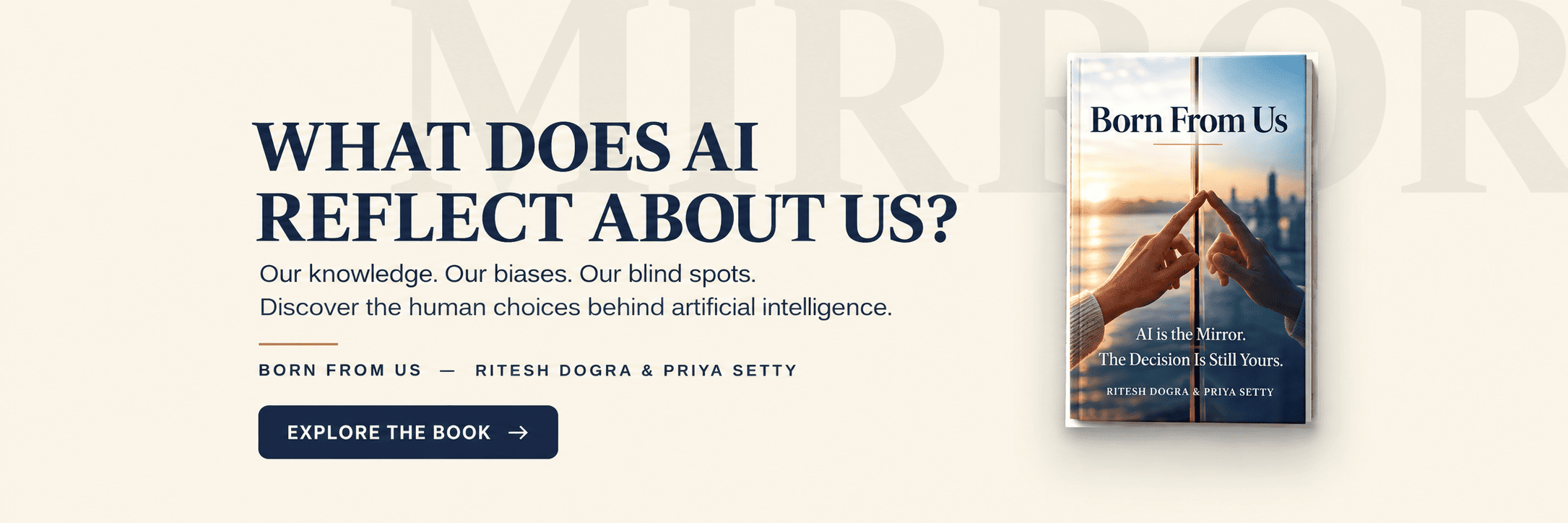
Artificial intelligence can generate an answer in seconds. Deciding whether that answer deserves our trust is a different task. For business leaders, professionals, and anyone trying to make sense of AI, the challenge extends beyond learning how to use a new tool. It involves understanding what the tool is doing, recognising the assumptions behind its output, and accepting responsibility for the decisions that follow. Born From Us by Ritesh Dogra and Priya Setty enters this conversation with a clear proposition: “AI Is the Mirror. The Decision Is Still Yours.” Now available for pre-order through Ananta Press, the book invites readers to look closely at the human foundations of artificial intelligence.
The book’s central idea gives its title meaning. AI emerges from human knowledge, data, processes, and choices. It can carry forward our expertise and creativity, but it can also reproduce our inconsistencies and blind spots. When a system produces an unexpected result, the explanation may involve more than the technology itself. It may reveal something about the information it received, the process it was asked to follow, or the objective someone chose. Looking at AI as a mirror encourages readers to examine these foundations before accepting the output.
This perspective makes Born From Us relevant to people who feel pressure to have an opinion about AI without having had the opportunity to understand it properly. Conversations about the technology can swing between extraordinary promises and alarming predictions. Both can leave practical questions unanswered. What problem are we solving? What would a useful result look like? How will we know whether the system is helping? The book offers readers a way to approach these questions with greater clarity and less dependence on impressive terminology.
At its heart are three questions: “What is it doing?”, “What is it reflecting?”, and “Who’s responsible when it’s wrong?” Their strength lies in how readily they apply to real situations. A manager evaluating a proposal, a professional reviewing an automated recommendation, and a team introducing a new workflow can all begin here. The questions shift attention toward purpose, evidence, and accountability. They also make participation possible for readers who have valuable domain experience but do not speak the language of software development.
Across twenty-five short, story-driven chapters organised into five parts, Born From Us connects its argument to examples from healthcare, regulatory work, parenting, aviation, and ordinary life. This breadth helps bring abstract ideas into familiar territory. Readers do not need to work in aviation to understand the danger of losing a skill through disuse. Nor do they need to work in healthcare to appreciate why a confident recommendation should be checked before it affects another person. The situations differ; the demands on human judgment remain recognisable.
The opening part examines what AI actually is and the misunderstandings that can distort our expectations. It considers the importance of context, the gap between intended goals and actual behaviour, and the consequences of accelerating a weak process. These ideas have practical value for organisations considering adoption. If a workflow is confused, speeding it up may simply spread the confusion further. Before asking what AI can automate, readers are encouraged to consider whether the underlying work is understood well enough to be automated responsibly.
The second part turns to the people using these systems. Chapters such as “The Fastest Way to Get Dumber” and “Kicking Away the Ladder” raise questions about learning and the development of expertise. Receiving a polished answer is different from developing the ability to judge one. For experienced professionals, this invites reflection on which skills require continued practice. For managers, it raises a further responsibility: ensuring that junior colleagues still encounter the experiences through which judgment develops, even when technology can produce a finished result quickly.
Human oversight receives equally close attention. Assigning someone to review an output does not, by itself, establish a meaningful safeguard. Review requires time, knowledge, clear standards, and the authority to challenge a result. Without these conditions, oversight can become a routine approval step. Born From Us asks readers to consider what people are actually being asked to do when they supervise AI. This is a useful question for anyone designing a workflow in which responsibility appears to be shared but may be poorly defined.
The third part brings trust, evidence, and ownership into focus. An encouraging demonstration does not answer every question about performance, and an unsuccessful rollout does not necessarily establish that a system has no value. Evaluation requires care in both directions. The book also examines the organisational problem of several teams owning separate pieces while no one takes responsibility for the overall outcome. For leaders, this makes accountability a practical design question: who can explain the decision, investigate a failure, and ensure that something changes?
The later sections move into implementation, data, usefulness, and governance. They consider the work that follows an attractive demonstration and the limitations created by poorly understood information. They also ask whether a technically correct answer makes a meaningful difference to the task at hand. This is where the book’s balanced approach becomes particularly useful. It allows room for AI’s strengths while insisting that those strengths be connected to a real purpose. Readers are encouraged to look for value that can be explained and examined.
The authors bring complementary experience to these themes. Ritesh Dogra’s background includes founding TalkDoc.AI, building Indegene’s GenAI practice, and co-founding Alethic Insights. His work connects emerging technology with the demands of healthcare and enterprise settings. Geethapriya “Priya” Setty brings experience in pediatric occupational therapy, medical-device regulatory affairs, quality systems, and AI governance and validation. Together, these perspectives connect the ambition to build useful systems with an understanding of how people learn, how standards operate, and why consequences deserve attention.
A foreword by Professor D.V.R. Seshadri of the Indian School of Business reinforces the book’s central argument. His observation that these systems reflect our data, processes, decisions, and blind spots places human responsibility firmly within the discussion. For readers, the implication is demanding but constructive: improving outcomes requires examining our own practices alongside the technology. That gives the book relevance beyond a particular platform or product announcement. Its questions concern habits of thought that readers can carry into future decisions.
For you as a reader, the value lies in becoming a more active participant in conversations that might otherwise feel intimidating. You may be choosing a tool, assessing a vendor’s proposal, supervising a team, or simply trying to understand how AI fits into your work. Born From Us offers a starting point for asking clearer questions and recognising where your own expertise matters. It is especially timely for readers who want to move from reacting to AI headlines toward making informed, considered choices.
Born From Us is now available for pre-order through Ananta Press. The advertised pre-order offer includes a 10% discount, an author-signed copy, and a special author note inside the book.
Visit the official website to explore its themes, chapter details, and authors. To reserve your copy and review the offer, visit the Ananta Press pre-order page. The invitation is simple: take the time to understand what the mirror reflects before deciding what to do with the answer.