
Book Review : The Art of Emotional Detachment – Vikas Singh on Love and Boundaries
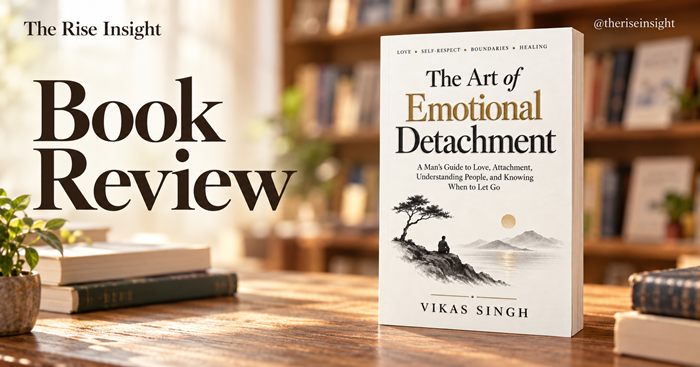
The Art of Emotional Detachment by Vikas Singh is a practical self-help book for men navigating relationship anxiety, attachment, and the difficulty of letting go. It explores how to care deeply for someone while protecting the judgment and self-respect needed to make sound decisions. This book review considers its approach to boundaries, communication, emotional dependence, and recovery after a breakup. Singh’s central concern is the space between feeling something intensely and deciding what to do about it. His accessible guidance encourages readers to develop that space through observation and everyday choices, while respecting both their own vulnerability and another person’s freedom.
Understanding Emotional Detachment in Relationships
The title could suggest a retreat from intimacy, but the book gives detachment a more considered meaning. Caring remains possible, even necessary; what changes is the expectation that another person must provide continuous reassurance or guarantee a particular future. Singh repeatedly returns to the limits of personal responsibility. A reader can speak honestly, recognise a harmful reaction, and follow through on an agreement. He cannot make a partner feel differently or secure commitment through persistence alone. This distinction gives the advice its ethical grounding. Emotional independence becomes a way of participating more fairly in a relationship, while preserving a life that can withstand uncertainty.
The early discussion of attraction and connection helps establish that argument. Strong interest can make a person overlook practical incompatibility or mistake attention for sustained investment. Singh asks readers to notice what a relationship actually contains over time: whether plans are honoured, concerns can be discussed, and effort is shared. His treatment of mixed signals is particularly relevant to communication through phones and social media. Online activity and delayed replies become easy material for anxious interpretation. The book redirects attention towards clearer questions and observable behaviour, without pretending that every ambiguity reveals manipulation. That restraint makes its advice more credible than confident explanations of a stranger’s hidden motives.
Equally valuable is the book’s willingness to examine the reader’s own conduct. Although its language addresses men and frequently discusses relationships with women, it cautions against treating gender as a universal explanation. A partner has individual preferences, circumstances, and limits that require conversation. The reader is also asked to consider whether a demand for certainty reflects genuine commitment or a need to feel desirable. This gives the book more depth than a guide concerned only with identifying faults in others. Its account of dignity includes the ability to accept refusal, acknowledge an unfair response, and avoid turning hurt into pressure.
Boundaries Communication and Emotional Responsibility
Boundaries provide another substantial thread. Singh presents them through ordinary decisions about time, friendships, independent interests, and shared responsibilities. Wanting space does not remove the obligation to communicate or contribute fairly. The same freedom must be available to both partners. The discussion becomes especially useful when it distinguishes a reasonable limit from behaviour intended to provoke insecurity. Withholding affection or making oneself deliberately unavailable can reproduce the confusion the reader hopes to escape. By connecting self-respect with consistency and mutual consideration, the book makes boundaries feel less like a dramatic declaration and more like an arrangement that can be maintained.
The passages on conflict and repair extend this practical emphasis. An apology gains meaning when it identifies an action and is followed by a change that can be observed. Explanations of good intentions cannot settle the effect of hurtful behaviour. Singh also recognises that repair requires participation; one person cannot sustain a relationship by endlessly improving the wording of a concern. Crucially, the manuscript distinguishes ordinary disagreement from threats, coercion, and controlling conduct. Its reader’s note establishes the limits of general guidance. These qualifications matter because they prevent the encouragement to communicate from becoming a demand to remain available for unsafe or degrading treatment.
Letting Go and Rebuilding After a Breakup
The later material on breakups and rebuilding is persuasive in its attention to unremarkable parts of daily life. The hours once occupied by calls, visits, and shared routines remain after a relationship ends, and recovery involves deciding how to inhabit them. Singh resists presenting heartbreak as a competition in appearance, earnings, or public success. Instead, he considers manageable commitments, renewed friendships, and interests pursued for their own value. Grief is allowed to coexist with a sound decision. Missing someone does not automatically invalidate an ending, and unanswered questions need not prevent a person from making plans. This offers readers a patient account of recovery without imposing an emotional deadline.
Stylistically, the book relies on direct address, brief sections, everyday examples, and suggested ways of framing difficult conversations. Its language is plain and its approach largely instructional. Readers looking for literary memoir, an extended personal narrative, or a technical treatment of psychological research should approach it with that distinction in mind. The manuscript explicitly describes its situations as illustrative rather than accounts of real people. Its usefulness therefore rests chiefly on the fairness of its reasoning and the applicability of its suggestions. At its best, it translates an abstract concern such as emotional dependence into a choice a reader can recognise within an ordinary day.
Strengths Limitations and Who Should Read This Book
There are limits to this method. Ideas about observing patterns, preserving independent routines, and communicating clearly recur across the discussions. That repetition can reinforce the advice for someone reading selectively, though a reader moving straight through may wish for greater compression. General guidance also leaves the difficult work of interpreting context with the reader. What counts as sufficient effort, a reasonable wait, or a lasting change cannot be determined by a single rule. The book is strongest when it acknowledges that uncertainty and offers questions rather than verdicts. Its measured tone supports reflection, but it cannot remove the discomfort involved in an individual decision.
For readers considering The Art of Emotional Detachment, the book’s clearest value is its practical approach to relationship decisions. It is best suited to adult men examining relationship anxiety, one-sided effort, boundaries, or life after separation. Those in stable relationships may also appreciate its attention to repair and maintaining independent interests within commitment. Singh asks readers to take affection seriously while noticing reality and respecting another person’s choices. The book earns its recommendation through that measured perspective and its attention to ordinary behaviour. A clearer conversation or a decision made without demanding reassurance can be a useful place to begin. Its advice leaves room for uncertainty while encouraging readers to take responsibility for what they can change.