
Book Review: Drifting Thoughts by Sanjana U K
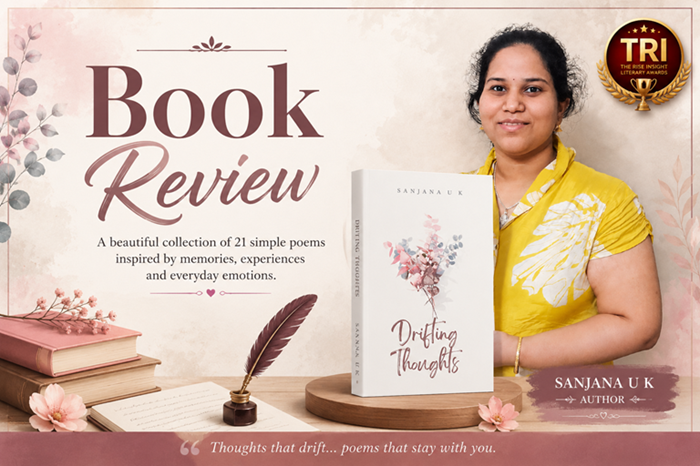
Drifting Thoughts by Sanjana U K is a simple and heartfelt collection of poems that takes the reader through different stages, emotions and memories of life. The book contains 21 poems, written in a simple form and inspired by the author’s childhood memories and personal experiences.
What makes this collection interesting is that it does not try to deal only with one particular emotion or subject. Instead, the poems move freely from childhood and school life to friendship, family, Indian culture, nature, ageing, relationships and difficult experiences. The title Drifting Thoughts is therefore quite suitable because the thoughts in the book seem to move from one memory and feeling to another, just as our own mind often does.
Sanjana U K’s writing comes from a place of observation. She looks at ordinary experiences and tries to find meaning in them. The poems are not complicated or heavily decorated with difficult words. They are written in a straightforward manner, making the collection accessible to young readers as well as general readers. The author’s dedication also shows her connection with poetry. She mentions that her interest in writing and inspiration from famous Indian poets encouraged her to write, and she dedicates the book to beginners who have a passion for writing.
One of the strongest aspects of the book is its focus on memories. Many poems remind us of moments that may appear small at first but become precious as time passes. The poem “School”, for example, brings together teachers, friends, discipline, competitions, punishments, jokes, failures and success. These are common parts of school life, but when we look back after many years, they become some of our most valuable memories. The poem captures this feeling of looking back at school as the beginning of the “golden days” of life.
A similar feeling can be found in “The Story of Backseaters.” The poem describes students travelling home in a school bus, sharing jokes, food and conversations while thinking about assignments and examinations. The school bus becomes more than just a means of transport. It becomes a place where friendships are formed and memories are created. The poem successfully captures the carefree side of student life.
The theme of friendship is explored directly in the poem “Friendship”. The poem describes how strangers slowly become friends and how relationships develop through shared notes, jokes, problems and experiences. The idea that true friendship is a bond created without expectations is simple but meaningful.
Family relationships also occupy an important place in this collection. “Siblings” describes the special relationship between brothers and sisters. There may be arguments and differences, but underneath them lies affection and a shared childhood. The poem reminds readers that siblings may choose different paths in life while still remaining connected through their memories and family bond.
One of the most touching poems is “Father-Daughter Love.” It presents the father as a child’s first protector, supporter and friend. Images such as the child holding the father’s finger for the first walk create a strong sense of affection. The poem celebrates the trust and emotional connection between a father and daughter.
The poem “My Lovely Grandmother” is another warm family portrait. The grandmother is shown as energetic, social, caring and deeply connected with her grandchildren. The poem recalls games, holidays, conversations, cultural values and the affection shared between generations. It also highlights the important role grandparents play in passing traditions and values to younger family members.
Nature is another recurring element in Drifting Thoughts. In “Bangalore Winter,” the writer describes chilly winds, hot tea, cookies, colourful shawls and jackets, Nandi Hills and the festive arrival of Santa Claus. The poem combines the physical experience of winter with the happiness and hope associated with the season.
Similarly, “Seasons” uses familiar images such as hot winds, ice cream, ice cubes, woollen sweaters, raincoats, flowers and birds to show how changing weather becomes part of our everyday life. The poem is simple, but its simplicity makes the images easy to understand.
The book also moves beyond personal memories and touches upon larger subjects. “Indian Culture” celebrates the country’s different cultures, traditions, religions, food, clothing, art, music and dance. The poem presents India as a land of diversity where different traditions exist together as part of a larger heritage.
Another interesting poem is “Stages of Ageing.” Here, the writer looks at human life from birth to old age and the changes that take place along the way. The poem reminds us that while people may be independent during one stage of life, they may need care and support later. It brings attention to self-care, hygiene, exercise and the importance of loved ones.
The collection also includes poems based on difficult experiences. “Life Experience-Hudhud Cyclone” describes strong winds, darkness, shortage of food and essential resources, and the difficulties faced by families during a natural disaster. At the same time, it highlights humanity, patience and the value of basic necessities such as food, shelter and electricity.
“Accidental Fall” presents another emotional situation. It describes a girl falling at school, the confusion and fear of those around her, the call to her parents and finally the comfort of her father’s hug. The poem shows how suddenly an ordinary day can change and how important family support becomes during difficult moments.
There are also poems about butterflies, nighttime, new skills, childhood memories, weddings, colours and new family members. This variety gives the book a broad emotional range. A reader can find something familiar in many of these subjects because they are connected to experiences that most people encounter at some point in life.
From a literary point of view, Drifting Thoughts is not a collection that depends on complex poetic techniques. Its biggest strength is simplicity and sincerity. The author writes about things she has observed, experienced or remembered. The poems often feel like personal reflections rather than highly structured literary compositions. This gives the collection an innocent and personal quality.
The book can especially appeal to young readers, beginner poets and readers who enjoy simple poetry based on everyday life. It can also encourage aspiring writers because the author herself acknowledges the importance of beginning one’s writing journey. Her acknowledgement shows that family, friends and teachers played an important role in encouraging and reviewing her work.
Overall, Drifting Thoughts is a sincere attempt to capture the small and large experiences that shape a person’s life. It reminds us that poetry does not always have to be about extraordinary events. Sometimes, a school bus, a grandmother, a sibling, a winter morning, a childhood holiday or a father’s hug can become poetry when we look at them with emotion.
Sanjana U K’s Drifting Thoughts is ultimately a book about remembering, observing and feeling. Its simple poems invite readers to pause and think about their own memories and relationships. The collection may be especially meaningful to those who enjoy nostalgic and relatable writing. It is a gentle reminder that the moments we often consider ordinary today may become the memories we treasure most tomorrow.
To buy this book on Amazon: https://www.amazon.in/Drifting-Thoughts-Sanjana-U-K/dp/9357216626