
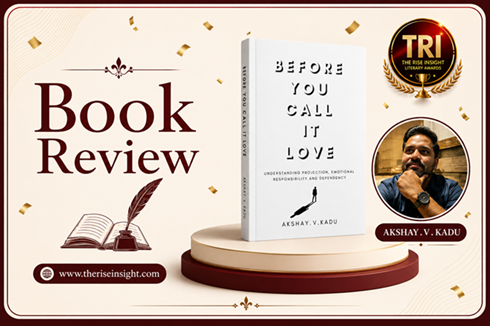
About the Author
Akshay V. Kadu is a thoughtful writer interested in questioning commonly accepted ideas and exploring different perspectives on human experience. His writing observes patterns in human thought, behaviour, emotions and the ways in which people relate to themselves and others.
Book Review
Love is often presented as the most beautiful and desirable human emotion. From childhood, people are taught to search for it, protect it and fear losing it. Popular films, books, songs and social traditions repeatedly suggest that another person will complete us and give meaning to our lives. Akshay V. Kadu’s Before You Call It Love: Understanding Projection, Emotional Responsibility and Dependency asks readers to pause before accepting this familiar idea.
This is not a conventional relationship guide that teaches readers how to attract a partner, repair a broken relationship or find a soulmate. It is a reflective inquiry into the meaning we give to love. The author questions whether everything we describe as love is actually love. Sometimes what appears to be love may be attachment, emotional dependence, fear of loneliness, the need for validation or a projection of our inner desires onto another person.
The book begins with a simple but powerful question: Where did our definition of love come from? Most people never consciously decide what love means to them. They absorb its meaning from family, culture, cinema, stories and the relationships they observe while growing up. A common pattern is presented repeatedly: attraction begins, effort follows, commitment is achieved, and the relationship becomes proof of happiness.
Through this pattern, people quietly develop certain beliefs. They begin to think that love comes from another person, that love must be earned, that someone else will complete them and that a relationship will provide permanent emotional security. According to the book, these beliefs place the source of our happiness outside us. When another person behaves warmly, we feel secure. When that person becomes distant, we feel anxious. Our emotional condition starts depending on someone else’s presence, attention and approval.
One of the strongest qualities of the book is its use of ordinary situations to explain complex emotional patterns. For example, the author describes what may happen after we send a message to someone important and do not receive an immediate reply. The silence itself is only a fact, but the mind quickly creates a story around it. We wonder whether the person is losing interest, speaking to someone else or becoming tired of us. Within a short time, a delayed reply can become a judgment about our worth.
The example is simple, but it will feel familiar to many readers. It shows how fear can enter a relationship without any direct evidence. The person may be genuinely busy, yet the mind interprets the silence through old insecurities. Anxiety then leads to repeated messages, unnecessary explanations, quick apologies and an urgent search for reassurance. When reassurance arrives, the person feels calm again. This cycle reveals how emotional stability has been handed over to someone else.
The book does not shame readers for such behaviour. It explains that dependence is often a learned pattern. People are not weak merely because they seek comfort or reassurance. From childhood, human beings depend on parents, teachers, friends and caregivers for safety and guidance. The mind naturally learns to look outward whenever discomfort appears. The problem begins when external reassurance becomes the only source of emotional stability.
Another important theme is the connection between love and identity. When someone chooses us, we may feel valuable, important and worthy. Gradually, being chosen becomes part of our identity. We are no longer simply ourselves; we become somebody’s partner and begin imagining a shared future. Routines, expectations and emotional habits develop around the relationship.
When such a relationship ends, the pain is therefore not limited to missing the other person. The identity built around being chosen also collapses. The reader may feel that something inside has been lost. Rejection can turn into shame, and shame quietly says, “I was not enough.”
This is one of the most insightful observations in the book. The author distinguishes the pain of separation from what may be called an injury to identity. A person begins reviewing every conversation, comparing themselves with imagined alternatives and searching for personal flaws. They may try harder to bring the relationship back, not only because they miss the person, but because they want to recover the secure version of themselves that existed while they were being chosen.
From identity, the discussion naturally moves towards projection. Projection happens when we stop seeing a person simply as a human being and begin seeing them as the answer to our emotional needs. We assign them a role: the person who will always stay, provide security, remove loneliness and confirm our worth.
The other person may never have promised to carry these responsibilities. Still, the mind creates an internal script. When the person behaves differently, changes direction or expresses doubt, it may feel like betrayal. However, the book asks a difficult question: did the person truly betray us, or did they simply step outside the role we had created for them?
This does not mean that the connection was false. The affection, warmth, laughter and shared moments may have been completely real. The problem lies in the emotional weight placed upon the relationship. No single person can continuously regulate another individual’s emotions, remove every insecurity and remain permanently unchanged. Human beings grow, struggle, hesitate and evolve. Projection freezes them into a fixed image, while real relationships require space for change.
Part One of the book, titled “Perception and Suffering,” examines how love becomes connected with fear, identity, projection and the inability to stand alone. Part Two, “The Inward Journey,” shifts the reader’s attention from the other person towards the self. This movement gives the book a clear and meaningful structure. It first explains the pattern and then encourages the reader to observe its source.
The chapter on the need to be seen is especially relatable. A thoughtful message, a compliment or someone listening carefully can immediately improve our mood. Such attention makes us feel acknowledged and safe. The author explains how the need to be seen begins early in life and becomes connected with emotional comfort.
The need for recognition is not treated as something shameful. Every human being wants to feel that their presence matters. The more important question is whether our complete sense of worth depends on another person continuously noticing and validating us. If their attention becomes necessary for our stability, affection slowly turns into dependence.
The book then asks whether we can offer ourselves the same attention we demand from others. Can we recognise our own effort, sit with our emotions and acknowledge our experiences without waiting for external confirmation? This question introduces the idea of “holding ourselves.”
Holding ourselves does not mean avoiding relationships or becoming emotionally cold. It means learning to remain present with our thoughts and feelings. When anxiety, anger, insecurity or discomfort appears, most people immediately search for an escape. They reach for their phones, open social media, contact someone or surround themselves with noise. Silence feels uncomfortable because it brings us face to face with emotions that we may not understand.
Kadu suggests that genuine self-love begins in this uncomfortable space. Self-love is not limited to repeating positive statements in front of a mirror. It means developing an honest understanding of ourselves. It involves observing our thoughts, reactions, fears and insecurities without harsh judgment. It means staying with ourselves during difficult moments instead of immediately searching for someone else to make the discomfort disappear.
This understanding leads to the central idea of the book: the source was never the other person. According to the author, another person may awaken love, warmth and security within us, but they do not create our capacity to love. They act as a trigger or messenger for something already present inside.
This argument encourages readers to reconsider expressions such as “falling in love.” The book suggests that without self-understanding, people may fall into projection and dependency. When they begin to understand themselves, love can instead become a conscious and responsible connection between two individuals who do not require each other to feel complete.
The discussion of emotional responsibility is the book’s boldest and most challenging section. It asks readers to stop focusing only on what another person did and examine their own participation in an unhealthy pattern. Even if someone behaved inconsistently or caused pain, important questions remain: Why did we tolerate the behaviour? Why did we continue chasing? Why did we ignore warning signs? What part of us accepted the situation?
These questions should not be misunderstood as blaming the person who was hurt. The author clearly presents emotional responsibility as awareness rather than guilt. Taking responsibility does not mean excusing disrespect or denying another person’s mistakes. It means recognising the internal fears and patterns that kept us attached to a damaging situation.
The author also challenges the romanticisation of emotional intensity. Anxiety is sometimes called passion, attachment is called destiny, and emotional instability is presented as proof of deep love. The book argues that such intensity may actually be the nervous system repeating familiar patterns. If inconsistency feels familiar, stability may initially appear boring. If a person believes that love must be earned, peaceful affection may feel undeserved.
These observations make Before You Call It Love relevant to readers experiencing heartbreak, but the book is not only for those recovering from a relationship. It is equally valuable for anyone interested in emotional awareness, self-understanding and healthier human connections. The questions raised can apply to friendships, family bonds and other situations in which a person’s sense of worth depends heavily on external approval.
The writing style is direct, conversational and questioning. Rather than presenting complicated theories, the author speaks to the reader through familiar examples and short reflective passages. Many chapters contain questions that invite readers to pause and examine their own experiences. Because the book is designed as a mirror rather than a list of instructions, it is best read slowly.
Some central ideas, particularly external validation, projection and emotional dependence, are repeated across different chapters. However, this repetition also supports the reflective nature of the book. Each return to the subject adds another layer and allows readers to recognise the same emotional pattern in different forms.
The book’s minimal cover design complements its content. The white background, fragmented typography and lonely human figure with a long shadow create a feeling of distance, uncertainty and introspection. The cover does not use romantic colours or familiar images of couples. This immediately suggests that the book is not offering a conventional celebration of romance. It invites readers to step away from the usual image of love and examine what exists beneath it.
In the final chapter, “After the Illusion,” the author imagines what remains when projection and dependence end. The answer is quiet but meaningful: the self remains. A person can then choose connection without making it a method of emotional survival. Love no longer needs to be a desperate attempt to avoid loneliness. It can become a relationship between individuals who value one another without surrendering their identities.
Before You Call It Love does not ask readers to reject love. It asks them to approach it with greater awareness. It does not promote isolation or emotional distance. Instead, it shows that healthy connection becomes possible when individuals learn to hold their own emotional centre.
Akshay V. Kadu has written a courageous and thought-provoking book that questions ideas many people accept without examination. Its greatest strength lies in its willingness to make readers uncomfortable without judging them. It asks us to look beyond the person we blame, miss or desire and observe what the relationship reveals within us.
The book leaves readers with an important understanding: another person can share love with us, but they should not have to become the entire foundation of our identity, worth and peace. Before calling something love, we must ask whether it gives freedom or creates fear, whether it encourages connection or produces dependence, and whether we are seeing the person clearly or only seeing our own needs reflected through them.
For readers willing to answer these questions honestly, Before You Call It Love can become more than a book. It can become the mirror the author intended it to be.