
An Interview with Author Panigrahi Bethi of ‘Sanskriti ka Mahasangram’
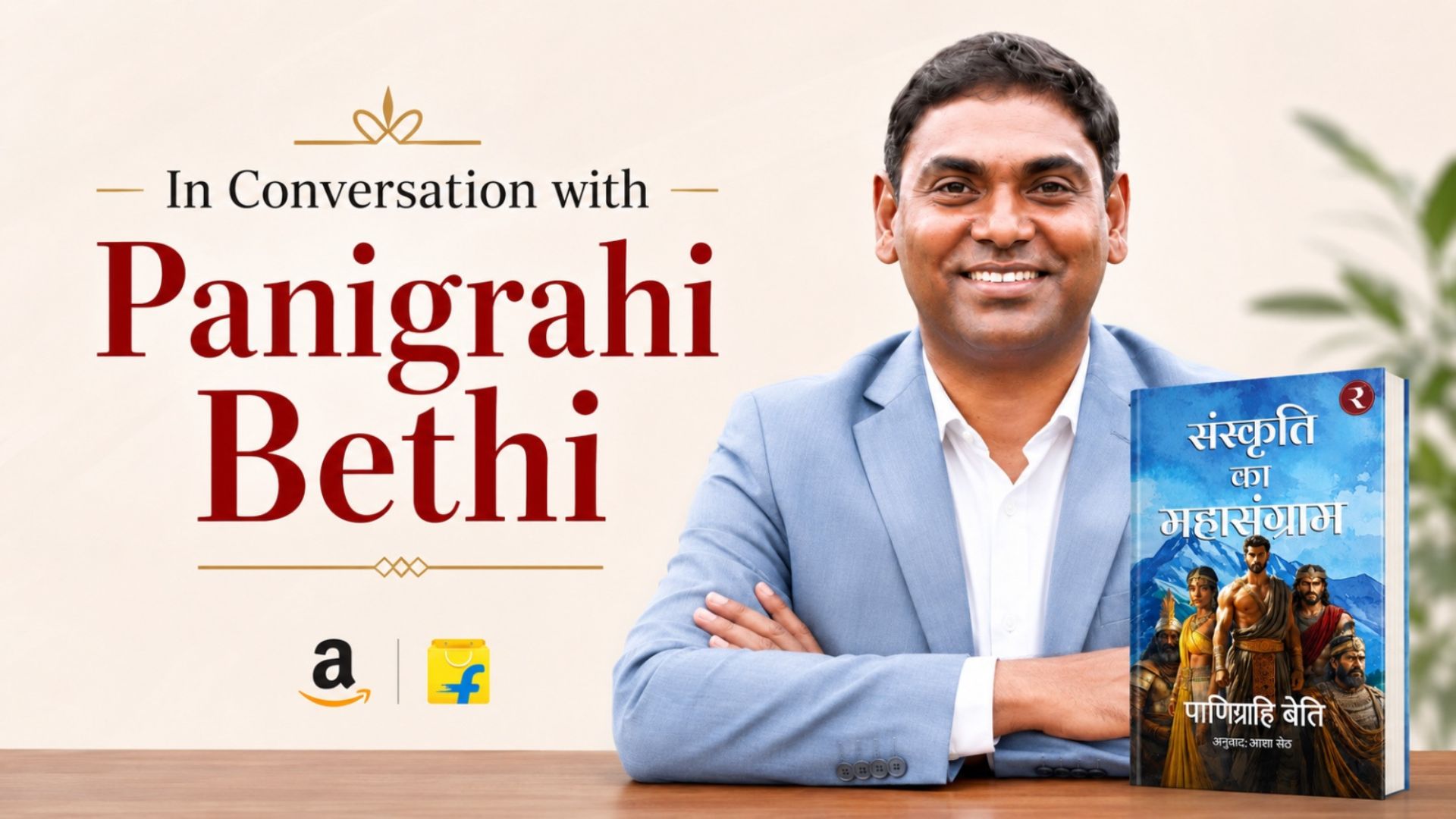
They discuss the Harappan and Aryan worlds, cultural transformation, historical imagination, translation, and the ideas that continue to shape Indian civilisation.
Sanskriti Ka Mahasangram is an ambitious historical novel set during a defining period of ancient India. Written by Panigrahi Bethi and brought to Hindi readers through Asha Seth’s sensitive translation, the book explores the encounter between the highly organised Harappan civilisation and the energetic, evolving Aryan world.
Rather than presenting history as a simple conflict between opposing communities, the novel examines how civilisations influence, challenge, and ultimately reshape one another. Through rulers, warriors, thinkers, families, and ordinary citizens, it raises important questions about cultural identity, political responsibility, coexistence, love, loyalty, and social transformation.
In this conversation, Panigrahi Bethi and Asha Seth discuss the inspiration behind the novel, its complex characters, the reconstruction of Harappan life, and the responsibility involved in carrying such a culturally layered story into Hindi.
Q1. What inspired you to write Sanskriti Ka Mahasangram?
Panigrahi Bethi:
The original inspiration came from my fascination with civilisations in transition. Historical narratives often describe change through battles, dynasties, and victories, but I wanted to explore what happens within people when two very different cultures encounter one another.
The story is not only about a confrontation between the Harappan and Aryan worlds. It is also about the ways in which they observe, resist, influence, and gradually reshape each other. In many ways, this interaction reflects the deeper roots of the cultural identity we recognise today.
I wanted to create a novel in which history was not merely a background, but a living force affecting relationships, beliefs, political decisions, and the future of entire communities.
Q2. Why did you choose the Harappan and Aryan worlds as the central setting of the novel?
Panigrahi Bethi:
These two worlds offered a powerful contrast.
The Harappan civilisation represents planning, stability, civic organisation, craftsmanship, trade, and sophisticated urban life. Its systems function with remarkable precision, both above and below the ground. Its architecture, drainage networks, pottery, and social organisation reveal a civilisation that was highly developed and forward-looking.
The Aryan world, on the other hand, is characterised by movement, energy, exploration, evolving rituals, horse-based travel, warrior traditions, and emerging Vedic thought.
When these worlds meet, the result cannot be reduced to conquest alone. Their interaction creates tension, curiosity, exchange, fear, adaptation, and transformation. That complexity became the foundation of the novel.
Q3. The Harappan civilisation feels remarkably vivid in the book. How did you reconstruct its everyday life?
Panigrahi Bethi:
I wanted readers to experience the Harappan world from within rather than observe it as a distant archaeological civilisation.
That required attention not only to large structures and political systems but also to ordinary activities: potters shaping clay, merchants travelling along trade routes, families living within carefully designed settlements, workers maintaining civic systems, and rulers carrying the responsibility of cultural preservation.
World-building becomes believable when the smallest details support the larger vision. The streets, houses, underground systems, rituals, crafts, and social relationships all had to feel interconnected.
My goal was to make readers feel that they were walking through the civilisation rather than reading a description of its ruins.
Q4. The novel does not portray either civilisation as completely right or wrong. Was this moral complexity intentional?
Panigrahi Bethi:
It was absolutely intentional.
History becomes less meaningful when it is divided into perfect heroes and complete villains. Civilisations, like individuals, contain strengths, weaknesses, contradictions, wisdom, ambition, compassion, and fear.
The Harappans are not presented as symbols of perfection, and the Aryans are not reduced to invaders without emotional or intellectual depth. Each culture possesses values worth preserving, but each also has limitations.
I wanted readers to engage with both worlds critically and empathetically. The most important historical questions often exist in morally uncertain spaces, where people make decisions based on duty, survival, love, belief, or political necessity.
Q5. What does the title Sanskriti Ka Mahasangram signify?
Panigrahi Bethi:
The title refers to a great struggle between cultural visions, but the word “Mahasangram” should not be understood only as physical warfare.
The deeper battle takes place between beliefs, traditions, political systems, social structures, and competing ideas about the future. It unfolds in royal courts, family relationships, philosophical conversations, and individual minds.
The novel asks whether a civilisation survives solely through military power or through the values, knowledge, and ideas it is able to preserve and pass forward.
The cultural conflict is therefore external as well as internal. Every major character must decide what to defend, what to question, and what to change.
Q6. Purush undergoes a quiet but significant transformation. How did you shape his journey?
Panigrahi Bethi:
Purush represents the Aryan world, but he is not meant to function merely as a symbol. He is a human being whose beliefs are challenged by direct experience.
Before encountering the Harappan civilisation, his understanding is shaped by the values and assumptions of his own community. As he begins to observe a different social order, he is compelled to reconsider what he believes about strength, progress, culture, and belonging.
His transformation is intentionally gradual. Genuine understanding cannot be forced. It develops when a person remains open enough to listen, observe, and accept that another way of life may also contain wisdom.
Purush’s journey demonstrates that cultural encounters can transform individuals before they transform societies.
Q7. What does Baguhara represent within the story?
Panigrahi Bethi:
Baguhara, the ruler of Harappa, carries the burden of leadership during a period of profound uncertainty.
He represents wisdom, responsibility, and cultural preservation, but he is also forced to confront the limitations of authority. A ruler may possess power, yet still be unable to control every historical force surrounding his people.
Through Baguhara, I wanted to explore what leadership means when a civilisation faces an uncertain future. His responsibility is not simply to protect territory. He must also protect knowledge, institutions, identity, and the dignity of his people.
His decisions show that leadership often involves choosing between equally painful possibilities.
Q8. Armita is one of the novel’s most emotionally compelling characters. What role does she play in the larger narrative?
Panigrahi Bethi:
Armita brings courage, intelligence, emotional strength, and humanity to the story.
Her relationship with Purush is not included merely as a romantic element. It becomes a symbolic bridge between two cultural worlds. Through their connection, the novel explores whether trust and understanding can emerge even when communities remain divided by fear and historical conflict.
Their relationship represents a fragile but meaningful possibility of coexistence. It shows that personal bonds can sometimes challenge inherited prejudices more effectively than political declarations.
At the same time, Armita remains an independent character with her own convictions. Her significance does not depend solely on her relationship with Purush.
Q9. How do Ashwin and Varun deepen the philosophical dimensions of the novel?
Panigrahi Bethi:
Ashwin and Varun represent different ways of interpreting society, power, belief, and the future.
Their philosophical tension allows the novel to move beyond political conflict and warfare. Through their debates, readers are invited to consider larger questions: What makes a civilisation just? Should tradition remain unchanged? Can social transformation occur without destroying cultural identity? What responsibilities do thinkers have during periods of political crisis?
Their disagreements are important because ideas often shape history long before their effects become visible on battlefields.
The conflict between them is therefore not simply personal. It reflects competing visions of how society should evolve.
Q10. The novel gives importance not only to rulers and warriors but also to ordinary citizens. Why was that necessary?
Panigrahi Bethi:
Civilisations are often remembered through rulers, monuments, and wars, but their consequences are experienced most directly by ordinary people.
Merchants, craftsmen, families, soldiers, workers, and common citizens carry the emotional and material cost of historical transformation. Their homes change, their livelihoods become uncertain, and their identities are sometimes challenged by political decisions over which they have little control.
By including these voices, I wanted to remind readers that history is not created only in palaces. It is also created in marketplaces, households, workshops, farms, and everyday acts of survival.
A civilisation is ultimately more than its rulers. It is the collective life of its people.
Q11. The story feels highly relevant to contemporary discussions about identity and coexistence. Was that connection deliberate?
Panigrahi Bethi:
Yes, although the novel is set in ancient India, its questions are deeply contemporary.
We continue to debate cultural identity, diversity, migration, belonging, political power, and the preservation of tradition. The novel reminds us that cultures rarely remain completely isolated. When communities meet, conflict may occur, but so may exchange, adaptation, learning, and the creation of something new.
Indian civilisation itself has been shaped through numerous encounters, influences, and transformations.
The past can help us understand that cultural interaction does not always result in the disappearance of one identity. It can also create a more complex and layered society.
Q12. Asha Seth, what attracted you to the task of translating this novel into Hindi?
Asha Seth:
What attracted me most was the emotional and cultural depth of the story.
Translating this book was not simply a matter of replacing words from one language with words from another. The novel contains historical atmosphere, philosophical debates, cultural references, political tensions, and deeply personal emotions. All of these elements had to remain alive in Hindi.
I wanted Hindi readers to experience the story with the same sense of immediacy and emotional intensity as readers of the original version.
The greatest responsibility was to preserve the novel’s spirit while ensuring that the language remained natural, accessible, and engaging.
Q13. What were the most challenging aspects of translating such a historically layered novel?
Asha Seth:
One major challenge was finding the right balance between historical richness and contemporary readability.
If the language became excessively formal, it could create distance between the reader and the characters. However, if it became too modern or casual, the historical setting would lose credibility.
The philosophical conversations required particular care because their meaning depended on tone, rhythm, and cultural context. The names of customs, social structures, rituals, and material objects also had to feel authentic without overwhelming the reader.
I approached each section by asking not only what the sentence meant, but also what emotional response it was intended to create.
Q14. How did you preserve the distinct voices of the characters in Hindi?
Asha Seth:
Every major character speaks from a different position within society and carries a different emotional history.
A ruler cannot sound exactly like a warrior, a philosopher, or an ordinary citizen. Similarly, characters from the Harappan and Aryan worlds needed subtle differences in expression without making the language feel unnatural.
I paid close attention to vocabulary, sentence structure, emotional restraint, and the rhythm of dialogue. The objective was to ensure that readers could sense a character’s authority, vulnerability, conviction, or uncertainty through the language itself.
Translation becomes successful when readers stop noticing the translation and begin responding directly to the characters.
Q15. How did the author and translator work together to retain the authenticity of the narrative?
Panigrahi Bethi:
The translation required trust and close attention to the intentions behind the story.
Historical fiction often contains meanings that are not visible at the surface level. A particular phrase may carry political, emotional, or symbolic importance. It was therefore necessary to communicate not only what was happening in a scene but also why it mattered.
Asha Seth:
Our focus remained on preserving the emotional and cultural essence of the book.
Whenever a passage carried multiple possible interpretations, the priority was to retain the author’s central intention while making it effective in Hindi. Translation is a collaborative act because it requires respect for the original voice as well as sensitivity towards the new readership.
Q16. The novel contains lengthy philosophical and cultural discussions. How did you balance these with the momentum of the story?
Panigrahi Bethi:
The philosophical discussions are not separate from the plot; they influence the decisions characters eventually make.
However, it was important that the novel did not become a collection of abstract debates. Ideas had to emerge through conflict, relationships, political pressure, and personal consequences.
The slower sections allow readers to understand what is at stake beyond physical survival. The battle concerns not only land and authority but also the kind of society that will emerge in the future.
The pacing is deliberate because civilisational transformation itself is gradual. It develops through accumulated decisions, conversations, compromises, and acts of resistance.
Q17. What role do love and loyalty play within this large historical conflict?
Panigrahi Bethi:
Love and loyalty make the larger conflict emotionally meaningful.
A person may feel loyalty towards a ruler, a family, a cultural tradition, a political ideal, or someone from another community. These loyalties do not always remain compatible.
Characters are frequently forced to choose between personal affection and collective duty. Such moments reveal the human cost of historical change.
Love in the novel does not erase political or cultural differences. Instead, it makes those differences more difficult and more deeply felt. It asks whether personal understanding can survive when the surrounding world demands division.
Q18. What do you hope readers will understand about the Harappan civilisation after reading the novel?
Panigrahi Bethi:
I hope readers will move beyond the idea of the Harappan civilisation as something primitive, distant, or defined only by archaeological ruins.
It was a sophisticated and highly organised civilisation with advanced civic systems, remarkable craftsmanship, structured urban planning, and a strong social imagination.
Many of its ideals—clean cities, effective infrastructure, organised trade, skilled labour, and thoughtful community planning—continue to resemble the aspirations of the modern world.
The novel invites readers to recognise the intelligence and humanity of the people who created that civilisation.
Q19. Who do you believe will connect most strongly with Sanskriti Ka Mahasangram?
Panigrahi Bethi:
The novel will appeal to readers who enjoy Indian historical fiction, political drama, philosophical inquiry, and character-driven storytelling.
It may also interest readers who are curious about the formation of civilisations and the relationship between culture, power, and identity.
This is not a novel focused only on constant action. It asks readers to engage with ideas, observe gradual transformations, and consider multiple perspectives.
Readers who appreciate stories combining history with emotional and intellectual depth will find much to explore within it.
Q20. What would you like readers to carry with them after finishing the book?
Panigrahi Bethi:
I hope readers finish the novel reflecting on the forces that shape civilisations and the people who experience those transformations.
Cultures do not survive only because they win battles. They survive through memory, knowledge, adaptability, values, and the willingness to learn from encounters with others.
The novel ultimately asks whether difference must always produce destruction or whether it can also become the beginning of transformation.
Asha Seth:
I would also like Hindi readers to feel that this story belongs naturally within their literary world. If they experience its characters, conflicts, and emotions without feeling any distance from the original narrative, the translation will have fulfilled its purpose.
About the Author
Panigrahi Bethi
Panigrahi Bethi is the author of Sanskriti Ka Mahasangram, an expansive historical novel exploring the encounter between the Harappan and Aryan worlds.
Through richly imagined settings, complex characters, political conflict, and philosophical inquiry, Bethi examines questions of cultural identity, governance, social transformation, and the forces that shape civilisations.
His storytelling combines large-scale historical developments with intimate human experiences, presenting the past not as a fixed record but as a living world of competing beliefs, emotional choices, and evolving relationships.
About the Hindi Translator
Asha Seth
Asha Seth is the Hindi translator of Sanskriti Ka Mahasangram.
Her translation seeks to preserve the historical atmosphere, emotional depth, philosophical complexity, and cultural richness of the original narrative while presenting it in clear and accessible Hindi.
Through careful attention to character voice, dialogue, and historical context, she has enabled Hindi readers to experience the novel with the same emotional and intellectual intensity as its original audience.
Buy the Book
Purchase your copy of Sanskriti Ka Mahasangram on Amazon:
https://www.amazon.in/dp/9349988852