
Samvidhan Decoder by Dr. Sneha Rakesh Gujjar – Book Review
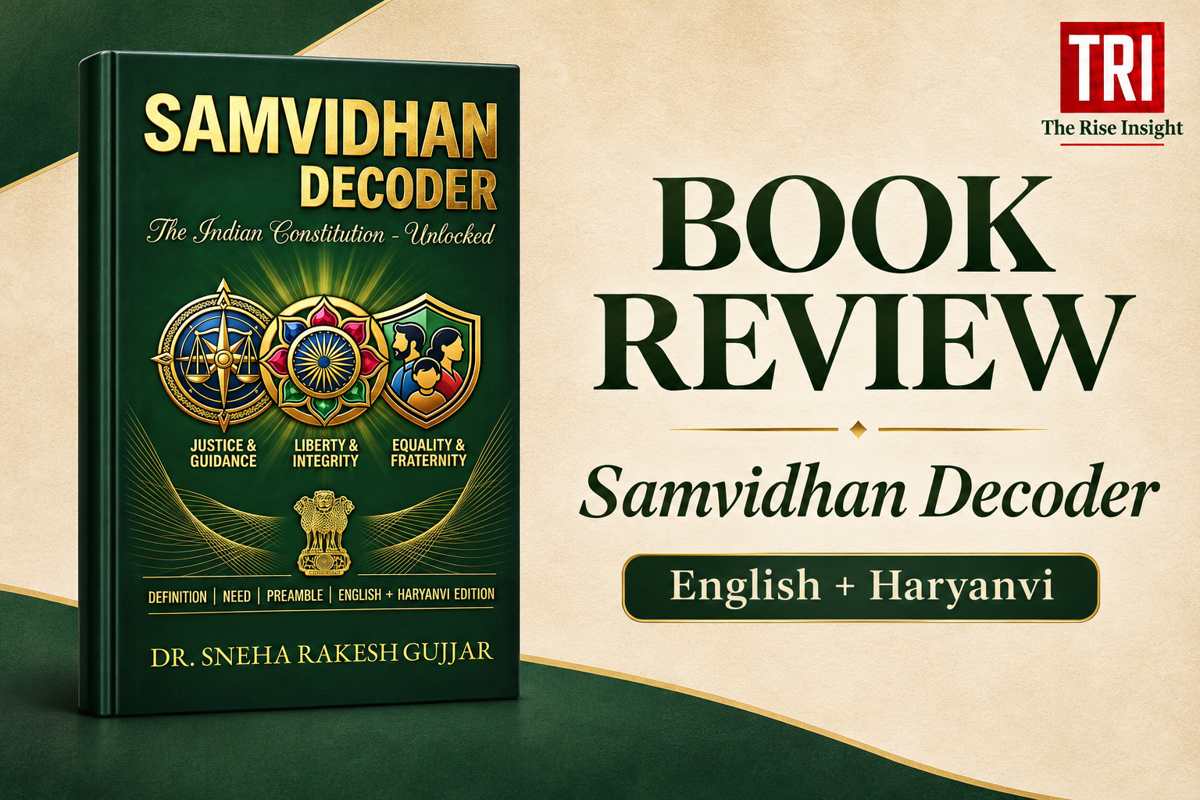
What would everyday life look like if the government had no limits, or if citizens had no way to challenge its decisions? Samvidhan Decoder: The Indian Constitution – Unlocked begins with a version of that question rather than a list of articles to memorise. Dr. Sneha Rakesh Gujjar’s short English-and-Haryanvi introduction puts two tasks side by side: explaining why constitutional rules matter and making that explanation available in a language familiar to Haryanvi speakers. It is most persuasive when it keeps those two aims in view and least convincing when a quick definition has to do the work of a fuller explanation.
Starting with a question, not a definition
The first chapter, “Understanding the Constitution,” asks readers to imagine a country without equal opportunities, reliable government or a way to speak against those in power. Only then does it introduce the Constitution as a set of foundational principles. The order matters. Instead of asking beginners to retain a definition before knowing what it is for, the chapter gives them a problem that the definition helps explain. It also makes an important distinction for a first lesson: constitutional rules do not simply empower governments; they set limits on them.
“Why do we need the Constitution?” picks up this distinction with two deliberately extreme scenarios. In one, an unchecked government decides which professions people may enter, and a dispute involving a political leader cannot count on a fair hearing. In the other, government is reduced to a nominal role and wealthy citizens can discriminate against poorer people. These are illustrations, not descriptions of how political systems actually operate. Their value is that they give readers a concrete way to ask who makes decisions, who can challenge them and what rules protect people with less power.
From everyday examples to the Constituent Assembly
The second chapter then changes gears. It traces the demand for a Constituent Assembly through the Cripps proposal and the Cabinet Mission, before turning to the Assembly’s composition, working and committees. Portraits and historical images give the reader visual points of reference. The third chapter, “Indian Constitution,” narrows its attention to the Drafting Committee, its chair Dr. B. R. Ambedkar and the role of constitutional adviser B. N. Rau. Its separate treatment of drafting, adoption and enforcement is helpful: a beginner can see that preparing a constitutional text and bringing it into force are different stages.
That historical material could be easier to follow. Partway through the second chapter, the conversational questions give way to a much denser series of names, dates and institutional details. A one-page timeline, with parallel English and Haryanvi labels, would help readers connect those details instead of remembering them as isolated facts. Clear references to primary sources would also make it easier to check particular historical claims or follow up on the Assembly’s debates. The book offers signposts into that history, but it is not designed to settle disputes about it.
The Preamble in familiar language
The final chapter returns to the book’s most useful teaching method: move from a familiar idea to a formal term. It treats the Preamble as an introduction to the Constitution’s objectives and then explains words including sovereign, socialist, secular, democratic and republic. Its discussion of justice is especially effective as a teaching device. By separating social, political and economic justice, it invites readers to think about different questions: who faces discrimination, who can take part in public decisions and who gets a fair chance to improve their circumstances. Liberty, equality and fraternity each receive attention rather than being left as a single ceremonial phrase.
The English and Haryanvi passages follow one another through much of the book. That arrangement lets a reader work through an idea in the more familiar language and then match it to the vocabulary they might see in a classroom or textbook. The Haryanvi is a means of teaching, not just a bilingual label on an English primer. Some Preamble definitions, however, are compressed enough to blur the difference between a constitutional ideal and an enforceable right. A reader looking for what a particular provision does in practice, or how courts interpret it, should turn to the official constitutional text and reliable legal commentary.
Who should read it?
Samvidhan Decoder is best suited to first-time readers, especially students who can discuss civic ideas more easily in Haryanvi than in formal English. A teacher or reading group could start with the opening scenarios and return to them after the Preamble chapter: which values are at stake in each example, and which ones are easy to confuse? That is where the book’s compact format works in its favour. It gives readers enough vocabulary to begin that conversation without pretending the conversation ends there.
Edition reviewed: Evincepub Publishing, 2026. ISBN: 9788166521089. Languages: English and Haryanvi.