
Racial Discrimination and Inequality in India – An Unhidden Reality: A Powerful Examination of Prejudice, Social Exclusion, and the Pursuit of Equality
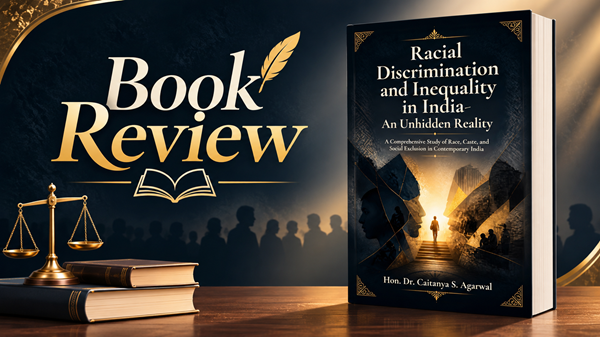
Book Review
Equality is one of the most fundamental principles of a civilized society, yet discrimination continues to influence the lives of individuals and communities across the world. Despite advancements in education, legislation, economic development, and social awareness, deeply rooted prejudices still affect people’s opportunities, identities, and dignity. Racial Discrimination and Inequality in India – An Unhidden Reality by Hon. Dr. Chaitanya S. Agarwal addresses these concerns through an examination of racism, colourism, social exclusion, and the historical and cultural forces that sustain inequality. The book explores an important and sensitive subject that remains relevant in contemporary India. By examining the relationship between prejudice, social attitudes, and unequal opportunities, the author encourages readers to question discriminatory practices and consider the importance of building a more inclusive society.
Rather than treating racial discrimination as a problem confined to particular countries or historical periods, the book’s central premise recognizes it as a continuing social challenge that requires awareness, education, legal safeguards, and meaningful changes in collective attitudes. One of the most significant aspects of the book is its recognition that discrimination can take different forms. Racism, colourism, prejudice, and social exclusion may overlap, but they are not identical. Racism involves discrimination or prejudice based on perceived racial identities. Colourism often places different social values on people according to skin tone, sometimes even within the same community. Social exclusion can emerge when individuals or groups are denied opportunities, recognition, or meaningful participation because of characteristics associated with their identity. By addressing these interconnected issues, the book encourages a broader understanding of inequality. Discrimination is not always expressed through direct hostility. Sometimes, it operates through subtle assumptions, biased expectations, unequal treatment, or social practices that appear ordinary because they have existed for generations.
Recognizing these less visible forms of prejudice is essential for understanding how inequality persists.
The book’s subject encourages readers to examine not only obvious discriminatory actions but also the beliefs and institutional patterns that can perpetuate unequal treatment. Discrimination rarely emerges without historical context. Social hierarchies, inherited prejudices, cultural expectations, and unequal access to resources can influence how communities understand identity and status. The book’s attention to the historical and social roots of racial bias provides an important foundation for examining contemporary inequality.
In India, discussions of discrimination require particular care because caste, ethnicity, religion, language, regional identity, and skin colour can influence social experiences in different and sometimes overlapping ways. Although these categories have distinct histories and meanings, they may contribute to patterns of exclusion when individuals are judged according to inherited identities rather than personal character or ability.A meaningful examination of inequality must therefore consider both individual behavior and larger social structures. The book’s interdisciplinary subject encourages readers to understand discrimination as something shaped by historical developments, social institutions, and everyday interactions. This perspective is valuable because lasting change requires more than condemning isolated incidents. It also requires understanding the conditions that allow prejudice to continue.
Education is widely recognized as a pathway toward personal development, social mobility, and greater opportunity. However, discrimination can undermine this potential when students experience exclusion, unfair treatment, stereotypes, or unequal access to educational resources.
The book highlights education as one of the important areas influenced by racial and social bias.
A student’s confidence and sense of belonging can be affected when their identity becomes a reason for ridicule or exclusion.
Similarly, unequal expectations or discriminatory assumptions may influence how individuals are treated within educational environments.
These concerns make the book’s subject relevant to teachers, educational administrators, students, and policymakers.
Creating inclusive educational institutions requires not only formal commitments to equality but also everyday practices that demonstrate fairness and respect.
Education also has a transformative role in challenging prejudice.
Through critical thinking, historical awareness, and exposure to diverse perspectives, educational institutions can help students question stereotypes and recognize the dignity of others. Employment is another important area in which discrimination can produce lasting consequences. Professional opportunities should ideally depend on qualifications, skills, experience, and performance. However, prejudice can influence recruitment, workplace relationships, advancement opportunities, and professional recognition. The book’s focus on employment highlights how unequal treatment can affect both individual careers and broader social mobility. Discriminatory assumptions may prevent capable individuals from receiving fair consideration or create environments in which employees feel undervalued. The consequences extend beyond financial disadvantage. Workplace discrimination can also affect confidence, emotional well-being, professional identity, and a person’s sense of belonging.
By including employment within its wider examination of inequality, the book reinforces the importance of fair institutional practices and inclusive professional cultures.
Organizations committed to genuine equality must examine not only their formal policies but also the attitudes and decision-making processes that influence everyday workplace experiences. Perhaps the most meaningful dimension of the book’s subject is its attention to human dignity. Discrimination is not merely an abstract social problem. It affects real people whose opportunities, relationships, and sense of identity may be influenced by unfair judgments.
Being repeatedly evaluated according to skin colour, ancestry, or social background can create feelings of humiliation, alienation, and insecurity.
Such experiences may influence how individuals perceive themselves and their place within society.
The book’s emphasis on dignity encourages readers to look beyond statistics and institutional definitions.
At the center of every discussion about equality are human beings who deserve respect and fair treatment.
This perspective is particularly important because discriminatory behavior is sometimes dismissed as harmless tradition, personal preference, or ordinary social judgment.
Understanding its emotional consequences can encourage greater empathy and responsibility.
A respectful society must recognize that dignity should not depend on appearance, identity, wealth, or social position. Social status often influences access to resources, recognition, and opportunities. When inherited identities or prejudicial assumptions determine how individuals are treated, existing inequalities may become increasingly difficult to overcome. The book examines the connection between racial bias and broader patterns of social disadvantage. This connection matters because discrimination can affect individuals across multiple dimensions of life. Unequal educational opportunities may influence employment prospects. Limited economic mobility can affect access to healthcare, housing, and social participation. As these disadvantages accumulate, they may reinforce existing inequalities. Addressing discrimination therefore requires a wider understanding of how social institutions and cultural attitudes interact.
The book encourages reflection on the difference between formal equality and equality in everyday experience.
Equal rights are essential, but their practical value depends on whether individuals can exercise them without facing unjust barriers. One of the most constructive elements of the book’s central message is its emphasis on education and changing social attitudes. Prejudice can persist when stereotypes are repeated without examination or when discriminatory behavior becomes normalized. Education creates opportunities to challenge these assumptions. However, meaningful awareness must extend beyond classrooms.Families, workplaces, community institutions, public discussions, and media representations all influence how people understand difference and equality.
The book’s focus on diversity and inclusion encourages readers to recognize the value of respectful social interaction.
Accepting diversity does not require individuals to abandon their cultural identities. Rather, it involves acknowledging that different identities deserve equal dignity and consideration. Social transformation becomes possible when people develop the willingness to question inherited prejudices and treat others fairly.
Amazon Link – https://www.amazon.in/Racial-Discrimination-Inequality-Unhidden-Reality/dp/9379000731/