
Who Owns the Kohinoor? Love, Legacy and the Morality of Reclaiming History
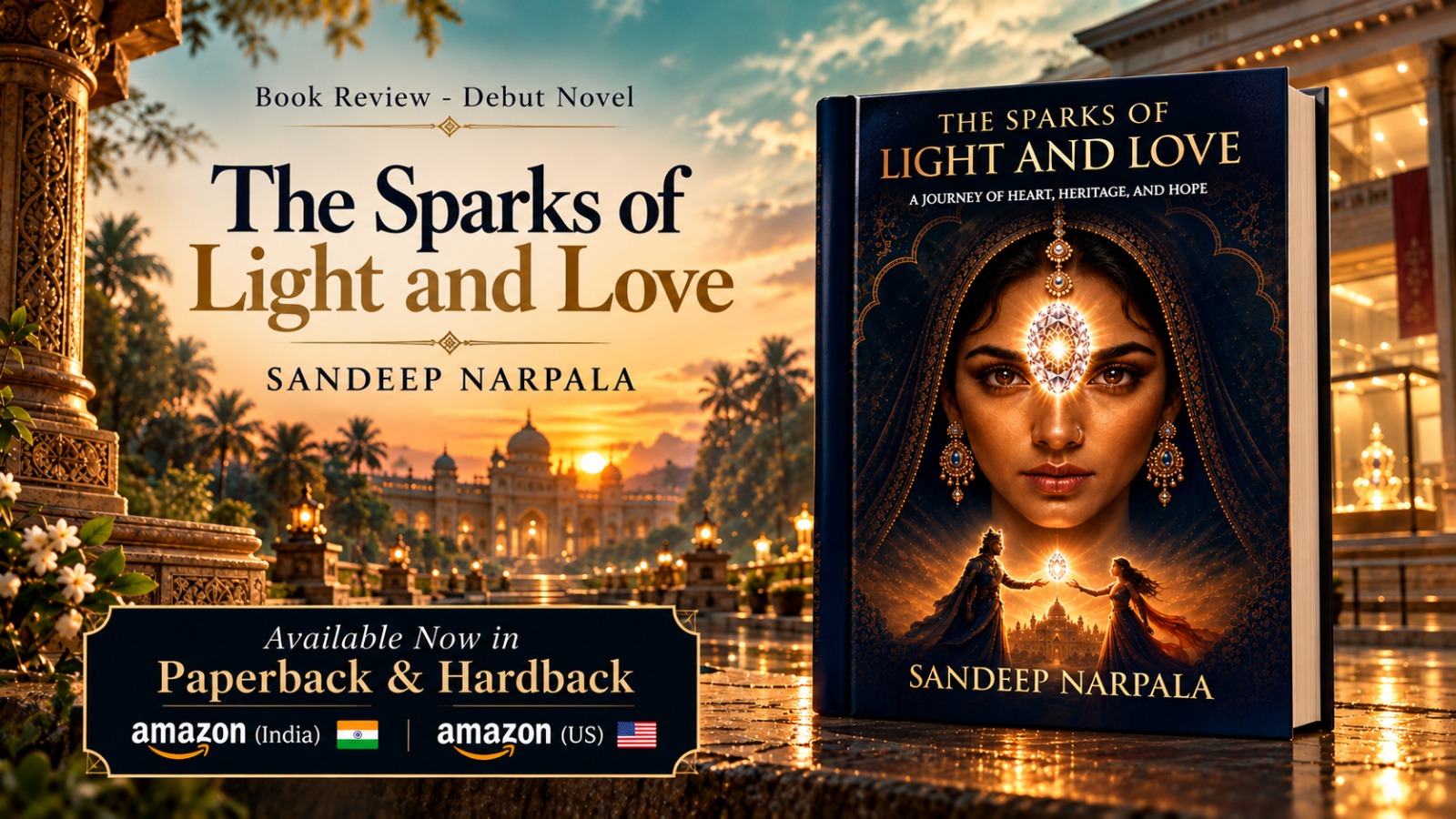
A review of Sandeep Narpala’s The Sparks of Light and Love
What happens when something taken through conquest is stolen back? That question sits at the heart of Sandeep Narpala’s The Sparks of Light and Love, a historical crime romance built around one of the world’s most contested treasures. The Kohinoor is stolen almost immediately, giving the novel an instant jolt of urgency. But the real intrigue lies beyond the mechanics of the heist. Sandeep is less interested in simply asking whether the diamond can be stolen than in asking what such an act means. If an object was acquired through conquest and colonial power, does reclaiming it constitute another crime, an act of justice, or something far more complicated? The novel refuses to offer an easy answer. Instead, the Kohinoor becomes many things at once: evidence, inheritance, temptation and wound. Around it, Sandeep constructs a story where romance, crime and questions of cultural memory continually collide.
When History Becomes Personal
At the centre of the story is Prince Suryanarayana, a brilliant gemologist whose Indian and British citizenship places him between two national histories. His expertise gives him unusual access to the Kohinoor, but his divided sense of belonging makes the diamond’s history deeply personal. Prince is not simply a clever protagonist attempting to outwit the authorities. He is caught between law and justice, professional integrity and cultural memory, public responsibility and private devotion. That tension gives the character his complexity. His actions may be understandable without being uncomplicated, and Sandeep allows readers to sit in that uncomfortable space rather than handing them an easy moral conclusion.
The emotional centre of the novel is Vajra, the gifted student Prince loves. Her mysterious connection to the Kohinoor transforms the diamond from an object protected behind glass into something with an active presence in the lives of those who encounter it. Vajra is haunted by visions of the stone’s violent past, and those visions begin to affect her health. Prince comes to believe that recovering the diamond may be the only way to save her. Suddenly, the stakes are no longer historical or political alone. They are deeply personal. Love becomes the reason Prince is willing to cross boundaries that his academic training and public position should compel him to respect. It does not simply soften the thriller. It drives it.
The Morality of a Stolen Treasure
This is where The Sparks of Light and Love finds its central tension. The Kohinoor carries a history so enormous that it could easily overwhelm any fictional character placed beside it. Its name evokes centuries of conquest, possession and political symbolism. Sandeep counters that scale by giving the historical question a human face. A debate about ownership becomes a decision about whether one person can be saved.
Readers may disagree with Prince’s methods, but they can understand the fear and devotion that motivate them. The suspense grows from precisely that gap between emotional necessity and ethical permission. The question is not simply whether Prince will succeed. It is whether success would actually make him right.
The British response to the theft expands the novel’s conflict. Detective Scott represents the determination of the authorities to recover what the state considers its property, while Amarkesh Vitrodi introduces another set of motives and uncertainties into the pursuit. This prevents the story from settling into a straightforward India-versus-Britain narrative. Instead, different characters approach the diamond with different claims, ambitions and interpretations of the past. The resulting pursuit becomes an argument conducted through surveillance, deception and risk.
That is one of the novel’s more interesting choices. Nobody gets to occupy the moral high ground completely. Each character brings a different understanding of ownership, duty, loyalty and justice to the same object, allowing the Kohinoor itself to become the point around which competing versions of the past collide.
When Knowledge Becomes Dangerous
One of the book’s strongest elements is the way Sandeep uses Prince’s expertise as a gemologist. His knowledge protects him, but it also makes him vulnerable. He understands stones, provenance and authenticity, and that same expertise allows him to navigate the systems designed to identify and protect valuable objects. His academic intelligence can therefore serve both scholarship and concealment.
Knowledge becomes a double-edged instrument. The more Prince understands about the diamond, the more capable he becomes of manipulating the structures surrounding it. His professional identity and his increasingly dangerous actions begin to overlap, keeping the protagonist morally and practically exposed even when he appears to be several steps ahead.
The novel also benefits from the contrast between the Kohinoor’s dazzling image and its violent history. “Mountain of Light” suggests beauty and radiance, yet the stone carries stories of conquest, transfer and loss. Through Vajra’s visions, that history acquires a physical and emotional dimension. The past refuses to remain safely in the past. It enters her present and begins to affect her life.
This allows Sandeep to explore historical memory through experience rather than exposition. The history surrounding the Kohinoor is not simply information for the reader to absorb. Within the novel, it becomes something the characters have to live with.
Where Romance Meets Crime Fiction
Sandeep’s blending of romance, crime and heritage defines much of the reading experience. The heist supplies momentum, the romance raises the emotional stakes, and the historical question gives the chase a larger purpose. The three strands continually pull against one another, preventing the novel from belonging neatly to a single genre.
A reader may arrive for the crime story and find themselves thinking about colonial history. Another may come for the romance and discover an ethical argument about ownership. Someone drawn to the historical dimension gets, in turn, a fast-moving story of deception, pursuit and risk. That genre-crossing quality gives the novel much of its accessibility and helps it move between the intimate and the monumental without losing its central thread.
The prose follows a similarly accessible philosophy. Sandeep has spoken about his preference for writing that is plain, quick and approachable, particularly for readers who may not consider themselves avid readers. That intention works with the premise. The novel takes a complicated subject and places it within recognisable human desires: the desire to save someone, to belong somewhere, to correct an injustice and to escape the consequences of a desperate decision. The language does not need to become ornamental for those emotions to carry weight.
The pacing follows the same principle. A stolen object of international importance cannot remain a private secret for long. Every attempt to control the situation creates another possibility of exposure. As a result, revelation becomes almost as important as pursuit. Will Prince be caught? What exactly is Vajra’s connection to the stone? And what do the people around them really want? The novel keeps several of these questions alive at once, allowing the suspense to develop through overlapping uncertainties.
The Human Fear Beneath the Spectacle
There is something cinematic about the novel’s combination of London authority, Indian memory, academic expertise and romantic danger. Yet beneath that larger-than-life setup is a much more ordinary fear: losing someone before finding a way to help them. That fear gives the story its emotional warmth and explains why the novel can appeal to readers of romance as readily as readers of crime fiction. Beneath the diamond, the chase and the historical argument is a relationship placed under extraordinary pressure.
Prince is at his most compelling when the plot places his motives under scrutiny. He may believe he is reclaiming heritage and saving Vajra, but good intentions do not automatically erase the consequences of deception. At the same time, the authorities may insist on legality, but legality alone cannot settle the historical circumstances through which the diamond came to be possessed. The novel’s moral energy emerges from allowing both ideas to coexist. One value can be protected only by compromising another.
What the Title Reveals
The title, The Sparks of Light and Love, captures this balance neatly. “Sparks” suggest beginnings, small points of energy capable of becoming something much larger. “Light” naturally evokes the Kohinoor, but it also suggests knowledge, hope and exposure. And then there is “love”, the force that turns an abstract historical conflict into a deeply personal one.
Together, the words describe a story in which a personal bond ignites a confrontation with history. Even the subtitle, Heart, Heritage and Hope, maps neatly onto the novel’s three central concerns. The title ultimately points towards the book’s larger argument: history may be inherited, but the way we respond to it remains deeply human.
Can the Past Really Be Reclaimed?
As the secrets deepen and loyalties are tested, the meaning of recovery becomes increasingly complicated. Recovering the Kohinoor might mean returning an object. It might mean rescuing Vajra. It might mean restoring a sense of cultural dignity. Or it might mean reclaiming a place in a story that was once written by empires.
These meanings do not necessarily lead to the same destination, and that is precisely where the novel finds its most interesting territory. Sandeep understands that a symbol as powerful as the Kohinoor cannot be reduced to a single victory. Even possession cannot erase the suffering attached to its history.
Ultimately, The Sparks of Light and Love uses the pleasures of fiction to reopen a question that history has never quite allowed to settle. It gives readers a chase to follow, a relationship to care about and an ethical conflict that lingers long after the immediate danger has passed. At its heart, the novel asks uncomfortable questions: Who owns the past? What can love justify? Can an act outside the law ever repair an injustice created through power?
There are no easy answers here, and perhaps that is precisely the point. The Kohinoor remains more than a diamond. In Sandeep’s hands, it becomes a symbol around which love, history, identity and morality collide. That combination of pace, emotion and historical questioning is what gives The Sparks of Light and Love its lasting spark.
About the Book
The Sparks of Light and Love by Sandeep Narpala
Goodreads: The Sparks of Light and Love
Amazon India: Buy on Amazon India
Amazon.com: Buy on Amazon
Ziffy Bees: Buy on Ziffy Bees