
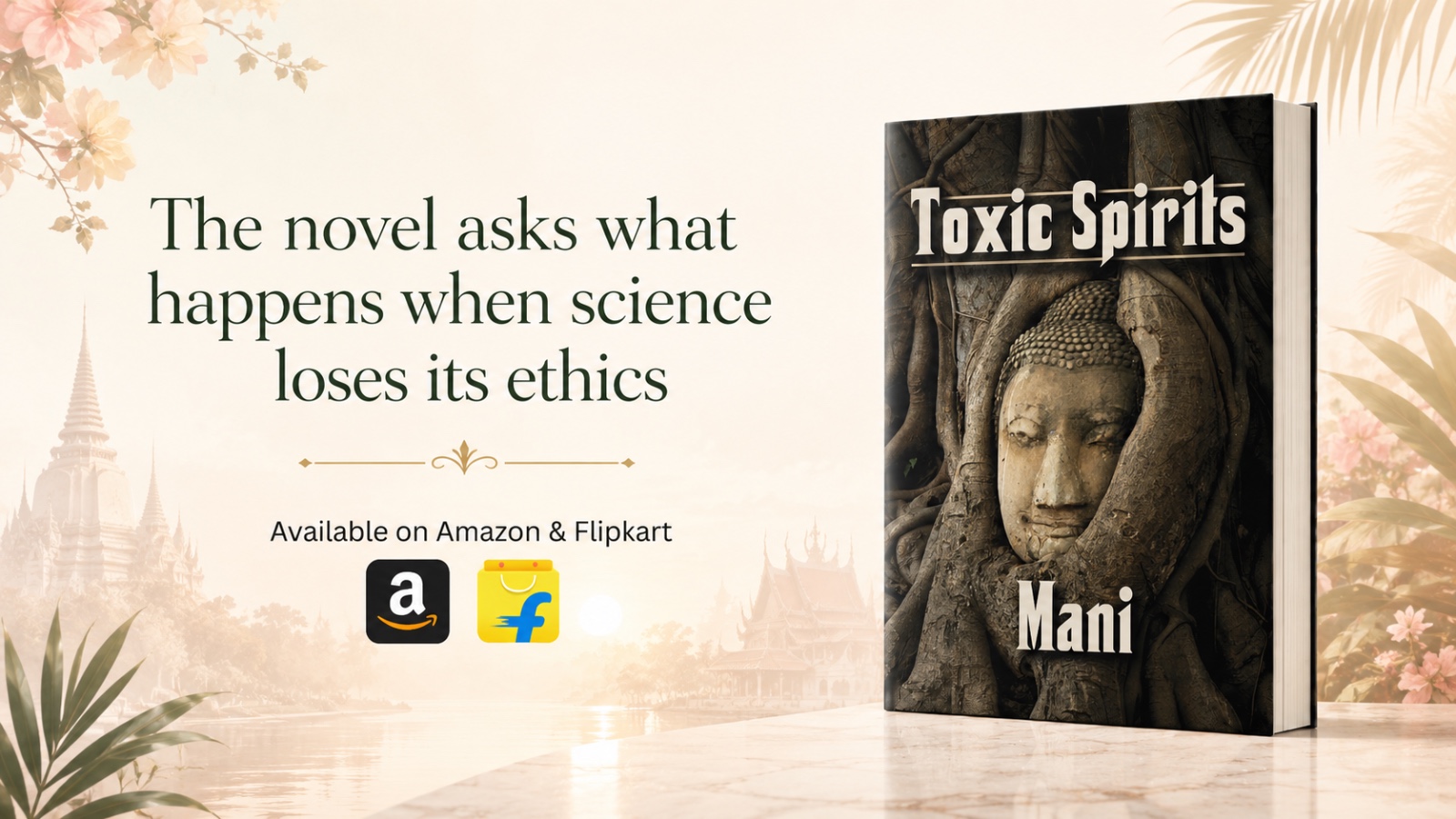
Many people come to Thailand looking for a new life. They expect beautiful beaches, lively markets, and a slower pace. That is the world Benton Sims hopes to find when he retires from Washington and settles in a Thai beach town. An evening at a local expat bar draws him into a mystery that reaches far beyond the tourist world. A young tribal singer named Siri disappears after speaking out about drug trials in her community. As Benton searches for her, he uncovers a secret programme that puts profit and scientific ambition ahead of human life. Toxic Spirits works well as a thriller, but it has larger interests. It poes questions about the limits of scientific progress and who benefits from it. It also explores the gap between those who hold power and those who live with its often devastating effects.
Table of Contents
ToggleA retirement that takes an unexpected turn
Benton is an appealing lead because he is savvy as well as vulnerable. He spent his career as an intelligence analyst, so he notices details and asks questions that others might miss. He is also grieving after losing his wife. Retirement offers a chance to leave that life behind, yet he soon finds himself facing a different kind of danger.
Siri’s disappearance changes everything. What first seems like simple curiosity becomes a personal commitment. Benton cannot ignore what he has learned about the medical trials, especially when he realizes that the people taking part have little power to protect themselves. His search leads him to Pierre, the doctor behind the experiments. Pierre is much more than a stock villain. He is intelligent, confident, and fully convinced that his work is justified. That certainty makes him far more unsettling than someone who simply enjoys doing harm for harm’s sake. He believes he is helping humanity, even as he destroys individual lives.
Thailand as more than a backdrop
One of the novel’s greatest strengths is its setting. Thailand shapes the story from beginning to end. Retirees, travellers, local workers, tribal people, and long-term foreigners cross paths in Prajawan’s bars and cafés. Everyone seems to have arrived for a different reason, and many carry a past they would rather leave behind.
The story also reaches beyond the coast. It moves into the forests of the Golden Triangle, back to Washington, DC, and later to Auroville in India. Each place adds something to the story and broadens its view of the world.
The descriptions are rich without slowing the pace. Food, temples, tropical heat, forests, and crowded streets all help create a strong sense of place. The landscape is beautiful, but dangerous. The same forests that attract visitors shelter communities living with exploitation. As the story unfolds, even the natural world begins to feel the effects of the experiments. Nature becomes part of the conflict instead of remaining in the background.
A thriller with real ethical weight
The mystery centres on genetically engineered drugs tested on a vulnerable hill-tribe community. That idea gives the novel much of its power because it feels believable, given well-known instances of experiments being carried out on marginalized communities without their consent.
Benton’s investigation becomes deeply personal when he himself falls victim to the experiments. The change is effective because it removes any distance between investigator and victim. The novel also raises difficult questions. What responsibilities come with scientific knowledge? Who has the right to change another person’s body? How much should people sacrifice in the name of progress?
Pierre sees human beings as material that can be improved. The hill-tribe healers offer a very different view. Their knowledge grows out of long experience and close ties to community. The conflict is never couched simplistically as science versus tradition. It is a struggle between knowledge used with care, and knowledge used without limits.
Characters caught between cultures
Benton is a strong central character because he never feels larger than life. His years in intelligence have taught him to observe people and spot patterns. At the same time, he carries the scars of racism, grief, and conflicting beliefs during his career. His position in Thailand is equally complex. He enjoys the freedom that comes with being an expatriate, yet he also knows what it means to live outside the circles of power. That gives him sympathy for people whose voices are easily ignored. His own ancestry also fits naturally into the novel’s interest in genetics and identity. It adds depth to his character without becoming the whole point of it.
Siri sets the story in motion, but her role goes beyond the mystery. She refuses to stay silent about the drug trials affecting her community. Her disappearance gives Benton a reason to investigate, yet her influence continues long after she leaves the page. She reminds the reader that the people most affected by the experiments deserve to be heard.
Later, Benton meets Mimi, a young Thai-Australian Muay Thai boxer. She brings warmth and energy to the story, and she is far more than a young romantic interest. She is resourceful, determined, and capable of looking after herself. Her relationship with Benton develops while his life is falling apart, so it never distracts from the central story, instead raising the emotional stakes.
Science, language and dark humour
Mani’s background in science gives the novel authority when it deals with genetics and medical research. The science supports the story without overwhelming it. Readers do not need specialist knowledge to follow what is happening , and the technical ideas are closely tied to the characters and the plot.
The novel also makes good use of local speech. Regional expressions and the glossary give the dialogue a sense of place.
Another strength is the balance of tone. The story contains violence and disturbing scenes, but it also has moments of dry humour, reflecting the oddities, to Benton, of the expat world as well as Thailand. The humour offers a pause without weakening the suspense.
Where the novel may challenge readers
Toxic Spirits brings together many ideas. It combines a mystery, a medical conspiracy, genetic science, romance, environmental concerns, and questions about identity. Most of the time these strands work well together, although some readers may wish that a few of them had more room to develop.
The novel also moves between several countries and shifts comfortably between different moods. Those changes keep the story lively, but they ask the reader to stay alert.
Some scenes are graphic. The novel includes violence, medical experimentation, and body horror. They fit the story, but readers who dislike this kind of material should be aware of it before they begin.
Final verdict
Toxic Spirits is a short novel that leaves a lasting impression. It succeeds as an international thriller because the suspense grows naturally from the characters and the setting. At the same time, it gives readers something more to think about.
The novel asks how scientific knowledge should be used and who should benefit from it. It also considers the responsibilities that come with power and the cost of ignoring people whose voices are easy to dismiss.
Frederick Barthelme calls it “a complex and enthralling international intrigue,” and that is a fair description. Yet the novel offers more than a well-constructed thriller. It presents Thailand in all its beauty while showing the lives that exist beyond the tourist view. Readers who enjoy international thrillers, Southeast Asian settings, and science-based fiction with strong moral questions should find Toxic Spirits both engaging and memorable.
Buy the book: Toxic Spirits on Amazon India