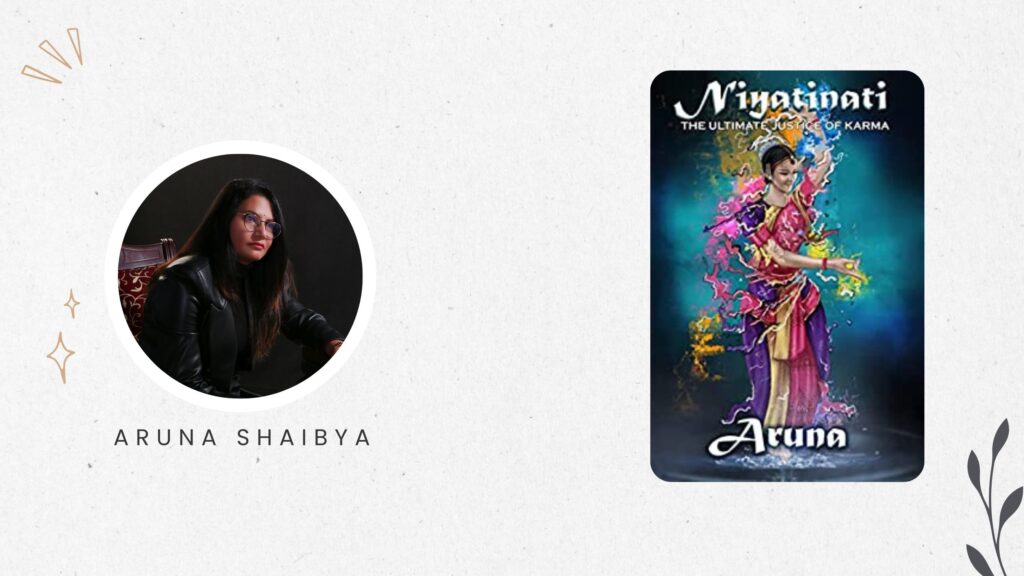
Aruna Shaibya was born in the Mirzapur district of India and grew up in the city of Varanasi. She graduated from Banaras Hindu University (BHU) with a degree in Hindi Literature and also holds a master’s in Social Work and a doctorate in Vedic Studies. In place of boring government job it is with writing that she has deepest connection and she is founder of an NGO called Aali-Foundation, which works to help women and children who are facing problems in life. Motivated by her father who still spends hours reading and writing every day, she has already written 5 Hindi poetry books and two novels, Niyatinati and Apoorva, and is now working on a 5 book series based on Indian mythology, called VIJAYSANGRAM Today, Aruna lives in National Capital Region (N.C.R.) and spends her free time reading, writing, listening to music and experimenting with new recipes in her kitchen. She has a deep connection with nature and children and enjoys travelling to quieter corners of the planet whenever she can, visiting temples and sacred places that provide her with comfort and inspiration. Her hopes for the future include doing enough positive things that bring great change to the world, causing others to one day write about her. She wants to see women treated as equals in society and have the same opportunities as men and to bring Indian mythology to life through her books so that even more people can learn about it and use it to change their own circumstances. Author Interview Akhila Saroha: I would like to begin by congratulating you on the publication of “Niyatinati.” How has the response to the book been so far? Aruna Shaibya: Thank you Akhila! I am getting very good response from the readers out there and I am very thankful to them for such a great response and reviews. I am very grateful to have all of you take some inspiration from my novel and bring some change in the society. Success comes the hard way so do the justice we have to work for it. No, matter what we must always follow the good and fight against bad. Ignoring what is going around us is not going to help any of us. So, we must fight for the good and make world a better place for the coming generation. Akhila Saroha: What led to the idea of writing “Niyatinati”? Were there any events that inspired the work? Aruna Shaibya: Yeah, this novel is related to some real-life events. Since, the day I am born I have seen the different colours and shades of life. Evil is spreading wide each day as most of us nowadays are just focusing ourselves and no, one wants to take interest to bring positive change in society. No, one wants to fight against the crime and violence in the society until it has happened to them and that’s when we all realize the importance of good karma and ultimate justice of niyati. Through this novel I am sending a message to the society that always fight for good and justice for the greater good of coming age and your next generation it will make our life peaceful and joyful. Akhila Saroha: How easy or difficult was it for you to decide the placement of ideas in “Niyatinati” and keep it simple to understand for the readers? Aruna Shaibya: No, it was not difficult and I think it is not much difficult to write and place the ideas in your novel when you know exactly what you want to convey and tell your readers. As an author, we do know how to create fictional and non-fictional stories. This novel of mine is non-fictional novel. It holds real-life events and experiences from my life so it came to me that it would be the perfect idea to put this in an inspirational novel. So, I was able to express emotions of each character and have put them in such an inspirational which all of the reader can understand easily in simple language. Akhila Saroha: What are your views about present-day writing? Do you think it does complete justice in depicting human nature in the light of “Niyatinati”? Aruna Shaibya: In present-day writing as an author, I want to make human society a better place for women. I hope to bring change to human society and make women seen as equal to men. I want to bring out the sinful things, crime and violence against women in society in the light of “Justice” and help women and society to stand and fight against crime and violence. Yes, it does complete justice in depicting human nature in the light of “Niyatinati”. We all get paid for karma whether it is good or bad. However, we must not rely on destiny and just sit there and do nothing. We must work hard for our dreams and goals. By, bringing change in ourselves we can bring some change in society. We should bring light to the bad things happening around us otherwise we will lose the peace in our life. Akhila Saroha: “Niyatinati” shows the uniqueness of your style of writing. Are there any authors that you enjoy reading or any books which are your favourites? Aruna Shaibya: Yes, it does. Thank you!!! I enjoy reading books and novels by Narendra Kohali. “Mahasamar” by Narendra Kohli which is a series of 9 books is my favourite and I love and enjoy reading it all the time. Akhila Saroha: How would you categorize “Niyatinati” as its appeal seems to be to a broad audience? Aruna Shaibya: “Niyati” is an inspirational non-fictional novel written for a social cause. It brings light to the unspoken reality of our society. In Niyatinati readers will find different phases of our lives and how life can change at any moment. Youth should learn about these parts of life. They should learn to take inspiration from such events in life like “Vivek” from this novel. In
“Niyatinati – the ultimate justice of Karma” by Aruna Shaibya: Book Review
Sometimes, one lifetime is enough to show the different phases of time and impact the personality of a person into an entirely different and unique person. The fact that a person is a product of the circumstances holds true when one reads “Niyatinati- the ultimate justice of Karma” by Aruna Shaibya. Through her story, the author shows the different phases of a person’s life and all that goes into the making of his personality on the whole. It also takes the readers into the different points of time in the protagonist’s life where there are sad times and happy times and times that make them wonder about the untold stories that exist in society and the life of a person. It also raises several issues of power, honesty, the corrupt nature of people, and the innocent being a victim in a major case. In that sense, the novel rises from being a simple story and becomes a writing for a social cause. “Niyatinati” has an interesting title that bears impressions throughout the story. Even though the readers can understand its meaning, its relevance at different levels makes sense when they read the story till the end. In one word, the title sums up the whole idea of the novel and yet does not spill the beans explicitly. This is the beauty of it. It is only later when the readers start exploring the book in depth and understand the happenings in the light of being a design of destiny that they experience the hold of destiny in people’s lives and its relevance on the whole. Although the effects of Niyatinati silently resonate in the book, they make their mark in the later phases of the novel when the protagonist resolves to finish the unfinished business of his father. It is here that the powerplay of destiny makes absolute sense. When Shaibya’s novel begins, the readers are taken into a happy world where everything seems perfect and more of a dream life. Things begin in an ideal world where everything seems perfect and falls into place like the natural course of life. “Niyatinati” takes the readers into a world that has talented college students with big dreams and hopes to achieve the heights of success based on their educational experience backed up by support from their families. This reflects in their behavior as well as their conduct among themselves and their peers. In the midst of this, they equally experience the highs and lows of life, only to understand who is there for them and who is not, thus resulting in the filtering of the right people. Thereafter, when the plot is constructed, the author gives it a twist that would not have been anticipated by the readers anytime in the plot. While this twist shows the characters, it leaves the readers lost in equal shock and wonder about how unpredictable life can be and how one moment is enough to change a person’s life, their share of responsibilities as well as the fact that life’s goodies may not always last for long. This holds true in the context of the plot of “Niyatinati.” The author shows how destiny pulls the strings of people’s lives and how everything that happens for a reason also has a fundamental purpose in determining the meaning of the life of any person. On observing “Niyatinati” closely, the readers also notice numerous themes and questions of relevance that the author covers in the novel. These range from personal to social issues and issues of universal relevance. Dheeraj’s troubles to adapt to different societal requirements, Vivek’s family’s short-lived happy days, his father’s and sister’s fate, and the fate of many girls like his sister, which is shown through Mrigi later and the contributing characters who also show a different side of life through them all address the different themes of ‘Niyatinati.” In this sense, “Niyatinati” has a wider significance on a universal level due to covering different issues at the same time. It also raises the serious issue of the innocent being prey to cunning and corrupt individuals who make the lives of others miserable in order to fill their treasury. While this issue disturbs the readers, it also opens their eyes to the unspoken reality and the stories of many who do not find mention anywhere and mostly die the same way. Hence, “Niyatinati” also becomes a novel for a social cause. Since it is available in both Hindi and English, it is likely to attract a larger reader base. This book is recommended to all readers who are interested in reading fiction and works that are of social relevance and hold a universal validity at the same time. It would also be enjoyed by people who are interested in reading books that evolve through the different phases of life and show the different sides of characters as life progresses and unfolds further.