
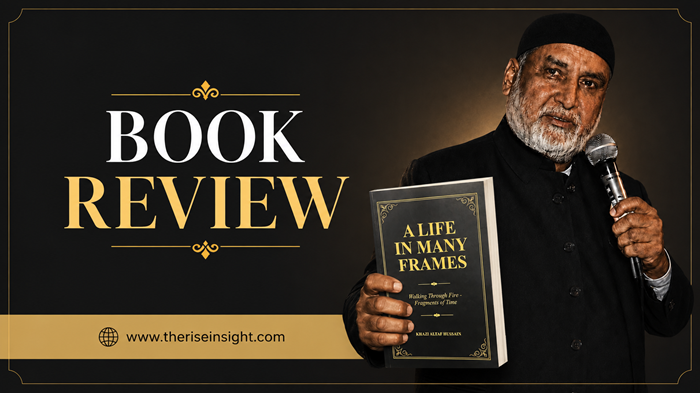
Introduction to the Author
Khazi Altaf Hussain is a distinguished professional whose journey covers corporate leadership, institutional development, entrepreneurship, media, healthcare, hospitality and public engagement. His wide professional experience gives him a unique understanding of people, organisations, responsibilities and the changing nature of society.
He completed his postgraduate studies in Mass Communication at the Indian Institute of Mass Communication, New Delhi. He further strengthened his professional knowledge through executive development programmes at some of India’s leading institutions, including IIM Ahmedabad, IIM Bangalore and IIT Delhi. This combination of academic learning and practical exposure has played an important role in shaping his professional outlook.
During his career, Khazi Altaf Hussain has held several senior leadership positions. He served as the Chief Executive Officer of the Indian Dairy Association, the national apex body representing the dairy sector. He was also part of the senior management team at the Torrent Group, where he contributed to important areas such as corporate affairs, human resources and customer relationship management during a period of major expansion.
His entrepreneurial journey is equally impressive. He is the Founder and CEO of Andhra Healthcare Private Limited and has contributed to hospitality and infrastructure development in Adoni. He has also worked in specialised media as the founder-editor of digital platforms such as ThePharmaTimes.in and TheHotelTimes.in.
Apart from his corporate and entrepreneurial work, he has served as a consultant to the Karnataka Chamber of Commerce and Industry. He has also worked as a visiting faculty member for corporate communication and management programmes. These varied experiences show that he is not limited to one profession or one identity. He has lived and worked through many roles, which makes the title A Life in Many Frames especially meaningful.
A Thoughtful Journey Through Life
A Life in Many Frames: Walking Through Fire – Fragments of Time is a deeply reflective and meaningful account of a life shaped by experience, responsibility, relationships and values. It is not presented as a conventional autobiography arranged only according to dates and events. Instead, the author looks back at selected moments that influenced his thinking, strengthened his character and changed the direction of his journey.
The word “frames” in the title works like a powerful image. A photograph captures one moment, but a collection of photographs tells a much larger story. In the same way, this book brings together different fragments from the author’s personal, professional and public life. Each fragment has its own background, people, challenges, emotions and lessons. When these individual frames are viewed together, they present the portrait of a complete and purposeful life.
The subtitle, Walking Through Fire – Fragments of Time, gives the book emotional depth. “Walking through fire” suggests hardship, uncertainty, struggle and difficult responsibilities. It also represents courage, endurance and transformation. Fire can cause pain, but it can also test strength and purify character. The author’s journey appears to have been shaped not only by achievements but also by situations that demanded patience, determination and moral courage.
This is one of the strongest features of the book. It does not treat life as a smooth path filled only with success. It accepts that uncertainty, struggle and disappointment are also essential parts of human growth. The author looks at these difficult experiences without unnecessary bitterness. He tries to understand what they taught him and how they helped him become a stronger and wiser person.
More Than a Record of Achievements
Many autobiographical works focus mainly on professional positions, awards and public achievements. This book takes a different approach. Khazi Altaf Hussain clearly states that life cannot be measured only through the positions a person has held or the accomplishments recorded against his name.
For him, the true measure of life lies in the values a person preserves, the trust he earns, the relationships he nurtures and the positive difference he makes in the lives of others. This belief becomes the moral foundation of the book.
Although the author has enjoyed an impressive career across several sectors, he does not use these pages merely to celebrate his success. His experiences become a means of discussing larger human questions. What does responsibility teach us? How do people influence our journey? What remains after professional titles are gone? How should we face uncertainty? What kind of legacy should a person leave behind?
These questions make the book relevant even to readers whose lives are very different from that of the author. One does not need to be a corporate leader, entrepreneur or public figure to connect with its message. Every person experiences change, forms relationships, carries responsibilities and faces moments of doubt. Therefore, the book’s reflections have a universal quality.
The Importance of People and Relationships
A warm and admirable feature of the book is the author’s recognition that no meaningful journey is travelled alone. Throughout life, people enter our path as family members, friends, mentors, colleagues, teachers, supporters and sometimes even challengers. Each person leaves behind an impression.
The author generously acknowledges the role played by those who stood beside him at different stages. He does not claim that his achievements were the result of individual effort alone. He gives importance to trust, encouragement, affection, guidance and cooperation.
This approach makes the narrative humble and emotionally mature. Success is often presented as a personal victory, but the book reminds readers that every achievement usually has many invisible contributors. A word of encouragement may restore confidence. A mentor’s advice may prevent a serious mistake. A colleague’s support may make a difficult responsibility manageable. A family member’s patience may allow a professional dream to grow.
By recognising these contributions, the author offers an important lesson: gratitude is not weakness; it is wisdom. A person who remembers those who helped him remains connected to the human side of success.
The book also suggests that relationships provide meaning beyond professional recognition. Positions and organisations change with time, but genuine human connections remain part of our inner life. This idea is particularly valuable in the present age, when people often become so busy chasing goals that they forget to care for the relationships that support those goals.
Leadership Rooted in Values
Because the author has worked in senior positions and managed important responsibilities, leadership naturally becomes one of the major themes of the book. However, his idea of leadership is not limited to authority or designation. It is closely linked with integrity, commitment, respect, discipline and responsibility.
The book shows that leadership is tested most clearly during periods of change and uncertainty. It is easy to lead when systems are stable and results are positive. The real challenge comes when circumstances are difficult, decisions are uncomfortable and people look towards the leader for clarity.
The author’s experiences across corporate organisations, institutions, industry bodies and entrepreneurial ventures allow him to examine leadership from many angles. He understands that institutions need proper systems and structures, but he also recognises that systems alone cannot create lasting progress. Institutions ultimately grow through people. Trust, compassion, courage and cooperation give life to organisational structures.
This is an important lesson for young professionals and future leaders. Technical knowledge may help a person secure a position, but values determine how responsibly that position is used. Good leadership requires the ability to listen, adapt, take ownership and respect the dignity of others.
The author’s reflections encourage readers to see responsibility as an honour rather than a burden. When responsibility is accepted with sincerity, even difficult work can become meaningful. When it is handled without integrity, even a powerful position loses its value.
Resilience During Changing Times
Change is a constant presence in A Life in Many Frames. The author’s journey moves through different professions, institutions, sectors and public responsibilities. Each transition demands adjustment. New environments bring unfamiliar expectations, and every role requires a different kind of understanding.
Instead of presenting change only as a problem, the book treats it as an opportunity for learning. Every association leaves an imprint. Every challenge carries a lesson. Every responsibility adds a new perspective.
This view of change is practical and hopeful. Life rarely unfolds exactly according to our plans. Some journeys begin with confidence but lead us to unexpected destinations. Others begin in uncertainty and reveal their purpose only after many years. We may not always control the events around us, but we can control the values with which we respond.
The author admits that there were moments of fulfilment as well as periods that demanded endurance. There were times of recognition and times of silent struggle. Such honesty gives balance to the book. It prevents the narrative from becoming an unrealistic success story.
Resilience, as presented here, is not loud or dramatic. Sometimes it simply means continuing to move forward when the future is unclear. It means fulfilling one’s responsibilities even when appreciation is absent. It means learning from a setback instead of allowing it to destroy confidence.
This message will connect strongly with Indian readers, especially those building careers in changing social and economic conditions. Students, professionals, entrepreneurs and managers regularly face uncertainty. The author’s journey reminds them that a difficult period does not define an entire life. It may become only one frame in a much larger picture.
A Book for the Younger Generation
The author expresses a clear desire to guide younger readers, particularly those entering professional and public life. This gives the book a purpose beyond personal remembrance. It becomes a bridge between experience and the next generation.
Young people often see the visible result of a successful career but remain unaware of the patience, discipline, difficult decisions and failures behind it. By sharing selected fragments of his life, the author opens a window into this less visible journey.
The book teaches that professional growth does not happen only through qualifications. Education is important, but practical wisdom comes from working with people, handling uncertainty, accepting mistakes and carrying responsibility. A strong career is built over time through continuous learning and ethical conduct.
The younger generation can also learn the importance of adaptability from the author’s varied career. He has worked across communication, corporate management, industry leadership, healthcare, hospitality, infrastructure and media. This diversity shows that a person’s professional identity need not remain limited to one role. Skills, curiosity and willingness to learn can open new paths.
At the same time, the book does not promote ambition without limits. It connects ambition with responsibility. The author’s message is that success becomes meaningful only when it is guided by values and contributes to the lives of others.
Language and Narrative Style
The writing style of A Life in Many Frames is calm, dignified and reflective. The author does not try to impress readers with unnecessary complexity. His language carries the confidence of someone who has experienced many situations and has taken time to understand their meaning.
The tone is personal without becoming overly emotional. The author speaks with honesty, but he also maintains balance and grace. This makes the book comfortable to read and gives readers space to connect the reflections with their own experiences.
Another strength is the author’s use of short philosophical ideas. Thoughts about trust, responsibility, relationships, integrity and resilience appear naturally within the narrative. They do not feel like artificial motivational statements. They arise from lived experience, which gives them credibility.
The non-chronological structure suits the central idea of “many frames.” Life is not always remembered in a straight line. A certain place, person or responsibility may bring back memories from different periods. By focusing on meaningful fragments instead of simply listing events year by year, the author creates a more thoughtful account.
However, readers looking for a fast-moving, event-based autobiography may find the pace quiet. This is not a book designed around suspense or dramatic revelations. It is best read slowly, with attention. Its strength lies in reflection rather than excitement. Readers who enjoy memoirs, leadership lessons and life writing will appreciate this approach.
The Meaning of Success
One of the deepest ideas in the book is its definition of success. Society often connects success with wealth, fame, rank and influence. Khazi Altaf Hussain presents a broader and more humane understanding.
Success, in his view, also includes trust earned over many years, duties performed honestly and people treated with dignity. It includes the ability to remain committed during uncertainty and the humility to recognise the contribution of others.
This definition is refreshing because it invites readers to examine their own priorities. A person may achieve a senior position but lose meaningful relationships. Another may receive public recognition but compromise his principles. Can such outcomes be called complete success?
The book suggests that the answer is no. Achievement without character remains incomplete. Professional growth must be supported by integrity and compassion. What matters in the end is not simply how high a person rose, but how he behaved during the journey and what he left behind for others.
This thought gives the book lasting value. Careers end and designations change, but the memory of a person’s conduct remains. People remember whether they were respected, supported and treated fairly. In this sense, human impact becomes the most enduring form of legacy.
The Journey Continues
The concluding reflection of the book does not present the author’s journey as finished. He sees life as a continuing process. This is an important and beautiful choice. A person may look back with gratitude and understanding without believing that there is nothing more to learn.
The author does not describe his life as perfect. He describes it as meaningful. This difference is central to the entire book. A perfect life is perhaps impossible, but a meaningful life can be created through purpose, responsibility, relationships and resilience.
Every experience has a role. Some experiences give confidence, some teach humility and some build endurance. Even painful phases may later reveal their value. When viewed from a distance, the separate fragments begin to form a larger picture.
The closing message leaves the reader with a sense of continuity and hope. Life keeps moving, and every new stage adds another frame. As long as a person remains willing to learn and serve with purpose, the journey continues.
Final Verdict
A Life in Many Frames: Walking Through Fire – Fragments of Time is a sincere, mature and inspiring reflection on a rich professional and personal journey. Khazi Altaf Hussain brings together experiences from many sectors and roles, but the heart of the book lies in its human values.
It is a book about achievement, but also about the people behind achievement. It is about leadership, but also about humility. It is about struggle, but also about the strength to continue. Most importantly, it is about understanding that the real value of life is not found only in where the journey leads, but in what it teaches, preserves and leaves behind.
The book is recommended for students, professionals, entrepreneurs, managers, institutional leaders and readers interested in reflective life stories. Young readers will find practical guidance about careers and responsibilities, while experienced readers may discover an opportunity to look back at their own journeys.
Khazi Altaf Hussain’s story proves that a life may contain many roles without losing its central values. Institutions, professions and circumstances may change, but integrity, commitment, respect and compassion can remain constant.
In the end, A Life in Many Frames is not merely the story of one successful professional. It is an invitation to every reader to pause and examine the frames of his or her own life. Which moments shaped us? Which people supported us? Which responsibilities strengthened us? What values did we preserve, and what difference did we make?
These questions remain with the reader after the book is closed. That is the true strength of this thoughtful work. It does not simply describe a journey; it encourages us to understand our own. It reminds us that life is ultimately a collection of memories, lessons, relationships and responsibilities—and that every meaningful frame has something valuable to teach.