It is with immense pride and admiration that The Rise Insight extends warmest congratulations to Sanvi Sharma for her outstanding nomination for the TRI Literary Awards 2025 Season 03. Her literary work, Footprints of Joy – A Journey Beckons, has been nominated in the Anthology category—an accolade that recognizes literary voices that inspire, uplift, and resonate deeply with the human spirit. The TRI Literary Awards stand as a beacon for literary excellence, identifying and honoring works that contribute meaningfully to society, literature, and culture. Sanvi Sharma’s nomination is a reflection of her poetic brilliance, narrative sensitivity, and the unique warmth her work radiates. A Journey of Emotion, Resilience, and Wonder Footprints of Joy: Walking Paths of Wonder, Hope, and Unfolding Dreams is more than just an anthology—it is a literary compass for the soul. Through an evocative collection of poems and stories, Sharma takes readers on an intimate journey that explores joy, perseverance, beauty, and the quiet magic in everyday life. With remarkable clarity and lyrical finesse, she draws from nature, dreams, and the human experience to weave a narrative that resonates across generations and geographies. Whether it is a quiet moment of introspection under a tree, a child’s laughter, or the strength to keep going after a setback, her work reminds us that joy often hides in life’s most subtle, overlooked corners. Why TRI Chose Footprints of Joy for This Prestigious Nomination The TRI Literary Awards panel selects nominees based not only on literary merit but also on the capacity of a work to move hearts, evoke deep thought, and contribute to a greater cultural dialogue. Footprints of Joy excels on all these fronts. What captivated the jury was Sharma’s exceptional ability to blend simplicity with profundity. Her anthology does not rely on ornate language or grand settings—it thrives in its authenticity. Each story and poem is crafted with heartfelt sincerity, offering readers an invitation to pause, reflect, and feel. Her writing is not just read—it is experienced. The panel recognized the strength of her themes: hope in adversity, resilience in silence, and faith in the unseen. At a time when the world seeks light amid chaos, Footprints of Joy becomes a much-needed literary lantern. Its optimistic tone, without being naive, brings comfort and courage to the reader, making it a fitting choice for this year’s awards, which seek to honor voices that heal, guide, and inspire. A Voice That Connects and Uplifts Sanvi Sharma’s writing is a celebration of human connection. Each piece in her anthology is like a footprint left behind by someone who dared to dream, who stumbled, rose again, and chose joy despite life’s trials. It is this very essence that aligns with the mission of the TRI Literary Awards—to recognize works that spark meaningful conversations and encourage a deeper engagement with life. Her stories and poems are particularly commendable for how they connect with readers of all backgrounds. There’s a universal familiarity in her words—a grandmother’s smile, the silence before sunrise, the courage to begin again—that invites the reader to see their own journey reflected on the page. The judges noted how Sharma uses her craft not only to tell stories, but to open doors for introspection, compassion, and renewed belief. The book is not just an anthology; it is a companion for those seeking encouragement, for those chasing dreams, and for those who simply want to rediscover the joy in being alive. An Inspiring Nomination Sanvi Sharma’s nomination is a well-earned recognition of both her literary talent and her ability to touch hearts through words. Her work continues to inspire aspiring writers, especially those who find joy in everyday reflections and quiet strength. This nomination not only honors her past work but anticipates even greater literary contributions in the future. Looking Forward As we await the final results of the TRI Literary Awards 2025, The Rise Insight celebrates Sanvi Sharma and the gift she has given the literary world through Footprints of Joy – A Journey Beckons. We commend her for the dedication, emotion, and honesty she brings to her writing and are proud to spotlight her as a leading voice in contemporary literature. We offer our heartfelt congratulations once again and wish her the very best for the awards and all the journeys yet to come—on the page and beyond. Buy Now:https://www.amazon.in/dp/9367396333/ref=sr_1_1?crid=Z0W68RQ964RI&dib=eyJ2IjoiMSJ9.Lwrf4oYEQ3HJBLJA9Q2UDg.hMXMd8cY18KuZg9VjTcEU9AygzFtPuGBipfBavRAhg4&dib_tag=se&keywords=9789367396339&qid=1736758299&sprefix=9789367396339%2Caps%2C263&sr=8-1
Celebrating Literary Excellence: Dr. Manjula Rajan Nominated for TRI Literary Awards 2025 for Her Poetic Masterpiece Verses from Life
The Rise Insight is delighted to extend heartfelt congratulations to Dr. Manjula Rajan for the prestigious nomination of her poetry collection, Verses from Life, for the TRI Literary Awards 2025 Season 03, under the Poetry category. This esteemed recognition reflects the literary brilliance, emotional depth, and inspirational power embedded within Dr. Rajan’s work. The TRI Literary Awards are a hallmark of excellence, celebrating voices that bring unique perspectives, emotional resonance, and transformative narratives into the world of literature. Dr. Rajan’s nomination is not only a personal achievement but also a moment of pride for the entire literary community that champions authenticity, courage, and expression through the written word. Verses from Life stands as a poignant mirror to real-life experiences—carefully woven with poetic elegance and profound introspection. Each poem is a window into the lived experiences, reflections, and emotional battles that Dr. Rajan has encountered herself or witnessed in the lives of those around her. The nomination acknowledges how beautifully and powerfully she translates life’s intricate emotions into verse—striking a chord with readers from all walks of life. Why TRI Chose Verses from Life for This Distinguished Honor The TRI Literary Awards jury, known for its discerning eye and commitment to literary merit, was deeply moved by the themes explored in Verses from Life. What makes this book stand out is not merely its poetic craft, but the soul it carries within each stanza. At a time when society is still coming to terms with the shifting roles and expectations placed on women, Dr. Rajan’s voice rises with clarity, courage, and conviction. Her poetry captures the seldom-discussed narrative of women who make “U-turns” in life—a rarity, especially in cultures where self-sacrifice for the sake of the family is often normalized. Through her words, Dr. Rajan challenges this norm with grace and depth. Her verses are not just expressions of emotion; they are powerful affirmations of reclaiming one’s identity, dreams, and agency. The judges were particularly impressed with how the collection speaks to self-awareness, resilience, and the inner journey of transformation. Each poem acts as both a confrontation and a healing—confronting societal norms and inner conflicts, while healing through self-acceptance and personal strength. The clarity with which she addresses internal battles—those quiet struggles that often go unnoticed—demonstrates not only poetic excellence but psychological insight and human empathy. Moreover, Verses from Life is a celebration of emotional honesty. In a world saturated with distractions, Dr. Rajan invites the reader to pause, reflect, and listen to the quiet voice within. Her ability to universalize personal stories makes this collection deeply relatable and universally relevant. A Beacon for Aspiring Poets Dr. Manjula Rajan’s nomination also serves as an inspiration to aspiring poets and writers everywhere. It exemplifies how powerful storytelling can emerge from one’s own lived experiences. Her journey is a testament to the fact that it is never too late to pursue one’s passions and voice. The courage to reflect, revisit, and reclaim parts of ourselves through writing is what gives literature its transformative power—and Verses from Life does this effortlessly. Looking Ahead As the TRI Literary Awards 2025 approach their final deliberations, The Rise Insight proudly celebrates this well-deserved recognition of Dr. Manjula Rajan. We commend her dedication to literature, her voice that echoes the silent battles of many, and her poetic grace that captures the spirit of transformation and resilience. We wish Dr. Rajan all the best for the final round and look forward to seeing her work reach even greater heights. Congratulations once again on this remarkable milestone! Buy Now: https://amzn.in/d/iRjF0WE
Congratulations to Dr. Joydeb Patra & Dr. Prodipta Barman!
Your Book Has Been Officially Nominated for The Rise Insight Literary Awards 2025 We are thrilled to announce that the remarkable academic work, “Short Book on Sociology of Law” by Dr. Joydeb Patra and Dr. Prodipta Barman, has been officially nominated for The Rise Insight Literary Awards 2025 in the Biography category. This nomination celebrates a book that not only educates but inspires. Bridging the gap between law and society, the book offers an engaging, compact, and thoughtful exploration of legal systems and their deep entanglement with cultural, social, and economic forces. The accessible style of the book makes complex sociological theories—from thinkers like Max Weber, Durkheim, and Karl Marx—understandable to students, scholars, and general readers alike. Through real-world examples and insightful case studies, the authors explore themes of power, social norms, legal institutions, and globalization, presenting law as both a reflection of and influence on social structures. The book’s strength lies in its clarity, relevance, and ability to stimulate critical thinking—key reasons for its nomination. The award also recognizes the inspirational academic journey of Dr. Joydeb Patra, whose transformation from a humble small-town boy in West Bengal to a respected Professor of Sociology at Brainware University is a story of perseverance, social commitment, and scholarly brilliance. His lifelong mission to make education inclusive and impactful resonates deeply in this collaborative work. We congratulate both authors for this incredible recognition and thank them for their contribution to academia and society. Your dedication to making knowledge accessible and transformative is truly commendable. 🌟 Here’s to many more milestones, recognitions, and inspiring minds! Buy Now: https://www.amazon.in/Short-Book-Sociology-Joydeb-Patra/dp/9363554430 #TheRiseInsight #LiteraryAwards2025 #BookNominated #NonFiction #SociologyOfLaw #DrJoydebPatra #DrProdiptaBarman #AcademicExcellence #AuthorRecognition
Book Review: Naamghar in America by Dr. Binoy K Bordoloi
In Naamghar in America, Dr. Binoy Bordoloi tenderly weaves together memory, devotion, and the immigrant experience to document how the spiritual heartbeat of Assam, the Naamghar, found new life in the far corners of North America. From the very first chapter, the author sets the tone of reverence and nostalgia: “The Naamghar is not just a structure. It is a soul-space, where voices rise in chorus, and faith, no matter how far from its birthplace, finds home again.” This quote encapsulates the book’s theme: that faith is not confined to geography. Through the author’s eyes, we witness the quiet determination of the Assamese community to carry their traditions across oceans, and in doing so, redefine what it means to belong. Dr. Bordoloi’s scientific and entrepreneurial background adds a unique lens, making the narrative deeply observant yet emotionally grounded. He writes: “The challenge was not just building a Naamghar in a foreign land, it was about growing a community where one did not yet exist.” The book is structured with elegance. Photographs, essays, and personal accounts blend into a tapestry of heritage, reminding readers of the importance of ritual in the face of change. The author’s voice is both personal and collective, echoing the stories of many immigrants who yearn to plant their cultural roots in new soil. One particularly striking excerpt reflects on the act of gathering in a Naamghar: “In a land of snow and speed, the slow rhythm of naam stills the mind. Here, amidst highways and deadlines, one finds the music of peace.” This line reveals the quiet rebellion of the diaspora, choosing stillness and spiritual continuity in a fast-paced, modern world. Highlights: Final Thoughts: Naamghar in America is more than a book. It is a bridge. A bridge between continents, generations, and hearts. Dr. Bordoloi writes with the clarity of a scientist and the heart of a devotee, creating a work that is both educational and profoundly moving. “We didn’t just bring songs, we brought silence, sanctity, and the sacred.” This book will speak deeply to anyone who has ever tried to carry their roots into a new world. When people migrate, they carry many things with them. Some pack clothes, some bring spices, and some carry stories. In Naamghar in America, Dr. Binoy Bordoloi shows us what happens when a community carries its faith. This book is not loud. It does not demand attention. Instead, it speaks gently, like the naam (devotional chants) it describes. Through personal memories, photographs, and reflections, Dr. Bordoloi takes us into the world of the Assamese diaspora in North America. More importantly, he shows us how they created spaces of peace and prayer in a land that felt nothing like home at first. “Naamghar is not just a place. It is the rhythm of our people’s heartbeat.” Reading this book feels like sitting in a quiet room, listening to an elder speak about something sacred. The stories are not dramatic, but they stay with you. There is something deeply moving about people gathering in basements, rented halls, or quiet rooms to sing songs that connect them to their ancestors. “We were not just praying. We were remembering who we were.” This book is a reminder that even in a fast-moving world, people still seek what is still and timeless. For the Assamese community, the Naamghar became that still point. There are also beautiful photographs that capture the warmth of these gatherings. You see faces lit with devotion, hands folded in prayer, and children watching with curiosity. It feels like a photo album that tells the story of something precious. In short: Naamghar in America is a book about love. Love for a tradition, for a people, and for the quiet strength it takes to keep something alive across oceans. It does not try to impress. It simply tells the truth. And that is what makes it powerful. This book is for anyone who has ever missed home. It is also for anyone who believes that even the smallest flame can light up a new world. Dr. Binoy K. Bordoloi’s Naamghar in America is an expansive and heartfelt documentation of cultural perseverance. The book offers a rare and important glimpse into how a faith tradition rooted in 15th-century Assam has been kept alive by the Assamese diaspora in North America. With personal essays, photographs, and historical references, Dr. Bordoloi crafts a vivid picture of how the Naamghar—a traditional community prayer hall—has transformed and thrived in unfamiliar landscapes. The book spans the early efforts of a few families gathering in living rooms to the establishment of full-fledged Naamghars across cities in the U.S. and Canada. “In our Naamghars, oceans away from Assam, we did not recreate a past. We created a living present.” That sentiment permeates the book. It is not merely about nostalgia or preserving rituals for the sake of tradition. It is about continuity with consciousness. Dr. Bordoloi skillfully explores how rituals, when adapted with care, do not lose their soul. The photographs add richness to the narrative. They capture moments of worship, celebration, construction, and quiet contemplation. These images speak to the reader with as much clarity as the words do. For scholars of religion, diaspora studies, or cultural anthropology, this book is an invaluable resource. But it is also an emotional read. At its core, Naamghar in America is a story of human longing: to be connected, to remember, to recreate sacredness in strange lands. It reminds us that migration is not just a journey of bodies but also of beliefs. “Wherever naam is sung with love, the Naamghar lives.” This book is proof that faith can travel. And when it does, it often builds something new and beautiful.
Book Review: The Heartbeat of Bharat: Unveiling Hidden Cultural Gems
Author: Rakhya Ranjan Sahoo India, or Bharat, as it has been known for centuries, is a land of incredible diversity, rich traditions, and profound cultural wisdom. While modernization and globalization have propelled the nation forward, they have also created a disconnect between contemporary society and the cultural heritage that once formed the foundation of Indian identity. In The Heartbeat of Bharat: Unveiling Hidden Cultural Gems, Rakhya Ranjan Sahoo takes on the vital mission of reconnecting young Indians with their roots, offering a compelling exploration of India’s overlooked cultural treasures. A Journey into the Soul of India This book is more than just a historical or cultural analysis; it is a heartfelt journey into the soul of Bharat. Through vivid storytelling and in-depth research, Sahoo presents the richness of Indian traditions, art forms, folklore, and festivals, each carrying the essence of the country’s diverse heritage. The book uncovers forgotten or lesser-known aspects of Indian culture, ensuring that these invaluable gems are not lost in the rush of modernization. The narrative seamlessly weaves together past and present, offering insights into the wisdom of ancient customs while highlighting their relevance in today’s fast-paced world. The author emphasizes that India’s cultural heritage is not just a relic of the past but a living, breathing entity that continues to shape identities and values. By doing so, he makes a strong case for preserving and celebrating these traditions, especially among the youth who stand at the crossroads of modernity and tradition. Themes and Cultural Insights One of the book’s strongest aspects is its exploration of diverse themes. Sahoo does not limit himself to well-known cultural markers but goes beyond mainstream narratives to highlight unique and often ignored traditions. Some of the key themes include: Engaging Narrative and Research Depth Sahoo’s writing is both engaging and insightful, making complex cultural narratives accessible to a broad audience. His passion for the subject matter is evident in the way he brings India’s history and traditions to life. The book is not just an academic exploration but a deeply personal and emotional journey, as the author shares his reflections on how these cultural elements have shaped his own understanding of identity and belonging. Furthermore, the research in The Heartbeat of Bharat is commendable. Sahoo has meticulously gathered information from historical texts, regional sources, and firsthand experiences, ensuring that his depiction of Indian culture is both accurate and immersive. He strikes a perfect balance between academic rigor and storytelling, making the book appealing to both scholars and casual readers. Relevance in the Modern World One of the book’s key strengths is its ability to connect the past with the present. While many books on Indian culture focus solely on history, The Heartbeat of Bharat actively explores how these cultural elements can be preserved and adapted in a rapidly changing world. The author urges young Indians not just to appreciate their heritage but to actively engage with it—whether through practicing traditional art forms, celebrating festivals, or understanding the deeper meanings behind age-old customs. In an era where Western influences dominate popular culture and lifestyles, this book serves as an important reminder of the beauty and wisdom inherent in India’s traditions. It challenges readers to rethink their perceptions of progress and identity, encouraging them to take pride in their cultural roots rather than seeing them as outdated relics. Final Thoughts The Heartbeat of Bharat: Unveiling Hidden Cultural Gems is an inspiring and enlightening read for anyone interested in Indian heritage. Rakhya Ranjan Sahoo has masterfully crafted a book that not only educates but also evokes a deep sense of appreciation and pride in one’s cultural identity. This book is particularly significant for young Indians who may feel disconnected from their traditions due to the pressures of modern life. It offers them a chance to rediscover the richness of their heritage and understand that embracing one’s roots does not mean rejecting progress—it means carrying forward the best of the past while building a meaningful future. Whether you are a history enthusiast, a cultural explorer, or someone simply curious about India’s hidden gems, this book is a must-read. It is a heartfelt tribute to Bharat’s enduring spirit, reminding us all that culture is not just about the past—it is about who we are today and who we aspire to be tomorrow.
Embracing Ethical Cheating: A book that explores polyamory and extends the boundaries of love, loyalty and commitment
“Embracing Ethical Cheating” is a book written by Yogesh Qumaar, exploring the evolving nature of relationships, attraction, and commitment. The book challenges conventional monogamous structures and proposes a framework where honesty, ethical considerations, and mutual consent play a central role in redefining fidelity. Beyond relationship ethics, the book presents a social reformative approach, advocating for the eradication of crimes linked to hidden relationships and the abolition of the traditional divorce system to ensure that children do not lose either parent due to legal separations. Yogesh Qumaar, a filmmaker and author, conceived the book to question the rigid boundaries of traditional relationships and address the social consequences of secrecy, betrayal, and legal battles over love and marriage. He argues that monogamy, as enforced by societal norms, often leads to deception, emotional distress, and family breakdowns rather than fostering genuine commitment. The book aims to promote transparency in relationships to eliminate the stigma around non-monogamy, reduce crimes related to secret affairs, such as blackmail, violence, and emotional abuse, and advocate for the abolition of divorce as a means to separate partners while ensuring children retain the presence of both parents. Yogee draws from history, psychology, and mythology to demonstrate how alternative relationship structures have always existed, but modern society has enforced rigid norms that often result in emotional suffering and legal conflicts. One of the key themes explored in the book is the psychological basis of desire. It delves into why humans are naturally drawn to multiple partners, citing psychological studies on evolutionary biology and human attraction. The book also addresses how monogamous expectations often conflict with natural instincts, leading to secrecy, infidelity, and emotional pain. Additionally, it highlights how many relationship-related crimes stem from the pressure to hide affairs or suppress desires, including domestic violence due to suspicion of infidelity, murders and honor killings caused by societal rejection of non-monogamous relationships, and blackmail and financial extortion linked to extramarital affairs. By normalizing consensual, ethical non-monogamy, Qumaar suggests that many of these crimes could be prevented, as transparency removes the motive for secrecy and fear of exposure. Through historical and mythological references, the book presents various examples from Indian mythology and history that reflect non-monogamous relationships, such as Lord Krishna and the Gopis, King Dasharatha in the Ramayana, and Draupadi in the Mahabharata. It challenges the notion that polyamory and multiple romantic partners are “un-Indian,” emphasizing that Indian traditions have long acknowledged multiple romantic and sexual relationships. The book argues that modern relationship norms are restrictive impositions, contrasting with history where love, desire, and family structures were fluid rather than rigid. A radical yet humanitarian proposal in the book is the abolition of the divorce system—not to force unhappy couples to stay together, but to ensure that children are not deprived of either parent due to legal separations. Yogee argues that divorce often leads to children losing close contact with one parent, affecting their emotional well-being, and that legal battles over custody are traumatic and create lifelong resentment. Instead of divorce, the book proposes a new family model where partners may separate romantically but remain equal co-parents, preventing emotional damage to children. By removing the need for legal separations, the book envisions a future where family units adapt rather than break apart, allowing children to grow in a stable, loving environment with both parents present. Yogesh Qumaar is a promising new filmmaker and storyteller, making his debut with the Telugu film “Love You Too.” Known for his thought-provoking narratives, Yogee explores the emotional intricacies of relationships in ways that resonate with contemporary audiences. His first feature film delves into the complexities of polyamory, portraying a man navigating love for both his wife and his lover while challenging societal norms without passing judgment. Before stepping into feature films, Yogee gained recognition through his short films like “Aa Gang Repu” and its sequel, where he showcased a knack for addressing complex themes with subtlety and depth. His stories often spark reflections on modern relationships, love, and loyalty, making his work both engaging and insightful. The inspiration to write and compile “Embracing Ethical Cheating” stems from witnessing daily reports of tragic outcomes such as honor killings, blackmail, extortion, and suicides, all rooted in the stigma surrounding non-traditional relationships. These stories are a stark reminder of the consequences of a society that rigidly upholds monogamy as the only acceptable form of love. Yogee believes that by normalizing polyamory, society can become more accepting, allowing individuals to love freely without fear of judgment or retribution. The book is not just a call for acceptance but an effort to bring dignity to those who practice polyamory, offering them a path to live authentically. It challenges societal norms, aims to eradicate crimes associated with hidden relationships, and promotes a world where love in its many forms can be celebrated openly and ethically. The title “Embracing Ethical Cheating” is intentionally provocative and oxymoronic to challenge the conventional understanding of relationships. The book aims to dismantle the perception of cheating as betrayal and introduce the concept of ethical polyamory—where multiple relationships are pursued openly, honestly, and with the consent of all parties involved. By pairing the words “ethical” and “cheating,” the title confronts the reader with a paradox that compels them to rethink the boundaries of love, loyalty, and commitment. Ultimately, the book seeks to reframe the narrative around non-monogamous relationships, showing that they need not be seen as dishonest or destructive but rather as an opportunity to extend and enrich connections between people in a way that honors everyone’s needs and desires.
Book Review: Unbound Love Author Ratnojyoti
Written with a unique tone and reflecting the essence of stupendous writing, author Ratno Jyoti’s incredibly appealing title, “Unbound Love” is a deeply emotional and evocative novel that blends the elements of romantic suspense and literary fiction. While at first glance, it might appear to be just another love story, but the novel delves into the complex themes of love, guilt, redemption and the inescapable weight of one’s past actions. In addition, the author masterfully evokes the breathtaking beauty and the serene tranquility of the landscape of Arunachal Pradesh, creating a truly immersive backdrop for the story. With its poetic narration, vivid descriptions of the Himalayas and intricately layered characters, this book stands out as a hauntingly beautiful tale of longing and consequences. Author Ratno Jyoti, a Civil Engineer and a writer nurtured amidst the indigenous communities of the Himalayan foothills, imbues his writing with the ethereal beauty and the profound human values that characterise the mountain life. Currently residing in Silchar, a city in the state of Assam, Ratno Jyoti’s novel, “Unbound Love” resonates with autobiographical undertones, particularly in its early and the middle chapters. Published by NuVoice Press during the month of August 2024, this admirable title, “Unbound Love” is available in both paperback and e-book formats, readily accessible across all the major online platforms. In this title, “Unbound Love” the storyline revolves around Gautam, who is an ordinary Hindu boy who finds himself drawn to Mary, a shy Christian girl from his Convent School. Their love story unfolds with a certain degree of innocence, pure & untainted feelings and full of youthful promises. The author’s ability to capture the essence of young love makes this part of the novel deeply heartfelt, immersing the readers in the tenderness and excitement of their connection. However, fate has other plans for Gautam and Mary. As Gautam moves away, leaving behind promises of a brighter future, an unforgivable mistake fuelled by alcohol and reckless emotions changes everything. When Gautam regains his senses, Mary is long gone and vanished from his life, leaving behind only guilt, questions and an aching void. Thus begins Gautam’s relentless search for the girl he lost, a journey that forces him to confront his deepest regrets and the shadows of his past. On top of that the author explores the themes of regret, the burden of past mistakes and the search for forgiveness. Gautam’s internal turmoil is palpable, his emotions clashing against the backdrop of Arunachal Pradesh’s serene landscape, creating a beautiful contrast between the chaos of his heart and the stillness of the mountains. While the book is undeniably a powerful and moving read, some passages might feel a bit heavy, particularly in terms of the philosophical reflections. Readers who prefer fast-paced narratives may find certain parts of Gautam’s introspective journey slightly slow, but those who genuinely appreciate literary fiction and deeply layered storytelling will find these moments rewarding and truly thought-provoking. One of the Book’s Strengths is author Ratno Jyoti’s ability to paint a picture with his words. The breathtaking descriptions of Arunachal Pradesh do not just serve as a backdrop; but also they become a living and a breathing part of the narrative. The mountains, the misty air, the rivers and the distant prayers of the monks all immerse the readers in the world of the novel, making them feel as though they, too, are journeying through the Himalayas. Another striking aspect of the book is its cultural richness. The novel seamlessly weaves in the nuances of North-Eastern traditions, with Buddhism, Hinduism and Christianity playing subtle yet powerful roles in shaping the lives of its characters. Gautam’s interest in the Lamas, his parents’ strict beliefs, and his sister Tshiring’s innocent curiosity add multiple layers to the story, making it more than just a romance. As, it is also a tale of cultural identity, generational conflicts, and self-discovery. Additionally, the contrast between Gautam’s emotional turmoil and the peaceful landscape enhances the novel’s depth, making it as introspective as it is visually stunning. The writing style is lyrical and yet accessible, ensuring that the readers remain engaged even when the novel dives into heavy emotions and deep philosophical musings. In conclusion, this title, “Unbound Love” is a deeply moving novel that lingers in the mind long after the last page is turned. Author Ratno Jyoti masterfully blends romance, suspense and emotional depth, crafting a story that is not just about love, but also about loss, redemption and the power of self-reflection. With its rich cultural backdrop, beautifully developed characters and evocative storytelling, this novel is a MUST READ for the fans of introspective, poignant fiction. For those who love stories that explore the human emotions with raw honesty, this particular novel, “Unbound Love” is a beautifully crafted tale that will touch the heart and leave a lasting impact. To buy this book: Amazon Link
Author Feature : Ankush Jangra
About the Book Education is more than just a transfer of knowledge—it’s a relationship built on trust, empathy, and effective communication. In the insightful book Teacher’s Psychology Vs Speech: Bridging the Gap Between Educator Insight and Expressive Speech, the author addresses a critical yet often overlooked aspect of education: the alignment of a teacher’s internal understanding with their external communication. This book sheds light on the subtle but significant distinction between a teacher’s psychological insight into their students and the way they articulate that understanding. While teachers may deeply care about their students’ growth and well-being, this empathy doesn’t always translate into their spoken words or teaching methods. The result is often a disconnect that leaves students feeling misunderstood or overwhelmed. The author examines the crucial role that speech and tone play in a teacher’s interaction with students. Many students, especially those navigating personal or academic challenges, value support delivered with politeness and an approachable demeanor. They seek concise, empathetic guidance rather than long-winded lectures that might miss the emotional mark. This book serves as a guide to bridging that gap, offering actionable strategies to ensure a teacher’s psychological understanding is effectively communicated in ways that truly resonate with their students. Through thoughtful discussions, real-life examples, and practical techniques, Teacher’s Psychology Vs Speech equips educators with the tools they need to transform their communication styles. The book emphasizes that effective teaching is not just about what you say but also how you say it. Teachers will learn how to foster stronger connections with their students by aligning their internal insights with expressive and constructive speech. This book is a must-read for educators at all levels—be it seasoned teachers looking to refine their skills or new educators eager to build meaningful relationships with their students. It’s a guide that addresses not just the mechanics of teaching but also the art of understanding and communication, making classrooms more inclusive and effective. Key Themes and Insights The Psychological Aspect of Teaching The book explores the role of empathy, patience, and understanding in the teaching process. Teachers are encouraged to understand their students’ perspectives and the emotional barriers that might affect their learning. Speech as a Tool for Connection Words have power. The book highlights the importance of choosing the right words, tone, and body language to foster a positive classroom environment. Bridging the Gap Between Thought and Action It’s not enough for teachers to understand their students—they need to communicate that understanding effectively. The book provides tips on how to make this connection seamless. Conciseness Over Complexity Long speeches or overly complex explanations can alienate students. The book promotes concise, clear, and empathetic communication as the cornerstone of effective teaching. Practical Strategies for Educators The book is packed with actionable advice that teachers can implement immediately, from structuring lessons to responding to student queries with compassion. Real-Life Examples and Case Studies Drawing from real-life classroom scenarios, the author illustrates common communication pitfalls and how to overcome them. About the Author Mr. Ankush Jangra, the author of *Teacher’s Psychology vs Speech*, is a skilled academic with an MSc in Chemistry. He comes from Panipat, Haryana, and uses his scientific knowledge along with a strong understanding of human behavior to look at how teachers and students interact. Mr. Jangra has always been passionate about education. He has spent many years observing the difficulties that both teachers and students face. His work shows his belief in the importance of empathy, good communication, and understanding in creating a positive classroom environment. In this book, he shares his ideas to help teachers improve their teaching by using better communication and understanding their students’ psychology. He believes that teachers should connect with students emotionally, not just focus on the syllabus. He aims to help teachers build stronger, more supportive relationships with their students. Apart from writing, Mr. Jangra actively conducts workshops and training for teachers, helping them use effective communication to create inclusive learning spaces where every student feels valued and understood. His approach to teaching focuses on emotional intelligence and helping students grow not just academically, but also emotionally. Why This Book Matters In today’s fast-paced and often impersonal educational landscape, Teacher’s Psychology Vs Speech offers a refreshing perspective. It reminds educators of the human side of teaching and the profound impact their words can have on shaping young minds. The book’s practical and empathetic approach ensures it will resonate with teachers, parents, and even students who wish for more meaningful interactions in classrooms. This book challenges educators to reflect on their teaching practices and strive for a more student-centered approach. It’s a call to action for teachers to not only think deeply about their students’ needs but also express their understanding in ways that truly inspire and motivate. Conclusion Teacher’s Psychology Vs Speech: Bridging the Gap Between Educator Insight and Expressive Speech is more than just a guide—it’s a movement toward more compassionate and effective teaching. Published by Evincepub Publishing, this book is a valuable resource for anyone involved in the education sector, offering timeless lessons on the art of understanding, connecting, and inspiring students. By reading this book, educators can transform their classrooms into spaces where every student feels heard, respected, and empowered to learn. Whether you’re a seasoned teacher, a school administrator, or a parent looking to better understand the dynamics of teaching, this book will leave you with actionable insights and a renewed appreciation for the power of words in education.
Book Review: Why I Did Not Die by Roxana
This inspiring title, “Why I Did Not Die” by author Roxana Jaffer is more than a memoir; it is a profound exploration of life, resilience and the transformative power of near-death experiences. Falling within the genres of biography, philosophy, self-realisation and life teachings, the book offers a unique perspective on living fully by confronting the very concept of mortality. Author Jaffer does not simply recount her eight brushes with death; she dissects them, extracting valuable lessons and sharing the resulting shifts in her consciousness. This intimate narrative invites the readers to reflect on their own lives and the choices they make. Author Roxana Jaffer is more than just a successful leader; she is a passionate advocate for positive change. Driven by a heart overflowing with compassion, she dedicates herself to making the world a better place. Her prestigious education at Harvard Business School, culminating in an MBA in leadership, equipped her with the expertise to become a visionary in the hospitality industry. However, Roxana’s true strength lies in her ability to combine this expertise with heartfelt humanitarian efforts. Through her impactful partnership with the United Nation’s World Food Programme, Roxana has made a tangible difference in the lives of 517,325 undernourished children across the globe. Her leadership has also transformed her workplace hotel, earning it the esteemed Arabia CSR Award for an impressive seven consecutive years. Roxana’s dedication extends beyond the boardroom. Recognised as a “Most Influential Women Leader” she empowers underprivileged communities, fostering a sense of self-sufficiency. As the founder of a not-for-profit NGO, she has demonstrably improved the lives of unemployed youth, with over 70% finding meaningful employment under her guidance. Beyond her leadership prowess, Roxana is a creative soul. Her poetry reflects a spirit of resilience and deep spirituality, a testament to her multifaceted personality. Roxana’s journey is an inspiring narrative of determination and compassion. She leaves a lasting mark on the world, motivating others to join the movement for positive change. Roxana’s creative spirit finds further expression in her book, “Why I Did Not Die” published by Austin Macauley in September 2023. This powerful memoir, a testament to her resilience, is available in both paperback and e-book formats, readily accessible on all the major online marketplaces. In this title, “Why I Did Not Die” the subject matter revolves around the author’s personal experiences and the profound realisations she gained from each near-death incident. These are not merely recounted as dramatic events; they serve as catalysts for introspection and growth. Author Roxana Jaffer had masterfully connected these experiences to her philosophy of leadership, drawing on the concept of servant leadership. As the book highlights, a servant leader begins with a desire to serve, which then evolves into a conscious choice to lead. This philosophy permeates the narrative, suggesting that true leadership stems from a deep understanding of life’s fragility and a commitment to serving others. This makes the book particularly relevant for those in both profit and non-profit organisations, as well as individuals involved in social and community groups. It serves as a valuable toolkit for lifelong learners seeking to integrate personal growth with effective leadership. Beyond the personal reflections, the book explores the relationship between Jaffer’s life experiences and her leadership philosophy. As the founder of the “Service Leadership Style” author Jaffer advocates for leadership rooted in the desire to serve others. Her assertion that a true leader is one who first seeks to serve and then aspires to lead is a powerful concept that resonates throughout the book. This philosophy transcends professional life, offering valuable lessons for individuals involved in profit and not-for-profit organisations, as well as those engaged in social and community work. Jaffer’s emphasis on lifelong learning and the integration of wisdom, compassion, and generosity into leadership practices is both inspiring and practical, making the book a valuable resource for readers seeking to enhance their personal and professional lives. One of the ‘Book’s Strengths’ lies in the simplicity of author Jaffer’s writing and the clarity of her memories. She presents a “kaleidoscope of life events” with remarkable precision, allowing the readers to connect with her experiences on a visceral level. The narrative is gripping, pulling the reader into each life-altering event and its subsequent impact on Jaffer’s worldview. This book offers a refreshing perspective on life, a stark contrast to the often-mundane realities that we face. It is a call to appreciate each moment, to live with gratitude, and to seek deeper meaning in our experiences. The book’s intimate and powerful narrative is sure to resonate with readers seeking inspiration, self-discovery and a renewed appreciation for the precious gift of life. It is a book that stops you in your tracks, prompting reflection and a re-evaluation of what truly matters. In conclusion, this title, “Why I Did Not Die” can be described as a study in resilience, hardiness, and pliability. Author Roxana Jaffer’s story is a testament to the human spirit’s capacity to not only survive but to thrive in the face of adversity. The book delves into the complex relationship between fate, life and death, with Jaffer uncovering a powerful truth — to truly live, we must “die before we die!” This concept, while seemingly paradoxical, speaks to the idea of letting go of fear and embracing the present moment. Through her experiences, author Jaffer is elevated to higher levels of consciousness, cultivating wisdom, compassion, generosity, forgiveness, and love. These qualities shine through in her writing, creating a narrative that is both powerful and deeply moving. Buy on Amazon
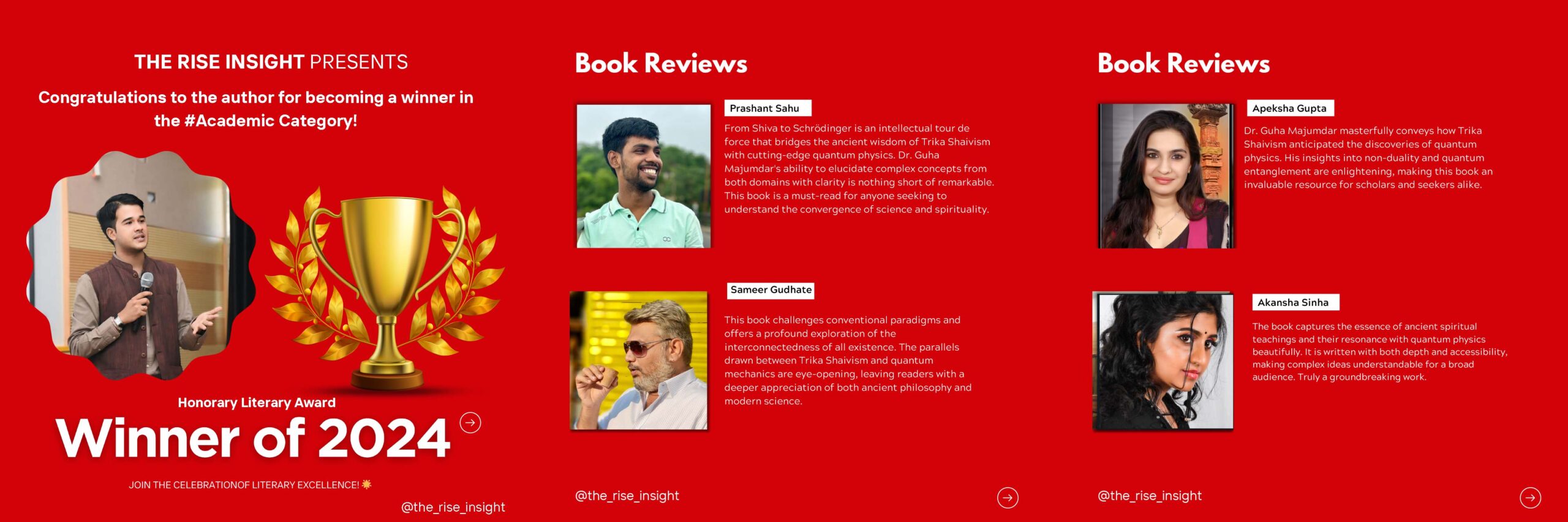
Congratulations to Dr. Mrittunjoy Guha Majumdar for winning the Honorary Literary Awards 2024, organized by The Rise Insight!
Heartiest congratulations to Dr. Mrittunjoy Guha Majumdar for winning the Honorary Literary Awards 2024, organized by The Rise Insight! Your groundbreaking book, From Shiva to Schrödinger, is an exceptional masterpiece that beautifully bridges the ancient wisdom of Trika Shaivism with the revolutionary discoveries of modern quantum physics. By uncovering profound parallels between spirituality and science, your work provides readers with a transformative perspective, uniting the realms of philosophy, consciousness, and quantum mechanics. This recognition is a testament to your remarkable vision and dedication to deepening our understanding of the universe and ourselves. May this honor inspire even more groundbreaking contributions in the future. Congratulations once again on this well-deserved achievement! Reviews for From Shiva to Schrödinger by Dr. Mrittunjoy Guha Majumdar Prashant Sahu: “A Profound Synthesis of Science and Spirituality”From Shiva to Schrödinger is an intellectual tour de force that bridges the ancient wisdom of Trika Shaivism with cutting-edge quantum physics. Dr. Guha Majumdar’s ability to elucidate complex concepts from both domains with clarity is nothing short of remarkable. This book is a must-read for anyone seeking to understand the convergence of science and spirituality. Sameer Gudhate: “A Transformative Perspective on Reality”This book challenges conventional paradigms and offers a profound exploration of the interconnectedness of all existence. The parallels drawn between Trika Shaivism and quantum mechanics are eye-opening, leaving readers with a deeper appreciation of both ancient philosophy and modern science. Apeksha Gupta: “A Beacon for Modern Thinkers”Dr. Guha Majumdar masterfully conveys how Trika Shaivism anticipated the discoveries of quantum physics. His insights into non-duality and quantum entanglement are enlightening, making this book an invaluable resource for scholars and seekers alike. Akansha Sinha: “An Intersection of Wisdom and Discovery”The book captures the essence of ancient spiritual teachings and their resonance with quantum physics beautifully. It is written with both depth and accessibility, making complex ideas understandable for a broad audience. Truly a groundbreaking work. Glenville Asbhy: “A Scholarly Yet Accessible Masterpiece”Dr. Guha Majumdar’s meticulous research and engaging narrative style make From Shiva to Schrödinger a masterpiece. It is a rare blend of intellectual rigor and spiritual wisdom, offering readers a transformative journey of discovery. Pooja Sahu: “A New Paradigm of Understanding”This book redefines the way we perceive the universe and our place within it. The exploration of the observer effect in both quantum mechanics and Shaivism’s teachings is particularly fascinating. A brilliant work for those interested in philosophical inquiry and scientific advancement. Versha Singh: “A Journey of Intellectual and Spiritual Discovery”Dr. Guha Majumdar’s work is a revelation. It seamlessly combines the abstract realms of quantum physics with the profound teachings of Trika Shaivism, offering a cohesive and transformative vision of reality. Highly recommended for those who wish to broaden their horizons. Shivangi Yadav: “A Rare Gem of Interdisciplinary Insight”This book is a testament to the author’s mastery of both science and philosophy. The connections drawn between ancient spirituality and modern physics are not only compelling but also profoundly impactful. A must-read for anyone on a quest for deeper knowledge. Exploring the Convergence of Science and Spirituality: A Deep Dive into From Shiva to Schrödinger In a world often divided by the boundaries of science and spirituality, Dr. Mrittunjoy Guha Majumdar’s From Shiva to Schrödinger emerges as a groundbreaking work that bridges these two seemingly disparate realms. This thought-provoking book delves into the profound teachings of Trika Shaivism, a non-dualistic spiritual philosophy from ancient India, and juxtaposes them with the revolutionary concepts of quantum mechanics. The result is a revelatory journey that offers readers not only a deeper understanding of the universe but also a transformative perspective on their place within it. The Essence of the Book At its core, From Shiva to Schrödinger seeks to illuminate the striking parallels between the principles of Trika Shaivism and the discoveries of modern quantum physics. Dr. Guha Majumdar artfully demonstrates how ancient spiritual insights, formulated centuries ago, predate and align with the findings of contemporary science. Through a synthesis of philosophical exploration and scientific inquiry, the book invites readers to consider profound questions about reality, consciousness, and existence. Trika Shaivism: Ancient Wisdom Revisited Trika Shaivism, rooted in the Kashmir region of India, is a spiritual tradition that emphasizes non-duality and the interconnectedness of all existence. Central to its philosophy is the concept that the universe is a manifestation of a singular, universal consciousness, often referred to as Shiva. This perspective challenges the illusion of separation, advocating instead for a holistic understanding of reality. Dr. Guha Majumdar delves deeply into these teachings, exploring concepts such as the unity of the observer and the observed, the illusion of duality, and the interplay of energy and consciousness. He draws fascinating parallels between these ancient ideas and the principles underlying quantum physics. Quantum Physics: A Modern Perspective Quantum mechanics, a cornerstone of modern science, has redefined our understanding of the physical world. Phenomena such as entanglement, superposition, and the observer effect challenge traditional notions of reality and suggest a universe far more interconnected than previously imagined. In From Shiva to Schrödinger, Dr. Guha Majumdar explains these complex scientific concepts with clarity and precision. He highlights how the findings of quantum mechanics echo the insights of Trika Shaivism, particularly in their shared emphasis on interconnectedness and the observer’s role in shaping reality. For instance, the observer effect—which posits that the act of observation influences the outcome of a quantum event—resonates deeply with the Shaivist belief in the inseparability of the observer and the observed. A Bridge Between Two Worlds One of the book’s most compelling aspects is its ability to serve as a bridge between the ancient and the modern, the spiritual and the scientific. Dr. Guha Majumdar’s interdisciplinary approach weaves together philosophical insights and empirical findings, creating a narrative that is both intellectually rigorous and spiritually enriching. The author’s exploration of quantum entanglement—a phenomenon where particles remain interconnected regardless of distance—is particularly striking. He draws parallels to the Shaivist concept of universal interconnectedness, suggesting that both perspectives point to a reality where separation is merely an